Home
Class 12
PHYSICS
A block of mass m(1) lies on top of fixe...

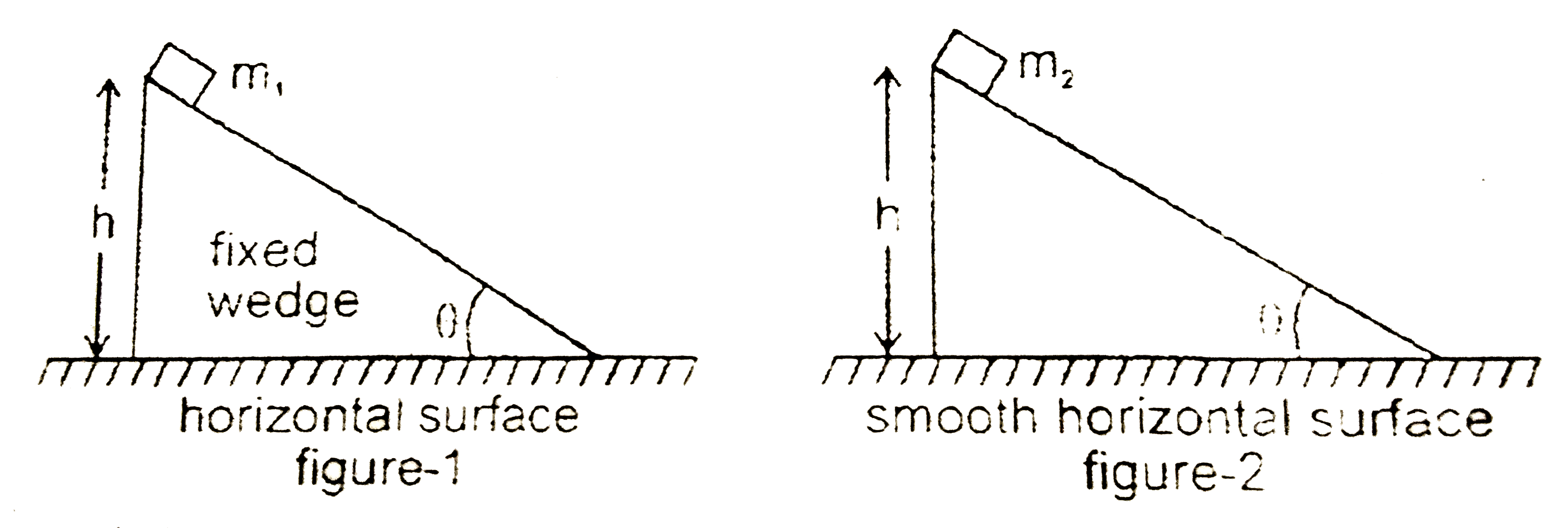
A block of mass `m_(1)` lies on top of fixed wedge as shown in figure 1 and another block of mass `m_(2)` lies on top of wedge which is free to move as shown in figure 2. At time `t=0`, both the blocks are released from rest from a vertical height `h` above the respective horizontal surface on which the wedge is palced as shown. There is no friction betwen block and wedge in both the figures. Let `T_(1)` and `T_(2)` be the time taken by block in figure 1 and block in figure 2 respectively to just reach the horizontal surface then:

A

`T_(1)gtT_(2)`

B

`T_(1)ltT_(2)`

C

Magnitude of normal reaction on block of mass `m_(2)` is equal to that on the block of mass `m_(1)`

D

After falling through same height (less than `h`) from top of wedge, the speed of block of mass `m_(2)` is less than that of block of mass `m_(1)`

Text Solution

Verified by Experts

The correct Answer is:
A

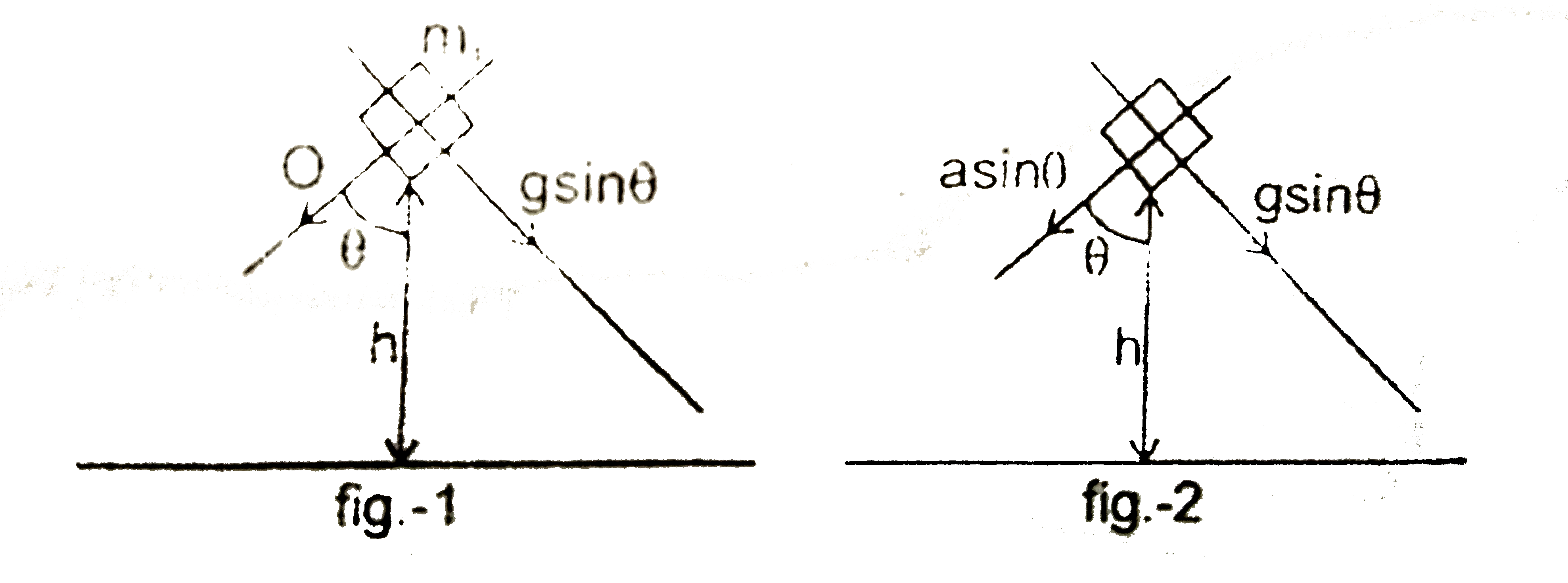
We draw axes of each along the incline and normal to incline. The component of acceleration for each block are as shown where is acceleration of wedge is figure 2.
It is obvious that vertical component of acceleration is larger for block in figure 2.
`:.T_(1)gtT_(2)`
Promotional Banner

Similar Questions

Explore conceptually related problems

A block of mass m_(1) lies on the top of fixed wedge as shown in fig. and another block of mass m_(2) lies on top of wedge which is free to move as shown in fig. At time t=0 both the blocks are released from rest from a vertical height h above the respective horizontal surface on which the wedge is placed as shown. There is no friction between block and wedge in both the figures. Let T_(1) and T_(2) be the time taken by the blocks respectively to just reach the horizontal surface. then

A block of mass m is at rest on a rought wedge as shown in figure. What is the force exerted by the wedge on the block?

A block of mass m is released from a wedge of mass m as shown in figure . Find the time taken by the block to reach the end of the wedge.

A block of mass m, is kept on a wedge of mass M, as shown in figure such that mass m remains stationary w.r.t. wedge. The magnitude of force P is

A block of mass m is at rest over the rough surface of the fixed wedge.

A cube of mass m is placed on top of a wedge of mass 2m, as shown in figure. There is no friction between the cube and the wedge. The minimum co - efficient of friction between the wedge and the horizontal surface, so that the wedge does not move is

A block of mass m rests on a stationary wedge of mass M. The wedge can slide freely on a smooth horizontal surface as shown in figure. If the block starts from rest

A triangular wedge is placed on smooth horizontal surface. A block is placed on wedge as shown in the figure. Coefficient of friction between block and wedge is mu . Initially system reamins at rest.

A wedge with mass M rests on a frictionless horizontal surface A block with mass m is placed on the wedge. There is no friction between the block and the wedge. A horizontal force f is applied to the wedge. What magnitude F must have if the block is to remain at constant height above the table top?

A smooth block of mass m is held stationary on a smooth wedge of mass M and inclination theta as shown in figure .If the system is released from rest , then the normal reaction between the block and the wedge is

