Home
Class 12
PHYSICS
A concave spherical surface of radius of...

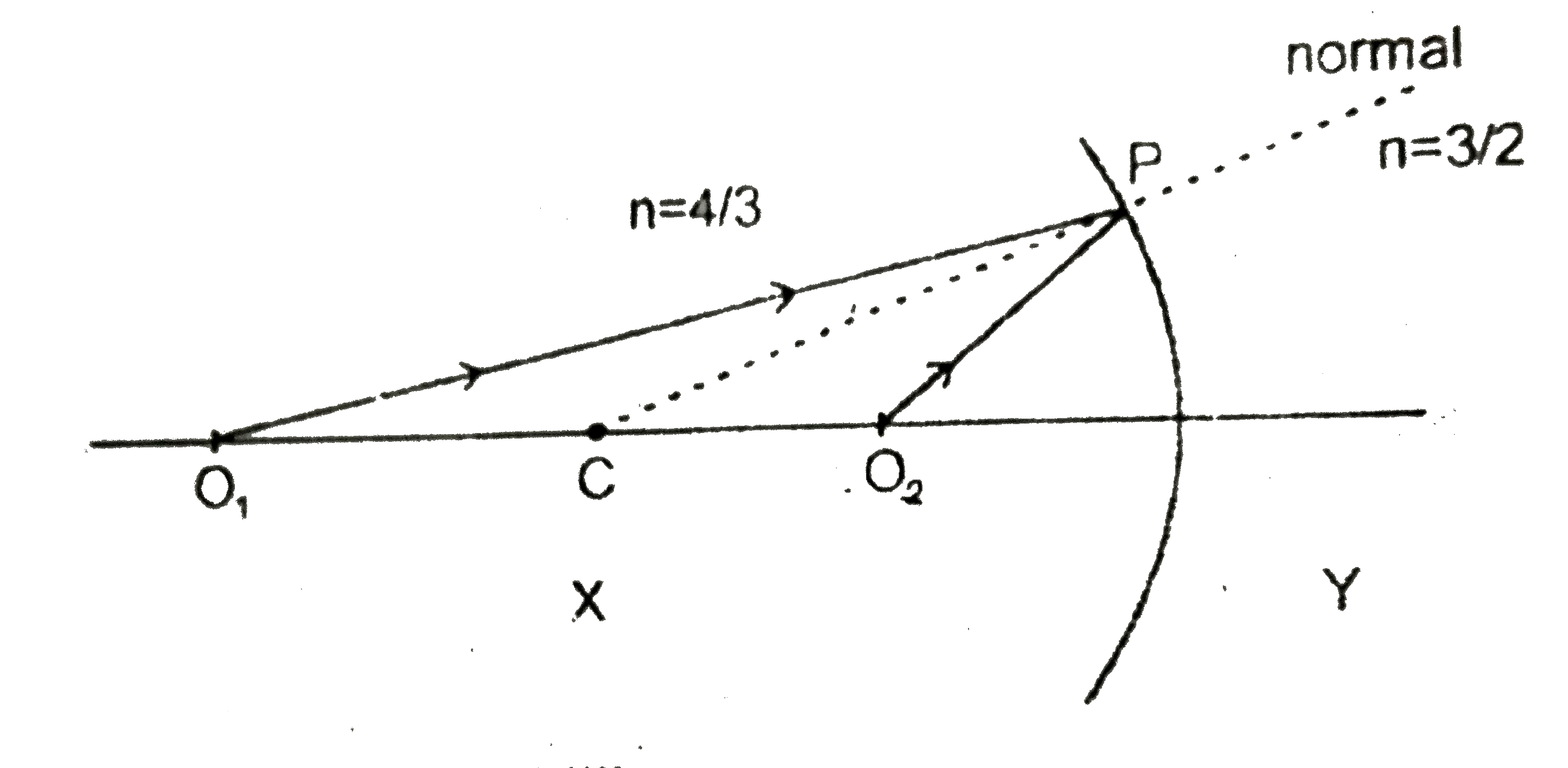
A concave spherical surface of radius of curvature `10 cm` separates two mediums `X` and `Y` of refractive indices `4//3` and `3//2` respectively. Centre of curvature of the surfaces lies in the medium `X`. An object is placed in medium `X`.

A

Image is always real

B

Image is real if the object distance is greater than `90`cm

C

Image is always virtual

D

Image is virtual only if the object distance is less then `90` cm

Text Solution

Verified by Experts

The correct Answer is:
C

(Moderate) Let there be two point objects `O_(1)` and `O_(2)`. Incident rays from `O_(1)` and `O_(2)` at point `P` shall both bend towards normal and hence the corresponding refracted rays shall intersect the principal axis in the left medium. Therefore image formed under given condition shall always be virtual.
Promotional Banner

Similar Questions

Explore conceptually related problems

A concave spherical surface of radius of curvature 10 cm separates two medium x & y of refractive index 4/3 & 3/2 respectively. If the object is placed along principal axis in medium X then

A concave spherical surface of radius of curvature R = 20 cm separates two media A and B having refractive indices mu_(A) =(4)/(3) and mu_(B) =(3)/(2) respectively. A point object is placed on the principal axis. Find the distance of the object from the surface so that its image is virtual when (a) the object is in medium A. (b) the object is in medium B.

A concave spherical surface of radius of curvature 100 cm separates two media of refractive indices 1.50 and (4)/(3) . An object is kept in the first medium at a distance of 30 cm from the surface. Calculate the position of the image.

A spherical surface of radius 30 cm separates two transparent media A and B with refractive indices 1'33 and 1.48 respectively. The medium A is on the convex side of the surface. Where should a point object be placed in medium A so that the paraxial rays become parallel after refraction at the surface ?

A spherical surface of radius 30cm separates two transparent media A and B with refractive indiecs 1.33 and 1.48 , respectively. The medium A is on the convex side of the surface. Where should a point object the placed in medium A so that the paraxial rays become parallel after refraction at the surface?

A convex surface of radius of curvature 40 cm separate two media of refractive indices (4)/(3) and 1.50. An object is kept in the first medium at a distance of 20 cm from the surface. Calculate the position of the image.

A spherical convex surface separates object and image spaces of refractive indices 1.0 and 4//3 . If radius of curvature of the surface is 10cm, find its power.

A convex refracting surface of radius of curvature 20 cm separates two media of refractive indices 4//3 and 1.60 . An object is placed in the first medium (mu = 4//3) at a distance of 200 cm from the refracting surface. Calculate the position of image formed.

