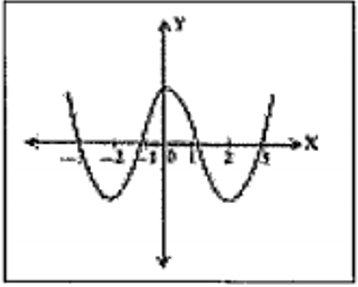
A
B
C
D
Text Solution
Verified by Experts
The correct Answer is:



Topper's Solved these Questions
POLYNOMIALS
VGS PUBLICATION-BRILLIANT|Exercise EXERCISE|244 VideosPOLYNOMIALS
VGS PUBLICATION-BRILLIANT|Exercise Part - B : Observation bits to solve various bits given in the public examination.|40 VideosPAIR OF LINEAR EQUATIONS IN TWO VARIABLES
VGS PUBLICATION-BRILLIANT|Exercise EXERCISE|262 VideosPROBABILITY
VGS PUBLICATION-BRILLIANT|Exercise EXERCISE|220 Videos
Similar Questions
Explore conceptually related problems
VGS PUBLICATION-BRILLIANT-POLYNOMIALS-Creative Bits for CCE Model Examination
- The graph of the polynomial f(x) = 2x - 5 is a straight line which int...
Text Solution
|
- If 1 is the zero of the quadratic polynomial x^(2) + kx -5 , then the ...
Text Solution
|
- The number of zeroes lying between -2 and 2 of the polynomial f(x) who...
Text Solution
|
- If both the zeroes of a quadratic polynomial ax^(2) + bx + c are equal...
Text Solution
|
- Sum and product of the zeroes of polynomial x^(2) - 3 are respectively...
Text Solution
|
- If the zeroes of quadratic polynomial are equal in magnitude but oppos...
Text Solution
|
- If one of the zeroes of the quadratic polynomial ax^(2) + bx + c is 0,...
Text Solution
|
- The polynomial whose zero are -5 and 4 is
Text Solution
|
- If -1 is a zero of the polynomial f(x) = x^(2) - 7x -8, then the othe...
Text Solution
|
- If one zero of the quadratic polynomial x^(2) - 5x -6 is 6, then the o...
Text Solution
|
- If alpha and beta are the zeros of the polynomial f(x) = x^(2) + px + ...
Text Solution
|
- If f(x)=ax^2+bx+c has no real zeros and a+b+c<0 then…..
Text Solution
|
- If alpha, beta, gamma are the zeros of the polynomial f(x) = ax^(3) + ...
Text Solution
|
- If the product of zeros of the polynomial f(x)=a x^3-6x^2+11 x-6 is 4,...
Text Solution
|
- If the order of ax^(5) + 3x^(4) + 4x^(3) + 3x^(2) + 2x +1 is 4 then a...
Text Solution
|
- If one zero of the polynomial f(x) = 5x^(2) + 13x + k is reciprocal of...
Text Solution
|
- If alpha, beta are the zeros of polynomial f(x) = x^(2) - p(x+1)-c the...
Text Solution
|
- If the sum of the zeros of the polynomial f(x) = 2x^(3) - 3 kx^(2) + 4...
Text Solution
|
- If alpha, beta, gamma are the zeros of the polynomial f(x) = ax^(3) + ...
Text Solution
|
- If the polynomial f(x) = ax^(3) + bx - c is divisible by the polynomi...
Text Solution
|