Home
Class 12
PHYSICS
The voltage V and current I graph for a...

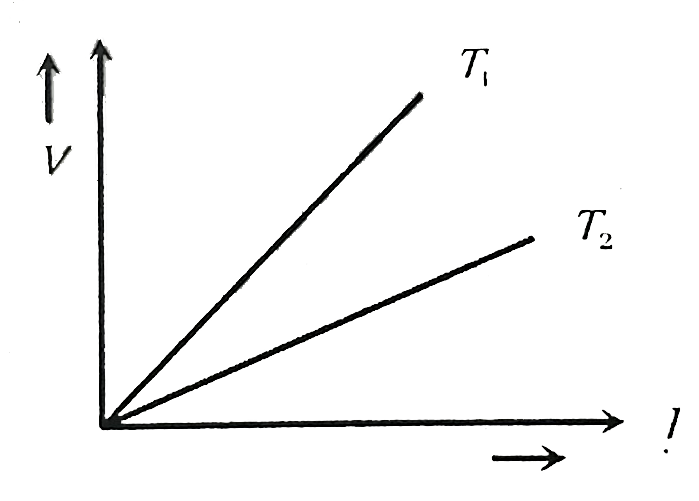
The voltage V and current I graph for a conductor at two different temperatures `T_(1)` and `T_(2)` are shown in the figure. The relation between `T_(1)` and `T_(2)` is

A

`T_(1) gt T_(2)`

B

`T_(1) ~~ T_(2)`

C

`T_(1) = T_(2)`

D

`T_(1) lt T_(2)`

Text Solution

Verified by Experts

The correct Answer is:

A
Promotional Banner

Topper's Solved these Questions

  • CURRENT ELECTRICITY

    ERRORLESS |Exercise Assertion & Reason|1 Videos
  • CURRENT ELECTRICITY

    ERRORLESS |Exercise Self Evaluation Test -19|23 Videos
  • CURRENT ELECTRICITY

    ERRORLESS |Exercise Critical Thinking|12 Videos
  • COMMUNICATION SYSTEM

    ERRORLESS |Exercise S E T|14 Videos
  • ELECTRO MAGNETIC INDUCTION

    ERRORLESS |Exercise SET|20 Videos

Similar Questions

Explore conceptually related problems

The voltage V and current I v graphs for a conductor at two different temperatures T_(1) and T_(2) are shown in the figure. The relation between T_(1) and T_(2) is

The V-i graph for a conductor at temeratures T_1 and T_2 are as shown in the figure. (T_2 - T_1) is alphaortional to. .

The V - i graph for a conductor at temperature T_(1) and T_(2) are as shown in the figure. ( T_(2) - T_(1)) is proportional to

The V - I graphs for a conductor at temperature T_1 and T_2 are shown in the figure (T_2-T_1) is proportional to

The V-l graph for a conductor at temperatures T_(1) " and " T_(2) are as shown in the figure. The term T_(2) -T_(1) is proportional to

The current - voltage graphs for a given metallic wire at two different temperatures T_1 and T_2 are shown in the figure. The temperature T_2 is greater than T_1 .

The current-coltage graphs for a given metallic wire at two differenct tempeature T_(1)" and "T_(2) are shown in the figure. Which one is higher, T_(1)" or "T_(2)

Assertion : Current versus potential difference (i-V) graph for a conductor at two different temperatures T_(1) and T_(2) is shown in figure. Hence T_(1)gt T_(2) . Reason : Resistance of a conductor increases with rise in temperature.
