Home
Class 12
CHEMISTRY
The sign and magnitude of Gibbs energy c...

The sign and magnitude of Gibbs energy change of a chemical process tells about its spontaneity and useful work that could be extracted from it. Explain.

Text Solution

Verified by Experts
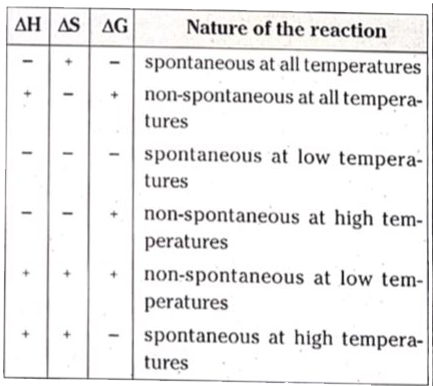
The process which takes place on its own accord without the aid of an external agency is called spontaneous process. To sum up, the criteria for spontaneous of process in terms of `DeltaG` can be given as
i) If `DeltaG` is -ve the process is spontaneous
ii) If `DeltaG` is zero, the process does not occur (or) the system is in equilibrium
iii) If `DeltaG` is +ve, the process does not occur in the forward direction The spontaneity of a reaction and the algebraic signs of `DeltaH, DeltaS,DeltaG` and the magnitude of T are related to each others as given in the below table.

For a spontaneous process in an isolated system the change in entropy should be positive. But many reactions with `DeltaS` in negative are known to occur spontaneously. These reactions takes place on account of coupling of these reactions with reactions of large negative `DeltaG` values.
Promotional Banner

Topper's Solved these Questions

  • THERMODYNAMICS

    VGS PUBLICATION-BRILLIANT|Exercise LONG ANSWER QUESTIONS|4 Videos
  • THERMODYNAMICS

    VGS PUBLICATION-BRILLIANT|Exercise ADDITIONAL QUESTIONS & ANSWERS|6 Videos
  • THERMODYNAMICS

    VGS PUBLICATION-BRILLIANT|Exercise ADDITIONAL QUESTIONS & ANSWERS|6 Videos
  • THE s-BLOCK ELEMENTS

    VGS PUBLICATION-BRILLIANT|Exercise Long Answer Question (8 Marks)|25 Videos
  • TS MARCH -2018

    VGS PUBLICATION-BRILLIANT|Exercise SECTION -C|3 Videos

Similar Questions

Explore conceptually related problems

What chemical process is used for obtaining a metal from its oxide ?

The change in Gibbs free energy of the system along provides a criterion for the spontaneity of a process at constant temperature and pressure. A change in the free energy of a sytem at constant temperature and pressure will be: DeltaG_("system") = DeltaH_("system") - T DeltaS_("system") For a spontaneous reaction DeltaG , equilibrium constant K and E_("cell")^(0) will be respectively:

The change in Gibbs free energy of the system along provides a criterion for the spontaneity of a process at constant temperature and pressure. A change in the free energy of a sytem at constant temperature and pressure will be: DeltaG_("system") = DeltaH_("system") - T DeltaS_("system") The free energy for a reaction having Delta H= 31400 cal, DeltaS= 32 cal K^(-1) mol^(-1) at 1000^(@)C is

Explain spontaneity of a process in terms of Gibbs energy.

When you lift a box from the floor and put it on an almirah the potential energy of the box increases but there is no change in its kinetic energy. Is it violation of conservation of energy. Explain.

Chemical reactions are invariably assocated with the transfer of energy either in the form of heat or light. In the laboratory, heat changes in physical and chemical processes are measured with an instrument called calorimeter. Heat change in the process is calculated as: q= ms DeltaT , s= specific heat = c Delta T , c= heat capacity Heat of reaction at constant volume is measured using bomb calorimeter. qv= Delta U= internal energy change. Heat of reaction at constant pressure is measured using simple or water calorimeter. q_(p) = Delta H, q_(p) = q_(v) + P Delta V, DeltaH = DeltaU + Delta nRT The amount of energy released during a chemical change depnds on the physical state of reactants and products, the condition of pressure, temperature and volume at which the reaction is carried out. The variation of heat of reaction with temperature and pressure is given by Kirchhoff's equation: (DeltaH_(2)- DeltaH_(1))/(TT_(2)-T_(1)) = DeltaC_(P) (At constant pressure), (DeltaU_(2)- DeltaU_(1))/(TT_(2)-T_(1)) = DeltaC_(V) (At constant volume) DeltaC_(P) for a reaction is given by 0.2T cal/deg. Its enthalpy of reaction at 10K is -14.2 kcal. Its enthalpy of reaction at 100K in kcal will be

Chemical reactions are invariably assocated with the transfer of energy either in the form of heat or light. In the laboratory, heat changes in physical and chemical processes are measured with an instrument called calorimeter. Heat change in the process is calculated as: q= ms DeltaT , s= specific heat = c Delta T , c= heat capacity Heat of reaction at constant volume is measured using bomb calorimeter. qv= Delta U= internal energy change. Heat of reaction at constant pressure is measured using simple or water calorimeter. q_(p) = Delta H, q_(p) = q_(v) + P Delta V, DeltaH = DeltaU + Delta nRT The amount of energy released during a chemical change depnds on the physical state of reactants and products, the condition of pressure, temperature and volume at which the reaction is carried out. The variation of heat of reaction with temperature and pressure is given by Kirchhoff's equation: (DeltaH_(2)- DeltaH_(1))/(TT_(2)-T_(1)) = DeltaC_(P) (At constant pressure), (DeltaU_(2)- DeltaU_(1))/(TT_(2)-T_(1)) = DeltaC_(V) (At constant volume) The heat capacity of bomb calorimeter (with its contents) is 500J/K. When 0.1g of CH_(4) was burnt in this calorimeter the temperature rose by 2^(@)C . The value of DeltaU per mole will be

For an ideal gas a) The change in internal energy in a constant pressure process from temperature T_(1) to T_(2) is equal to nC_(v) (T‌_(2)-T_(1)) , where Cv is the molar heat capacity at constant volume and n is the number of moles of the gas b) The change in internal energy of the gas and the work done by the gas are equal in magnitude in an adiabatic process c) The internal energy does not change in an isothermal process d) No heat is added or removed in an adiabatic process

VGS PUBLICATION-BRILLIANT-THERMODYNAMICS-SHORT ANSWER QUESTIONS
  1. What is entropy? Explain with examples.

    Text Solution

    |

  2. Explain spontaneity of a process in terms of Gibbs energy.

    Text Solution

    |

  3. The sign and magnitude of Gibbs energy change of a chemical process te...

    Text Solution

    |

  4. In a process 701 J of heat is absorbed by a system and 394 J of work i...

    Text Solution

    |

  5. The reaction of cyanamide (s), with dioxygen was carried out in a bomb...

    Text Solution

    |

  6. Calculate the number of kJ of heat necessary to rise the temperature o...

    Text Solution

    |

  7. Calculate the enthalpy change on freezing of 1.0 mol of water at 10.0^...

    Text Solution

    |

  8. Enthalpy of combustion of carbon to CO(2) is -393.5 kJ mol^(-1). Calcu...

    Text Solution

    |

  9. Enthalpies of formation of CO(g), CO(2)(g),N(2)O(g) and N(2)O(4)(g) ar...

    Text Solution

    |

  10. Given N(2)(g)+3H(2)(g)to2NH(3)(g),Delta(r)H^(theta)=-92.4 kJ mol^(-1) ...

    Text Solution

    |

  11. From the following data CH(3)OH(l)+(3)/(2)O(2)(g) rarr CO(2)(g) +2H(...

    Text Solution

    |

  12. Calculate the enthalpy change for the process "CC"l(4)(g)toC(g)+4CI(...

    Text Solution

    |

  13. For an isolated system , DeltaU=0 what will be DeltaS?

    Text Solution

    |

  14. For the reaction at 298 K, 2A+BtoC DeltaH=400 kJ mol^(-1) and Delt...

    Text Solution

    |

  15. For the reaction, 2Cl(g)toCl(2)(g), what are the signs of DeltaH and...

    Text Solution

    |

  16. For the reaction, 2A(g)+B(g)to2D(g) DeltaU^(theta)=-10.5 kJ and De...

    Text Solution

    |

  17. The equilibrium constant for a reaction is 10. What will be the value ...

    Text Solution

    |

  18. State the first law of thermodynamics. Explain its mathematical notati...

    Text Solution

    |

  19. State the second law of thermodynamics in any two ways.

    Text Solution

    |

  20. Explain spontaneity of a process in terms of Gibbs energy.

    Text Solution

    |

