Home
Class 10
CHEMISTRY
Five solutions A, B, C, D and E when tes...

Five solutions A, B, C, D and E when tested with universal indicator showed pH as 4, 1, 11, 7 and 9 respectively, which solution is:
(a) neutral (b) strongly alkaline (c) strongly acidic (d) weakly acidic (e) weakly alkaline Arrange the pH in increasing order of hydrogen ion concentration.

Text Solution

Verified by Experts
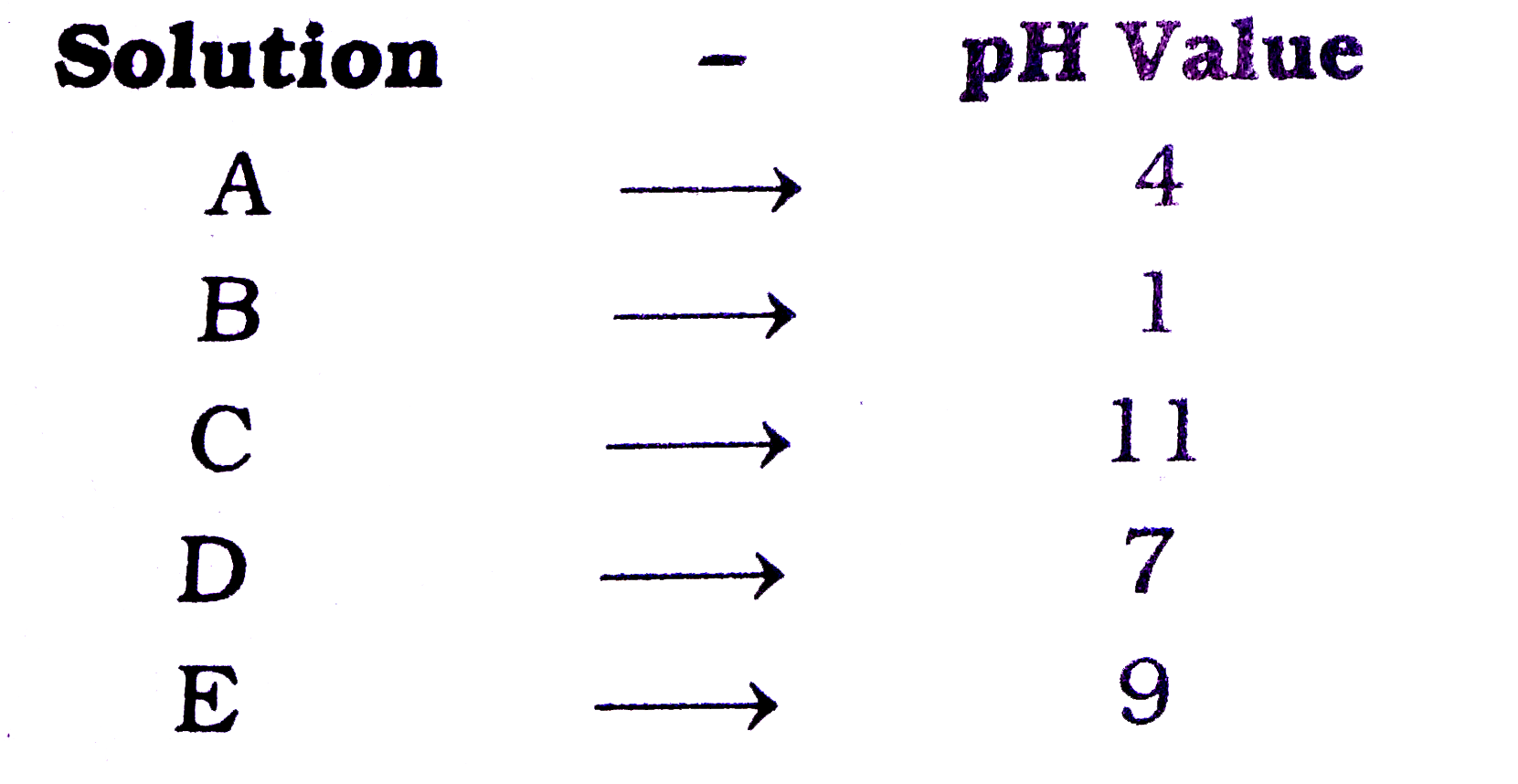

`:.` Increasing order of Hydrogen ion concentration : C, E, b, A, B.
Promotional Banner

Topper's Solved these Questions

  • ACIDS, BASES AND SALTS

    VGS PUBLICATION-BRILLIANT|Exercise Try these|4 Videos
  • ACIDS, BASES AND SALTS

    VGS PUBLICATION-BRILLIANT|Exercise Activities|26 Videos
  • ACIDS,BASES AND SALTS

    VGS PUBLICATION-BRILLIANT|Exercise 7 . Carbon and its Compounds|17 Videos

Similar Questions

Explore conceptually related problems

Five solutions A, B, C, D, E, F as 5, 2, 1, 3, 7 and 9 respectively which solution is (a) Neutral (b) Strongly alkaline (c ) Strongly acid (d) Weakly acidic Arrange the pH in increasing order of Hydrogen ion concentration.

You have two solutions, A and B. The pH of solution A is 6 and pH of solution B is 8. Which solution has more hydrogen ion concentration? Which of this is acidic and which one is basic?

The results of reactions of metals A, B, C, D, E with different solutions are given in the table below. Observe the table and write answers. Arrange the metals A, B, C, D, E in the order of their reactivity ?

When a salt reacts with water to form acidic (or ) basic solution the process is called salt hydrolysis. The P^(H) of salt solution can be calculated using the following relation P^(H) =(1)/(2) [P^(k_w) +P^(Ka) + log C ] for salt of weak acid and strong base. P^(H) =(1)/(2) [P^(K_w) -P^(K_a) -log C ] for salt of weak base and strong acid , P^(H) =(1)/(2) [P^(K_w) +P^(K_a) - P^(K_b) ] For a salt of weak acid and weak base where .c. represents the concentration of salt . When a weak acid (or) a weak base is not completly neatralised by strong base (or ) strong acid respectively, then formation of buffer takes places. The P^(H) of buffer solution can be calculated using the following relation P^(H) =P^(Ka) +log "" ((["salt")])/(["Acid "]) , P^(OH) =P^(Kb) +log ""(["salt"])/(["base"]) Answer the following questions using the following data pK_a (CH_3COOH) =4.7447 , pK_b (NH_4OH) =4.7447 , P^(K_W) =14. One mole CH_3 COOH and one mole CH_3 COONa are dissolved in water one litre aqueous solution The P^(H) of the resulting solution will be

When a salt reacts with water to form acidic (or ) basic solution the process is called salt hydrolysis. The P^(H) of salt solution can be calculated using the following relation P^(H) =(1)/(2) [P^(k_w) +P^(Ka) + log C ] for salt of weak acid and strong base. P^(H) =(1)/(2) [P^(K_w) -P^(K_a) -log C ] for salt of weak base and strong acid , P^(H) =(1)/(2) [P^(K_w) +P^(K_a) - P^(K_b) ] For a salt of weak acid and weak base where .c. represents the concentration of salt . When a weak acid (or) a weak base is not completly neatralised by strong base (or ) strong acid respectively, then formation of buffer takes places. The P^(H) of buffer solution can be calculated using the following relation P^(H) =P^(Ka) +log "" ((["salt")])/(["Acid "]) , P^(OH) =P^(Kb) +log ""(["salt"])/(["base"]) Answer the following questions using the following data pK_a (CH_3COOH) =4.7447 , pK_b (NH_4OH) =4.7447 , P^(K_W) =14. 0.001 M NH_4 Cl aqueous solution has P^(H)

An organic compound A(C_4 H_7 C_(13)) yields (B) when treated with aq. KOH. (B) upon treatment with C_2 H_5 OH in presence of acid gave (C) which upon reducing with LiAIH_4 gave (D) and (E). (B) upon treatment with NH_3 followed by heating with P_4 O_(10) and subsequent hydrolysis gives back (B). Sodium salt of (B) on Kolbe's electrolysis gave 2, 3-dimethylbutane at anode. The dehydration of compound (D) gives

VGS PUBLICATION-BRILLIANT-ACIDS, BASES AND SALTS -Section-4
  1. Five solutions A, B, C, D and E when tested with universal indicator s...

    Text Solution

    |

  2. How do the acid rains influence the aquatic life ? What is our main re...

    Text Solution

    |

  3. Explain an activity to show the water of crystallisation in CuSO4.5H2O...

    Text Solution

    |

  4. Draw a neat diagram showing a base solution in water conducts electric...

    Text Solution

    |

  5. Read the information given in the table and answer the following quest...

    Text Solution

    |

  6. Read the information given in the table and answer the following quest...

    Text Solution

    |

  7. Read the information given in the table and answer the following quest...

    Text Solution

    |

  8. Read the information given in the table and answer the following quest...

    Text Solution

    |

  9. List out the materials required to test whether the solutions of given...

    Text Solution

    |

  10. Observe the following table and answer the questions given below. Th...

    Text Solution

    |

  11. Observe the following table and answer the questions given below. Th...

    Text Solution

    |

  12. Which of the above two produce maximum heat when they react ? What doe...

    Text Solution

    |

  13. Observe the following table and answer the questions given below. Th...

    Text Solution

    |

  14. List out the material for the experiment "when Hydrochloric acid react...

    Text Solution

    |

  15. Prepare a table based on the colour responses of acid, base and salt w...

    Text Solution

    |

  16. If the pH values of solutions X, Y and Z are 13, 6 and 2 respectively ...

    Text Solution

    |

  17. If the pH values of solutions X, Y and Z are 13, 6 and 2 respectively ...

    Text Solution

    |

  18. If the pH values of solutions X, Y and Z are 13, 6 and 2 respectively ...

    Text Solution

    |

  19. If the pH values of solutions X, Y and Z are 13, 6 and 2 respectively ...

    Text Solution

    |

  20. Describe how sodium hydroxide is obtained from common salt.

    Text Solution

    |

  21. Describe chlor - alkali process.

    Text Solution

    |

