Home
Class 10
CHEMISTRY
Explain Pauli's Exclusion principle with...

Explain Pauli's Exclusion principle with an example.

Text Solution

Verified by Experts
Pauli's exclusion principle : According fo Pauli's exclusion principle, no two electrons of the same atom can have all four quantum numbers are same.
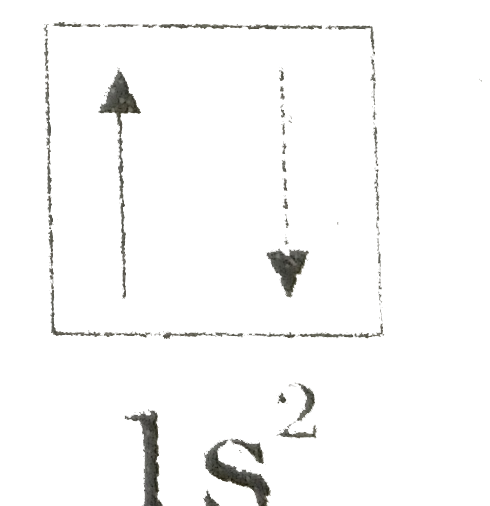
Ex : He ( Z = 2)
The electronic configuration is `1 s^(2)` i.e.

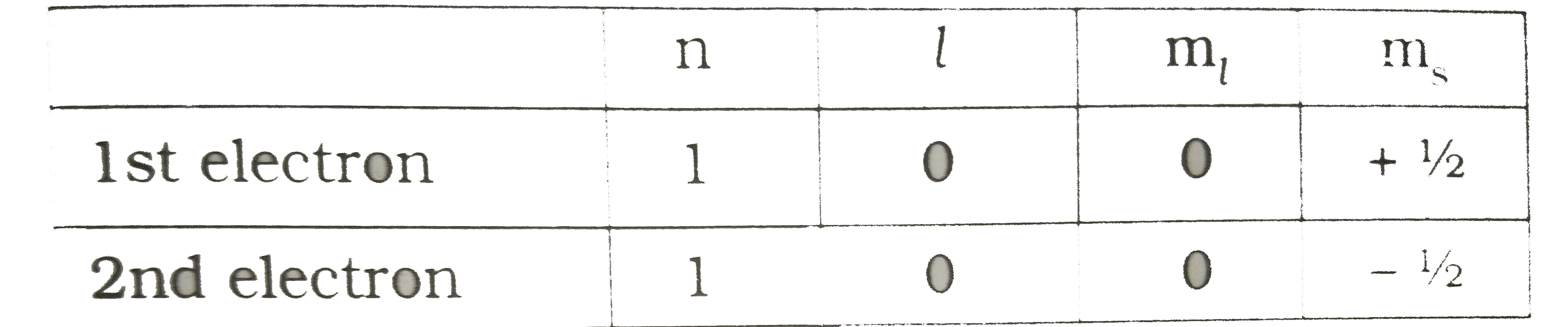
The set of four quantum numbers for two electrons of Helium atom is

From the table we can observe that the three quantum numbers are equal but fourth one is different.
Promotional Banner

Topper's Solved these Questions

  • STRUCTURE OF ATOM

    VGS PUBLICATION-BRILLIANT|Exercise CREATIVE QUESTIONS FOR NEW MODEL EXAMINATION ( SECTION - IV 4 MARKS )|32 Videos
  • STRUCTURE OF ATOM

    VGS PUBLICATION-BRILLIANT|Exercise CREATIVE QUESTIONS FOR NEW MODEL EXAMINATION ( SECTION - II 1 MARK)|71 Videos
  • REFLECTION AND REFRACTION

    VGS PUBLICATION-BRILLIANT|Exercise EXERCISE|24 Videos
  • SUMMATIVE ASSESSMENT

    VGS PUBLICATION-BRILLIANT|Exercise SUMMATIVE ASSESSMENT|28 Videos

Similar Questions

Explore conceptually related problems

Explain Paulis exclusion principle .

Explain Aufbau principle with an example .

State and explain Pauli's exclusion principle.

Explain Hund's rule with an example .

Explain conditioning with an example.

Electronic configuration of multielectron atoms can be written by the use of four quantum numbers and also by following certain principles. Pauli's exclusion principle suggests that maximum capacity of an atomic orbital is two. Auf bau principle suggests that the lower energy orbitals are filled first and hence stability can be attained. Hunds rule of maximum multiplicity suggests that pairing occurs with one electron. The arrangement of electrons in the space around the nucleus can be understood only after writing the electronic configuration. Thus writing electronic configuration is more important in the structure of an atom. Auf-bau principle is first violated for the element with atomic numbers

Electronic configuration of multielectron atoms can be written by the use of four quantum numbers and also by following certain principles. Pauli's exclusion principle suggests that maximum capacity of an atomic orbital is two. Auf bau principle suggests that the lower energy orbitals are filled first and hence stability can be attained. Hunds rule of maximum multiplicity suggests that pairing occurs with one electron. The arrangement of electrons in the space around the nucleus can be understood only after writing the electronic configuration. Thus writing electronic configuration is more important in the structure of an atom. Six unpaired electrons are present in the ground state electronic configuration of the element

Electronic configuration of multielectron atoms can be written by the use of four quantum numbers and also by following certain principles. Pauli's exclusion principle suggests that maximum capacity of an atomic orbital is two. Auf bau principle suggests that the lower energy orbitals are filled first and hence stability can be attained. Hunds rule of maximum multiplicity suggests that pairing occurs with one electron. The arrangement of electrons in the space around the nucleus can be understood only after writing the electronic configuration. Thus writing electronic configuration is more important in the structure of an atom. The set of quantum numbers not possible for electrons present in potassium atom in its ground state

Explain ozonolysis with one example.

VGS PUBLICATION-BRILLIANT-STRUCTURE OF ATOM -CREATIVE QUESTIONS FOR NEW MODEL EXAMINATION ( SECTION - III 2 MARKS QUESTIONS )
  1. Write Planck's equation .

    Text Solution

    |

  2. Give the equation which give electromagnetic energy (light) that can h...

    Text Solution

    |

  3. Explain Pauli's Exclusion principle with an example.

    Text Solution

    |

  4. Explain Aufbau principle with an example .

    Text Solution

    |

  5. There is an electron in one atom with n = 1, l = O, m(l) = O. a) P...

    Text Solution

    |

  6. Guess the orbital. If 1) It's energy lies in between the energies o...

    Text Solution

    |

  7. The electronic configuration of an atom is as follows 1s^(2) 2s^(2) 2...

    Text Solution

    |

  8. Fill the following table and write the rule which you use in filling t...

    Text Solution

    |

  9. An electron is an atom has the following set four quantum numbers to w...

    Text Solution

    |

  10. You know that the distribution of electrons in shells, sub-shells and ...

    Text Solution

    |

  11. You know that the distribution of electrons in shells, sub-shells and ...

    Text Solution

    |

  12. The differentiating electron in one atom is 4p^(1) . Write the set ...

    Text Solution

    |

  13. The differentiating electron in one atom is 4p^(1) . Write the full ...

    Text Solution

    |

  14. For n = 3. Write all the m(l) values.

    Text Solution

    |

  15. For n = 3. Write all the sub-shells

    Text Solution

    |

  16. Write the name of the atom and electronic configuration for the given ...

    Text Solution

    |

  17. Where does the 6^(th) electron go?

    Text Solution

    |

  18. Among 3d, 4s, 4p orbitals, which one has least orbital energy ? Why...

    Text Solution

    |

  19. Among 3d, 4s, 4p orbitals, which one fills last by an electron? And...

    Text Solution

    |

  20. Show all the p-orbitals in one diagram.

    Text Solution

    |