Home
Class 10
PHYSICS
How does a battery work ? Explain....

How does a battery work ? Explain.

Text Solution

Verified by Experts
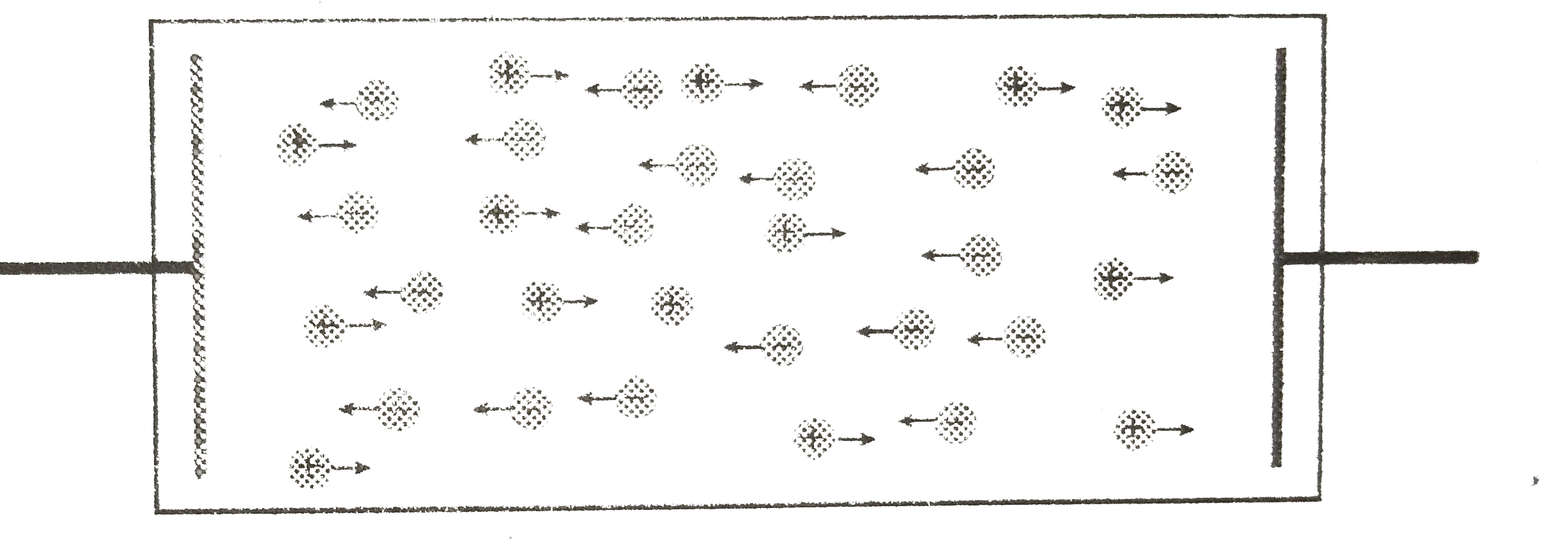
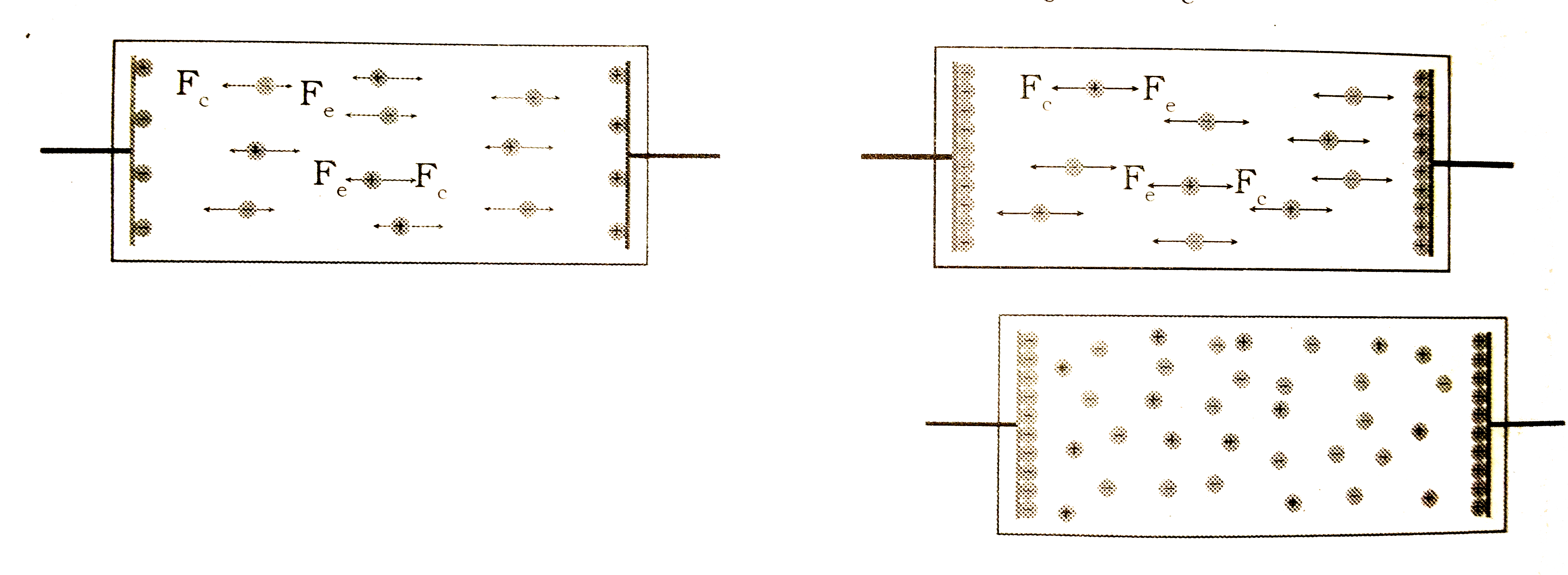
1. A battery consists of two metal plates (electrodes) and a chemical (electronlyte).

2. This electrolyte consists positive and negative ions which move in oppsite directions.
3. This electrolyte exerts a force called chemical force `(F_(c))` to make the ions move in a specified direction.
4. Positive ions move towards one plate and accumulate on that. As result this plate become positively charged (Anode).
5. Negative ions move to another plate and accumulate on that. As a result of this the plate becomes negatively charged (Cathode).
6. This accumulation continues till both plates are suffciently charged.
7. But the ions expertence another force called electric force `(F_(e))`, when suffcient number of charges accumulated on the plates.
8. The direction of `F_(e)` is opposite to `F_(c)` and magnitude depends on the amount of charge accumulated on the plates.
9. The accumulation of charges on plates is continuous till `F_(e)` becomes equal to `F_(e)` Now there will not be any motion due to balance of `F_(e)andF_(c).`

10. The new battery that we buy from the shop is under the influence of balanced forces. This is the reason for the constant P.D. between the terminal of a battery.
11. When a conducting wire is connected to the terminals of the battery. a P.D. is created between the ends of the conductor which sets up an electric field throughout the conductor.
12. The large number of electrons in the conductor, near the positive terminal of the battery are attracted by it and start to move towards positive terminal. As a results, the amount of positive charge on this plate decrease. So `F_(e)` becomes weaker than `F_(c)andF_(c)` pulls negative ions from anode towards cathode.
13. The negative terminal pushes one electron into the conductor because of stronger repulsion between negative terminal and negative ion.
14. Hence, the total number of electrons in the conductor remains constant during the current flow. The above said process continuous till `F_(e)=F_(c)`
Promotional Banner

Topper's Solved these Questions

  • ELECTRIC CURRENT

    VGS PUBLICATION-BRILLIANT|Exercise APPLICATION TO DAILY LIFE, CONCERN TO BIODIVERSITY|37 Videos
  • ELECTRIC CURRENT

    VGS PUBLICATION-BRILLIANT|Exercise FILL IN THE BLANKS|8 Videos
  • ELECTRIC CURRENT

    VGS PUBLICATION-BRILLIANT|Exercise SECTION - IV (4 Marks Questions)|16 Videos
  • CHEMICAL REACTIONS AND EQUATIONS

    VGS PUBLICATION-BRILLIANT|Exercise ESSENTIAL MATERIAL FOR EXAMINATION PURPOSE|1 Videos
  • ELECTROMAGNETISM

    VGS PUBLICATION-BRILLIANT|Exercise CREATIVE QUESTION FOR NEW MODEL EXAMINATION (SEC-4)|30 Videos

Similar Questions

Explore conceptually related problems

How does snake move ? Explain its locomotion.

How does candle work?

How does cow start eating ? Explain.

How does a catalyst work in a chemical reaction? Discuss the catalysis with suitable examples.

How is ClF_(3) prepared ? How does it react with water ? Explain its structure.

How does a vector represents ? Explain.

What is a Hinge Joint ? How it works ? Explain.

What are electro chemical cells ? How are they constructed ? Explain the working of the different types of galvanic cells ?

How does yeast reproduce ?

VGS PUBLICATION-BRILLIANT-ELECTRIC CURRENT-CONCEPTUAL UNDERSTANDING
  1. Explain the lorentz - Drude theory.

    Text Solution

    |

  2. Explain the lorentz - Drude theory.

    Text Solution

    |

  3. How does a battery work ? Explain.

    Text Solution

    |

  4. Write the difference between potential difference and emf.

    Text Solution

    |

  5. What do you mean by electric shock ? Explain how it takes place.

    Text Solution

    |

  6. "Derive R"=(rhol)/(A).

    Text Solution

    |

  7. Derive a formula that shows the relation between resistance length and...

    Text Solution

    |

  8. What is the relationship between length of a conductor and its resista...

    Text Solution

    |

  9. State Kirchhoff's law for an electrical network. Using these laws dedu...

    Text Solution

    |

  10. What is the of 1 KWH in joules ?

    Text Solution

    |

  11. What happens when this current (overloading) increases greatly to the ...

    Text Solution

    |

  12. Deduce the expression for the equivalent resistance of there resistor ...

    Text Solution

    |

  13. " Derive "R=R(1)+R(2)+R(3).

    Text Solution

    |

  14. Explain the expression for the equivalient resistance of three resisto...

    Text Solution

    |

  15. The second end of a first resistor is connected to first end of second...

    Text Solution

    |

  16. Derive an expression for the effective resistance when three resistors...

    Text Solution

    |

  17. "Derive"(1)/(Rp)=(1)/(R(1))+(1)/(R(2))+(1)/(R(3)).(Resistors in parall...

    Text Solution

    |

  18. Derive an expression for the effective resistance when three resistors...

    Text Solution

    |

  19. Derive an expression for the effective resistance when three resistors...

    Text Solution

    |

  20. Silver is a better conductor of electricity than copper. Whey do we us...

    Text Solution

    |