Home
Class 11
PHYSICS
One end of a spring of force constant k ...

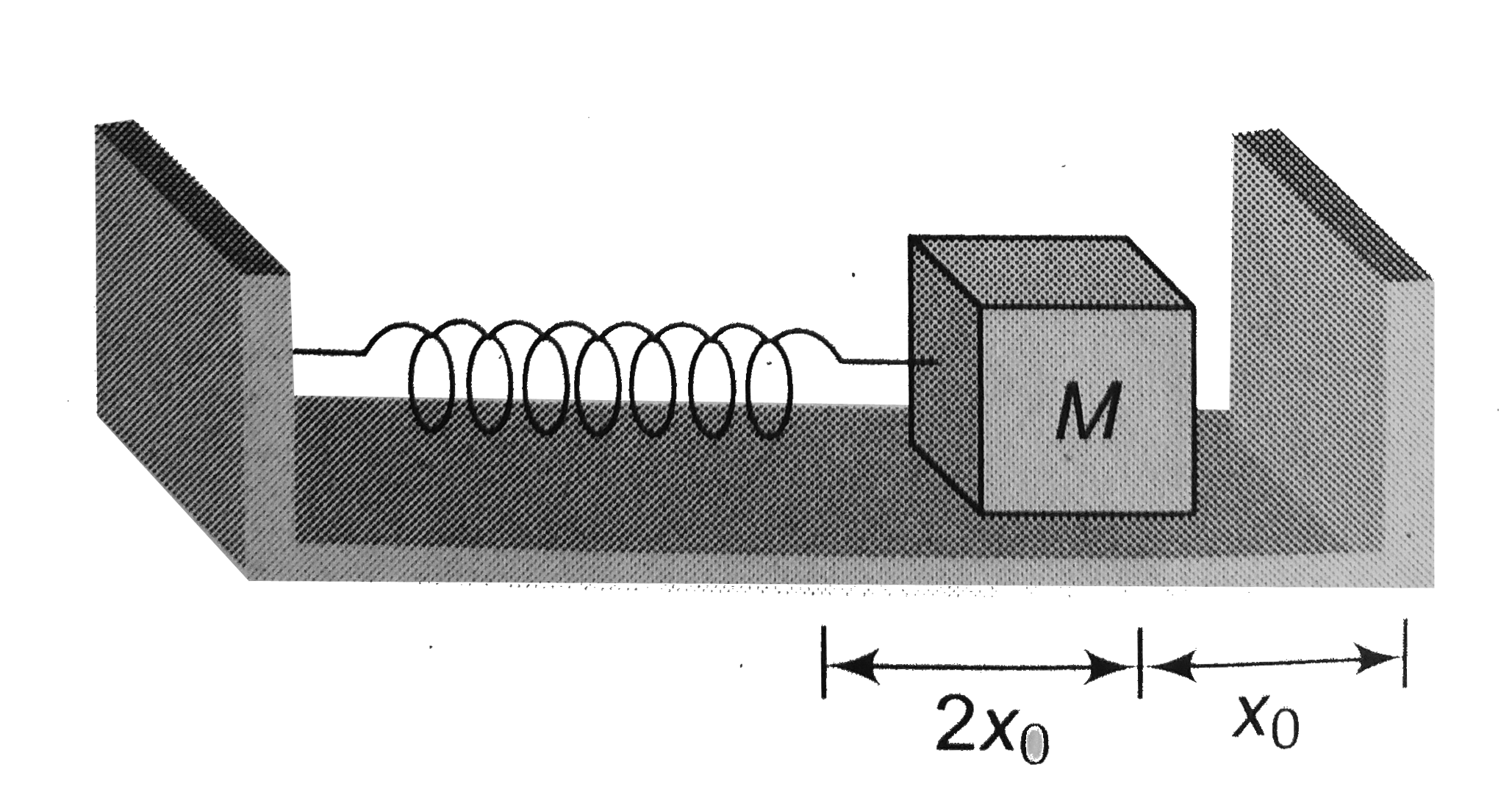
One end of a spring of force constant `k` is fixed to a vertical wall and the other to a block of mass `m` resting on a smooth horizontal surface There is another and wall at a distance `x_(0)` from the block The spring is then compressed by `2x_(0)` and released The time taken to strike the wall is

A

`1/6 pi sqrt(k/m)`

B

`sqrt(k/m)`

C

`(2pi)/6 sqrt(m/k)`

D

`(pi)/4 sqrt(k/m)`

Text Solution

Verified by Experts

The correct Answer is:

C
Promotional Banner

Similar Questions

Explore conceptually related problems

One end of a spring of force constant k is fixed to a vertical wall and the other to a blcok of mass m resting on a smooth horizontal surface. There is another wall at distance x_(0) from the block. The spring is then compressed by 2x_(0) and released. The time taken to strike the wall is

One end of aspring of force constant k is fixed to a verticle wall and the other to a block of mass m resing on a smooth horizontal surface There is another and wall at a distance x_(0) from the block The spring is then compressed by 2x_(0) and released The time taken to at the wall is

One end of a spring of force constant K is fixed to a vertical wall and the other to a body of mass m resting on a smooth horizontal surface. There is another wall at a distance x_0 from the body. The spring is then compressed by 3x_0 and released. The time taken to strike the wall from the instant of release is (given sin^-1((1)/(3))=((pi)/(9)) )

One end of a spring of force constant K is fixed to a vertical wall and other to a body of mass m resting on smooth horizontal surface. There is another wall at a distance of sqrt(3)x_(0) from the body. If all the collisions are elastic and spring is compressed by 2x_(0) and released, then the time period of oscillation is

One end of a light spring of spring constant k is fixed to a wall and the other end is tied to a block placed on a smooth horizontal surface. In a displacement, the work by the spring is 1/2kx^2 . The possible cases are

One end of a light spring of spring constant k is fixed to a wall and the other end is tied to a block placed on a smooth horizontal surface. In a displacment, the work done by the spring is +(1/2)kx^(2) . The possible cases are.

A block of mass m moving with velocity v_(0) on a smooth horizontal surface hits the spring of constant k as shown. Two maximum compression in spring is

A spring having a spring constant k is fixed to a vertical wall as shown in Fig. A block of mass m moves with velocity v torards the spring from a parallel wall opposite to this wall. The mass hits the free end of the spring compressing it and is decelerated by the spring force and comes to rest and then turns the spring is decelerated by the spring force and comes to rest and then turns back till the spring acquires its natural length and contact with the spring is broken. In this process, it regains its angular speed in the opposite direction and makes a perfect elastice collision on the opposite left wall and starts moving with same speed as before towards right. The above processes are repeated and there is periodic oscillation. Q. What is the time period of oscillation ?

One end of a light spring of natural length d and spring constant k is fixed on a rigid wall and the other is attached to a smooth ring of mass m which can slide without friction on a vertical rod fixed at a distance d from the wall. Initially the spring makes an angle of 37^(@) with the horizontal as shown in fig. When the system is released from rest, find the speed of the ring when the spring becomes horizontal. [ sin 37^(@) = 3/5]

A block of mass m is attached to one end of a mass less spring of spring constant k. the other end of spring is fixed to a wall the block can move on a horizontal rough surface. The coefficient of friction between the block and the surface is mu then the compession of the spring for which maximum extension of the spring becomes half of maximum compression is .
