Home
Class 12
CHEMISTRY
During the neutralisation of an acid by ...

During the neutralisation of an acid by a base, the end point refers to the completion of reaction. The detection of end point in acid-base neutralisation is usually made by an acid-base indicator. An acid-base indicator is itself a weak acid (Phenolphthalein) or a weak base (Methyl orange). At `50%` ionisation which depends on the medium. the anion furnished by an indicator (acid) cation furnished colour to solution at end point. For example, phenolphthalein dissociation
`underset("Colourless")(HIn)toH^(+)+underset("Pink")(In^(-)),K_(HIn)=([H^(+)][In^(-)])/([HIn])`
is favoured in presence of alkali and pink colour of phenolphthalein ion is noticed as soon as the medium changes to alkali nature. The end point of acid-base neutralisation not necessarily coincides with eqivalence point but it is closer to equivalence point. Also at equivalence point of acid-base neutralisation, pH is not necessarily equal to 7.
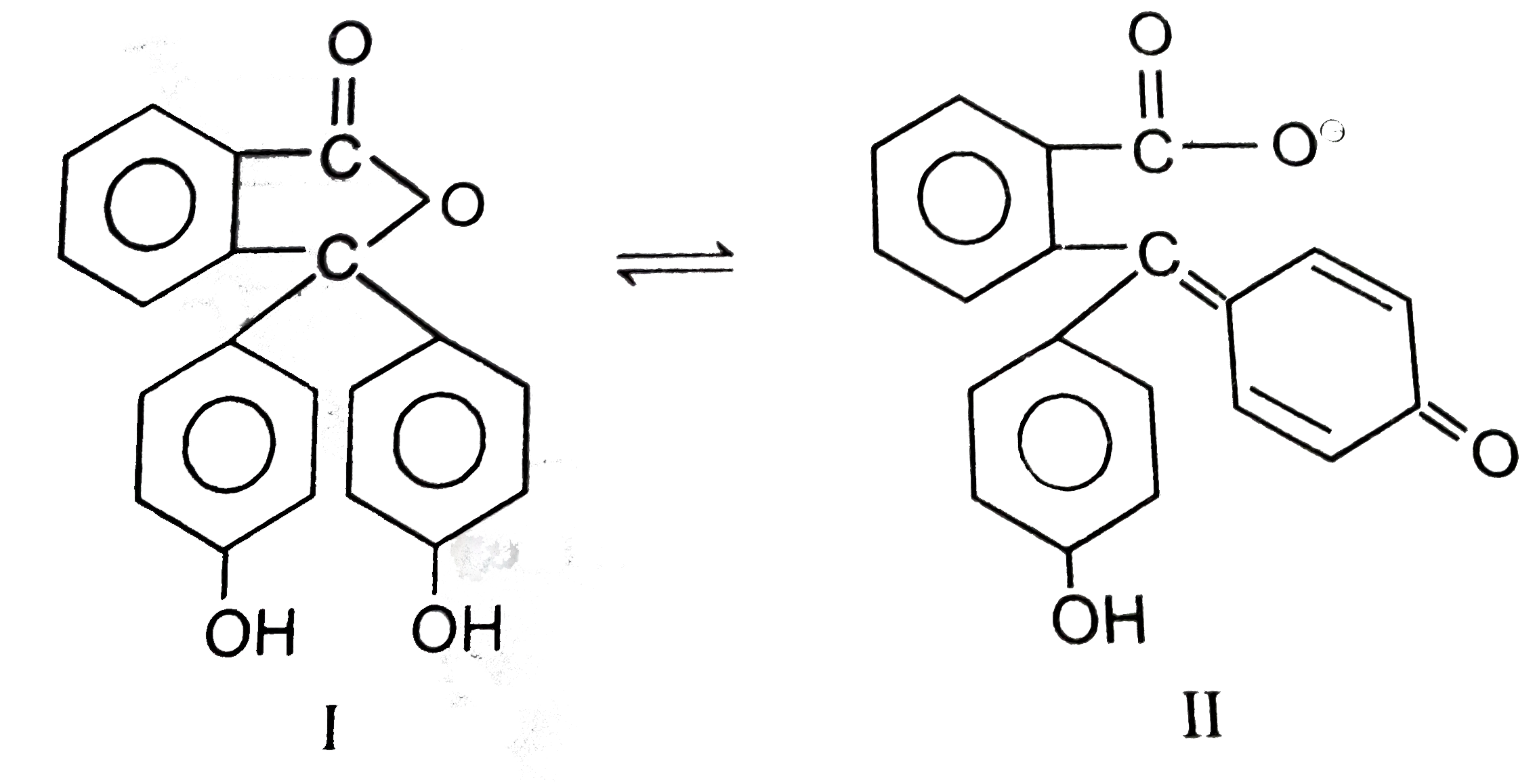
The indicator phenolphthalein is a tautomeric mixture of two forms as given below:
Which of the following statements are correct?
The form II is referred as quinonoid form and is deeper is colour.
(Q)The form I is referred as quinonoid form and is light in colour.
(R) The form II is more stable in alkaline medium.
(S) The change is pH from acidic to alkaline solution bring in the more and more conversion of I form to II form.
(T) The form I is more stable in acidic medium.

A

P,Q,R and S

B

P,R,S and T

C

R,S and T

D

Q,R,S and T

Text Solution

Verified by Experts

The correct Answer is:

b
Promotional Banner

Topper's Solved these Questions

  • HYDROGEN AND ITS COMPOUNDS

    GRB PUBLICATION|Exercise Subjective type|8 Videos
  • LIQUID SOLUTIONS

    GRB PUBLICATION|Exercise 11|12 Videos
GRB PUBLICATION-IONIC EQUILIBRIUM-All Questions
  1. During the neutralisation of an acid by a base, the end point refers t...

    Text Solution

    |

  2. During the neutralisation of an acid by a base, the end point refers t...

    Text Solution

    |

  3. During the neutralisation of an acid by a base, the end point refers t...

    Text Solution

    |

  4. During the neutralisation of an acid by a base, the end point refers t...

    Text Solution

    |

  5. The Ph of basic buffer mixtures is given by : Ph=Pk(a)+log (["Base"])...

    Text Solution

    |

  6. The Ph of basic buffer mixtures is given by : Ph=Pk(a)+log (["Base"])...

    Text Solution

    |

  7. The Ph of basic buffer mixtures is given by : Ph=Pk(a)+log (["Base"])...

    Text Solution

    |

  8. The Ph of basic buffer mixtures is given by : Ph=Pk(a)+log (["Base"])...

    Text Solution

    |

  9. The solubility product of a soluble salt A(x)B(y) is given by : K(sp)=...

    Text Solution

    |

  10. The solubility product of a soluble salt A(x)B(y) is given by : K(sp)=...

    Text Solution

    |

  11. The solubility product of a soluble salt A(x)B(y) is given by : K(sp)=...

    Text Solution

    |

  12. The solubility product of a soluble salt A(x)B(y) is given by : K(sp)=...

    Text Solution

    |

  13. The solubility product of a soluble salt A(x)B(y) is given by : K(sp)=...

    Text Solution

    |

  14. For the self-ionisation (protonation) process liquid formic acid at 20...

    Text Solution

    |

  15. For the self-ionisation (protonation) process liquid formic acid at 20...

    Text Solution

    |

  16. For the self-ionisation (protonation) process liquid formic acid at 20...

    Text Solution

    |

  17. Amino acid glycine (NH(2)-CH(2)-COOH) exists as a zwitter ion in aq. S...

    Text Solution

    |

  18. Amino acid glycine (NH(2)-CH(2)-COOH) exists as a zwitter ion in aq. S...

    Text Solution

    |

  19. Following titration method is taken to compute stepwise ionisation con...

    Text Solution

    |

  20. Following titration method is taken to compute stepwise ionisation con...

    Text Solution

    |
