Home
Class 12
CHEMISTRY
Following titration method is taken to c...

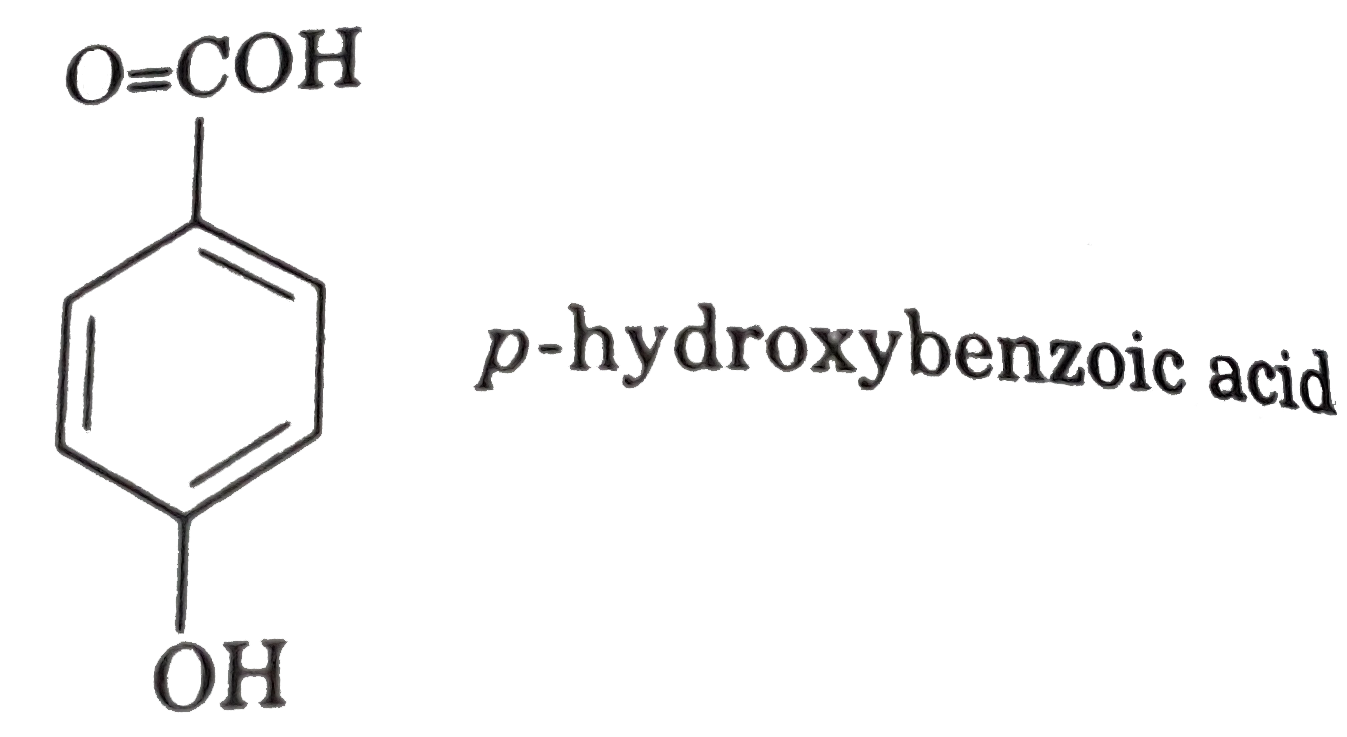
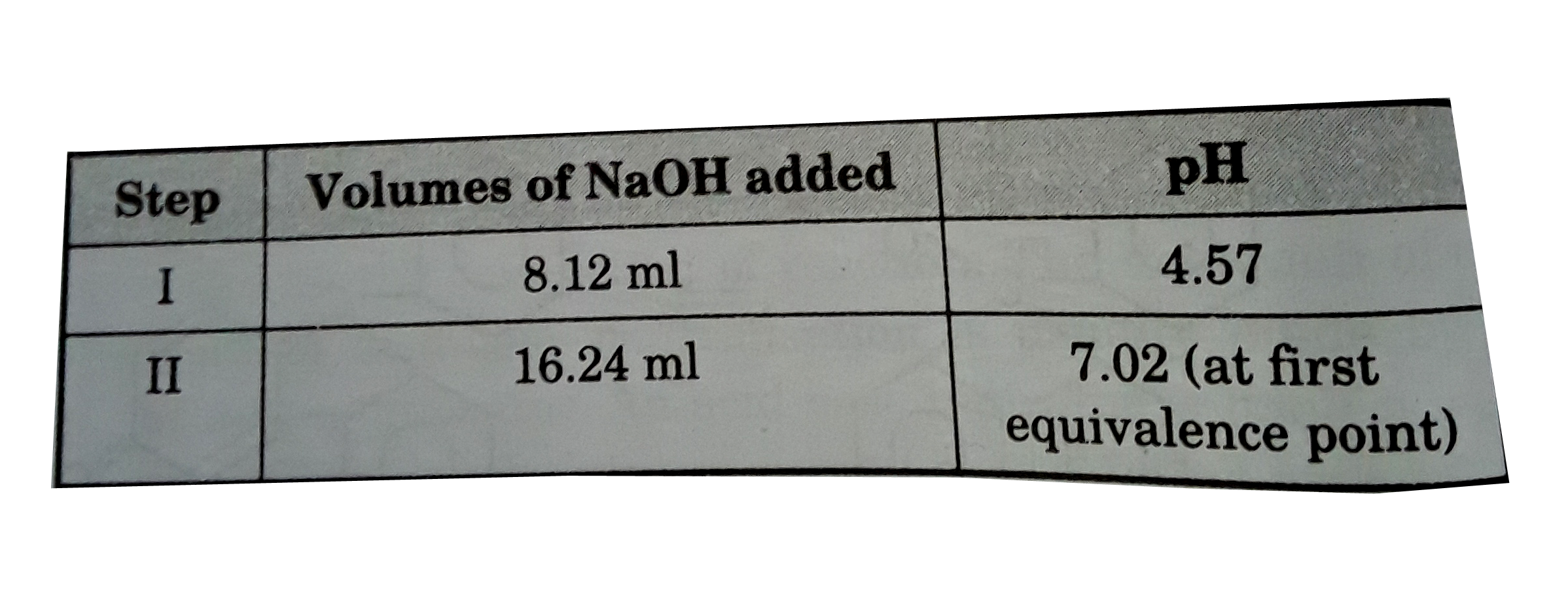
Following titration method is taken to compute stepwise ionisation constant of a weak dibasic acid

has two ionisable protons and there can be stepwise neutralisation by NaOH.
Which `H^(+)` removed in step `I`?
`pK_(a_2)(=-logK_(a_2))` of p-hydroxybexzonic acid is nearly:

A

`4.5`

B

`7`

C

`9.5`

D

`5`

Text Solution

Verified by Experts

The correct Answer is:

c
Promotional Banner

Topper's Solved these Questions

  • HYDROGEN AND ITS COMPOUNDS

    GRB PUBLICATION|Exercise Subjective type|8 Videos
  • LIQUID SOLUTIONS

    GRB PUBLICATION|Exercise 11|12 Videos

Similar Questions

Explore conceptually related problems

Following titration method is taken to compute stepwise ionisation constant of a weak dibasic acid has two ionisable protons and there can be stepwise neutralisation by NaOH. Which H^(+) removed in step I ? pK_(a_1) (=-logK_(a_1)) of p-hydroxybenzonic acid is :

For every diprotic acid of the type H_(2)X , how would you relate ionisation constant K_(a1) and K_(a2)

The dissociation of weak electrolyte (a weak base or weak acid) id expressed in terms of Ostwald dilution law. An acid is a substance which furnishes a proton or accepts an electron pair whereas a base is proton acceptor or electron pair donor. Storonger is the acid weaker is its conjugate base. The dissociation constants of an acid (K_(a)) and its conjugate base are related by (K_(w)=K_(a)xxK_(b) , where K_(w) is ionic prodcut of water equal to 10-14 at 25^(@)C . The numerical value of K_(w) however increases with temperature. In a solution of an acid or base [H^(+)][OH^(-)]=10^(14) .Thus, the [H^(+)] in a solution is expressed as : [H^(+)]=10^(-pH) and pH+pOH=14 . Buffer solutions are the solutions which do not show appreciable change in the pH on addition of small amount of acid or base. Which of the following statements are correct? (P) At 25^(@)C,pH of 10^(-10)MNaOH is nearly 7. (Q) The degree of dissociation of a weak acid is given by (1)/(1+10^((pk_(a)-pH))) . (R) For weak electrolytes of polyprotic acid nature having no other electrolyte, the anion concentration produced in II step of dissocitation is always equal to K_(2) at reasonable concentration of acid. (S) The concentraion of amide ions produced during self ionisation of NH_(3) is equal to concentration of ammonium ions. Ostwld dilution law is valid for strong electrolytes.

The dissociation of weak electrolyte (a weak base or weak acid) is expressed in terms of Ostwald's dilution law. An acid is substance which furnishes a proton or accepts an electron pair, where a base is proton acceptor or electron pair donor. Stronger is acid, weaker is its conjugate base. The dissociation constants of an acid (K_(a)) and its conjugate base (K_(b)) are related by K_(w)=K_(a)xxK_(b) , where K_(w) is ionic product of water equal to 10^(-14) at 25^(@)C . The numerical value of K_(w) however increase with temperature. In a solution of an acid or base [H^(+)][OH^(-)]=10^(-14) . Thus the [H^(+)] in a solution is expressed as: [H^(+)]=10^(-pH) and pH+pOH=14 . Buffer solution are the solutions which do not show appreciable change in the pH on addition of small amount of acid or base. Which of the following statements are correct ? (1) pH of 10^(-10) M NaOH is nearly 7. (2) The degree of dissociation of a weak acid is given by (1)/(1+10^((pK_(aq)-pH)) (3) For weak electrolytes of polyprotic acid nature having no other electrotrolype, the anion concentration produced in II step of dissociation is always equal to K_(2) at reasonable concentration of acid. (4) The concentration of amide ions produced during self ionisation of NH_(3) is equal concentration of ammonium ions. (5) Ostwald's dilution law is valid for strong electrolytes.

The dissociation of weak electrolyte (a weak base or weak acid) is expressed in terms of Ostwald's dilution law. An acid is substance which furnishes a proton or accepts an electron pair, where a base is proton acceptor or electron pair donor. Stronger is acid, weaker is its conjugate base. The dissociation constants of an acid (K_(a)) and its conjugate base (K_(b)) are related by K_(w)=K_(a)xxK_(b) , where K_(w) is ionic product of water equal to 10^(-14) at 25^(@)C . The numerical value of K_(w) however increase with temperature. In a solution of an acid or base [H^(+)][OH^(-)]=10^(-14) . Thus the [H^(+)] in a solution is expressed as: [H^(+)]=10^(-pH) and pH+pOH=14 . Buffer solution are the solutions which do not show appreciable change in the pH on addition of small amount of acid or base. Which of the following statements are true ? (1) CIO_(4)^(-) is weak base than CIO_(3)^(-) (2) The degree of dissociation of weak is 1.8xx10^(-9) (3) The equilibrium constant for dissociation of H_(2)O is 1.78xx10^(-16) (4) PO_(4)^(3-) is conjugate acid of HPO_(4)^(2-)

The dissociation of weak electrolyte (a weak base or weak acid) is expressed in terms of Ostwald's dilution law. An acid is substance which furnishes a proton or accepts an electron pair, where a base is proton acceptor or electron pair donor. Stronger is acid, weaker is its conjugate base. The dissociation constants of an acid (K_(a)) and its conjugate base (K_(b)) are related by K_(w)=K_(a)xxK_(b) , where K_(w) is ionic product of water equal to 10^(-14) at 25^(@)C . The numerical value of K_(w) however increase with temperature. In a solution of an acid or base [H^(+)][OH^(-)]=10^(-14) . Thus the [H^(+)] in a solution is expressed as: [H^(+)]=10^(-pH) and pH+pOH=14 . Buffer solution are the solutions which do not show appreciable change in the pH on addition of small amount of acid or base. The protonation constant for NH_(3) from water is 6xx10^(5) . The deprotonation from NH_(4)^(+) to H_(2)O has rate constant 5.6xx10^(-10) . The rate constant for NH_(4)^(+) and OH^(-) reaction to give NH_(3) and H_(2)O would be:

The dissociation of weak electrolyte (a weak base or weak acid) is expressed in terms of Ostwald's dilution law. An acid is substance which furnishes a proton or accepts an electron pair, where a base is proton acceptor or electron pair donor. Stronger is acid, weaker is its conjugate base. The dissociation constants of an acid (K_(a)) and its conjugate base (K_(b)) are related by K_(w)=K_(a)xxK_(b) , where K_(w) is ionic product of water equal to 10^(-14) at 25^(@)C . The numerical value of K_(w) however increase with temperature. In a solution of an acid or base [H^(+)][OH^(-)]=10^(-14) . Thus the [H^(+)] in a solution is expressed as: [H^(+)]=10^(-pH) and pH+pOH=14 . Buffer solution are the solutions which do not show appreciable change in the pH on addition of small amount of acid or base. SO_(2) contents in the atmosphere is 10 ppm and the solubility of SO_(2) in water is 1.36 mol litre^(-1) . If pK_(a) of H_(2)SO_(3) is 1.92 , the pH of rainwater is:

GRB PUBLICATION-IONIC EQUILIBRIUM-All Questions
  1. Following titration method is taken to compute stepwise ionisation con...

    Text Solution

    |

  2. Following titration method is taken to compute stepwise ionisation con...

    Text Solution

    |

  3. Following titration method is taken to compute stepwise ionisation con...

    Text Solution

    |

  4. Acetic acid tends to form dimer due to formation of intermolcular hydr...

    Text Solution

    |

  5. Acetic acid tends to form dimer due to formation of intermolcular hydr...

    Text Solution

    |

  6. Acetic acid tends to form dimer due to formation of intermolcular hydr...

    Text Solution

    |

  7. 100ml of 0.1M H(3)PO(4) is titrated with 0.05 M NaOH solution till 2nd...

    Text Solution

    |

  8. 100ml of 0.1M H(3)PO(4) is titrated with 0.05 M NaOH solution till 2nd...

    Text Solution

    |

  9. 100ml of 0.1M H(3)PO(4) is titrated with 0.05 M NaOH solution till 2nd...

    Text Solution

    |

  10. Selective precipitation of ions in a mixture in the form of salts can ...

    Text Solution

    |

  11. Selective precipitation of ions in a mixture in the form of salts can ...

    Text Solution

    |

  12. 0.3 g of CH(3) COOH is dissolved in 100ml water to prepare a solution ...

    Text Solution

    |

  13. 0.3 g of CH(3) COOH is dissolved in 100ml water to prepare a solution ...

    Text Solution

    |

  14. The equilibrium equation and K(a) values for the three acids are given...

    Text Solution

    |

  15. The equilibrium equation and K(a) values for the three acids are given...

    Text Solution

    |

  16. The equilibrium equation and K(a) values for the three acids are given...

    Text Solution

    |

  17. Human blood has a narrow Ph range of 7.3-7.4, which must be maintained...

    Text Solution

    |

  18. Human blood has a narrow Ph range of 7.3-7.4, which must be maintained...

    Text Solution

    |

  19. Human blood has a narrow Ph range of 7.3-7.4, which must be maintained...

    Text Solution

    |

  20. We represent various reagents pictorially such that, The relative...

    Text Solution

    |
