

Home
Class 11
PHYSICS
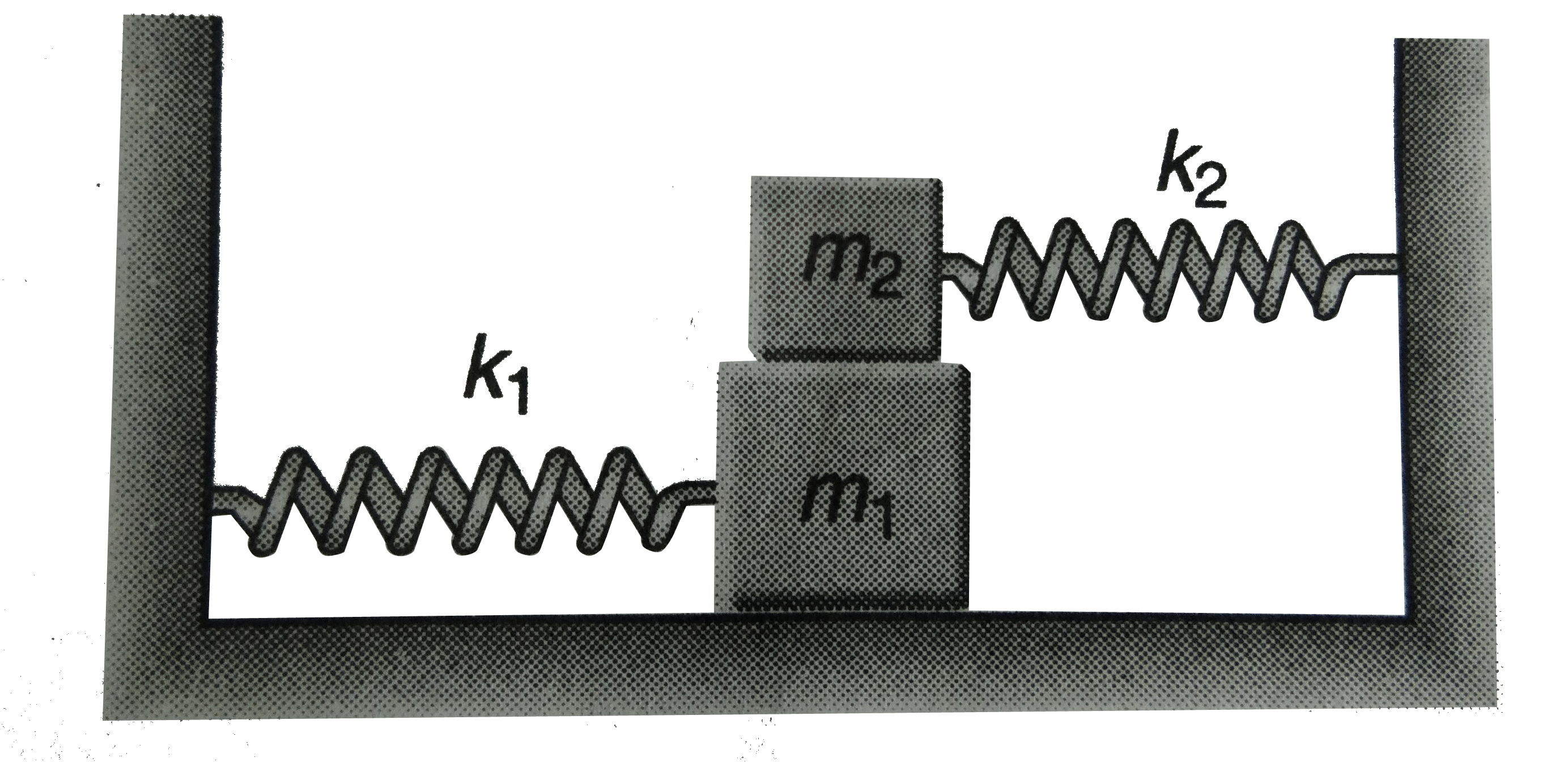
In the shown arrangement, both the sprin...

In the shown arrangement, both the spring are in their natural lengths. The coefficient of friction between `m_(2)` and `m_(1)` is `mu`. There is no friction between `m_(1)` and the surface. If the blocks are displaced slightly, they together perform simple harmonic motion. Obtain

(a) Frequency of such oscillations.
(b) The condition if the friction force on clock `m_(2)` is to act in the direction of its displacement from mean position.
( c) If the condition obtained in (b) is met, what can be maximum of their oscillations ?

Promotional Banner

Similar Questions

Explore conceptually related problems

(i) In the shown arrangement, both springs are relaxed. The coefficient of friction between m_(2) " and " m_(1) is mu . There is no friction between m_(1) and the horizontal surface. The blocks are displaced slightly and released. They move together without slipping on each other. (a) If the small displacement of blocks is x then find the magnitude of acceleration of m_(2) . What is time period of oscillations ? (b) Find the ratio (m_(1))/(m_(2)) so that the frictional force on m_(2) acts in the direction of its displacement from the mean position. (ii) Two small blocks of same mass m are connected to two identical springs as shown in fig. Both springs have stiffness K and they are in their natural length when the blocks are at point O. Both the blocks are pushed so that one of the springs get compressed by a distance a and the other by a//2 . Both the blocks are released from this position simultaneously. Find the time period of oscillations of the blocks if - (neglect the dimensions of the blocks) (a) Collisions between them are elastic. (b) Collisions between them are perfectly inelastic.

In the arrangement shown in figure, coefficient of friction between the two blocks is mu=1//2 . The force of friction acting between

The coefficient of friction between m_(2) and inclined plane is mu (shown in the figure). If (m_(1))/(m_(2))=sin theta then

The coefficient of friction between m_(2) and inclined plane is mu (shown in the figure). If (m_(1))/(m_(2))=sin theta then

The coefficient of friction between the block A of mass m & block B of mass 2m is mu . There is no friction between A & B is released from rest & there is no slipping between A & B then:

A mass m rests under the action of a force F as shown in the figure-2.158 on a horizontal surface. The coefficient of friction between the mass and the surface is mu . The force of friction between the mass and the surface is :

If coefficient of friction between both the block is mu- (1)/(2) . Find friction force acting between both block.

The coefficient of friction between block of mass m and 2m is mu=2tantheta . There is no friction between block of mass 2 m and inclined plane. The maximum amplitude of the two block system for which there is no relative motion between both the blocks is

The coefficient of friction between block of mass m and 2m is mu=2tantheta . There is no friction between block of mass 2 m and inclined plane. The maximum amplitude of the two block system for which there is no relative motion between both the blocks is