

Home
Class 11
PHYSICS
A football player catches a ball at his ...

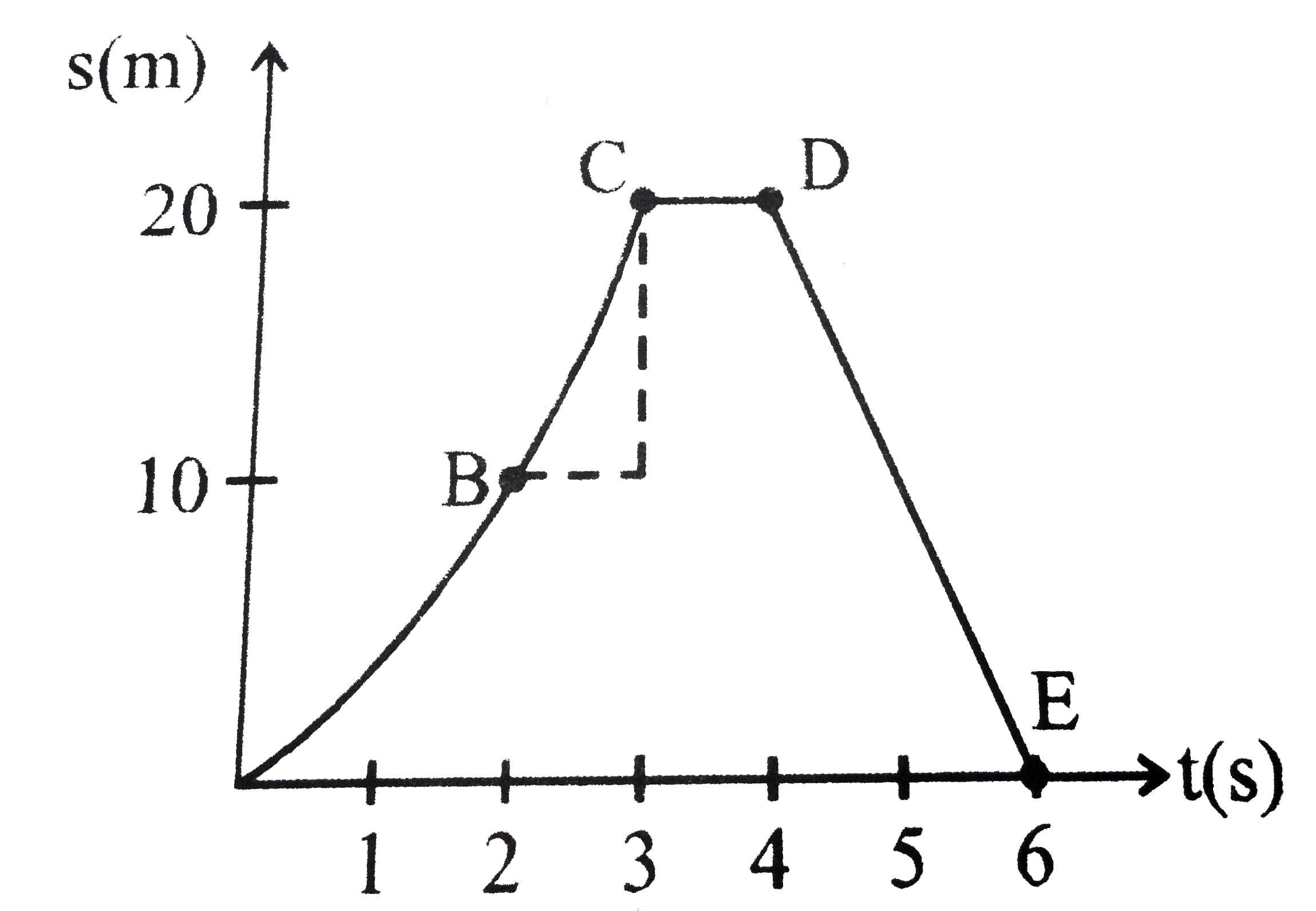
A football player catches a ball at his goal line `(x =0)` at `t = 0`, and his motion is then graphed on the displacement `vs`. Time graph below.

(A) During which interval is the player accelerating away from his goal line?
(B) What is his velocity between points `B` and `C`?
(C ) describes his motion between points `C` and `D`.
(D) What is his velocity (magnitude and direction) during interval form `4s` to `6s`?

Promotional Banner

Similar Questions

Explore conceptually related problems

When a cricket player catches the ball he pulls his hand gradually in the direction of the ball 's motion given reason

The graph between displacement and time in a motion along straight line is depicted below. Which interval indicates that no force is acting on the particle?

A player throws a ball vertically upwards. What is the direction of acceleration during upward motion? What is the velocity at the highest point of its motion.

The graph between the displacement x and time t for a particle moving in a straight line is shown in figure. During the interval OA, AB, BC and CD, the acceleration of the particles is

Boojho goes to the football ground to play football. The distance- time graph of his journey from his home to the ground is given as (a) What does the graph between point B and C indicate about the motion of Boojho? (b) Is the motion between 0 to 4 minutes uniform or non- uniform? (c) What is his speed between 8 and 12 minutes of his journey?

Explain why a player lowers his hands while catching a cricket ball.

What can you say about the motion of a body if : (a) its displacement-time graph is a straight line ? (b) its velocity-time graph is a straight line ?

A young boy can adjust the power of his eye lens between 50 D and 60 D. His far point is infinity. A. What is the distance of his retina from the eye-lens? b. What is the near point?