Home
Class 12
PHYSICS
A thin slice is cut out of a glass cylin...

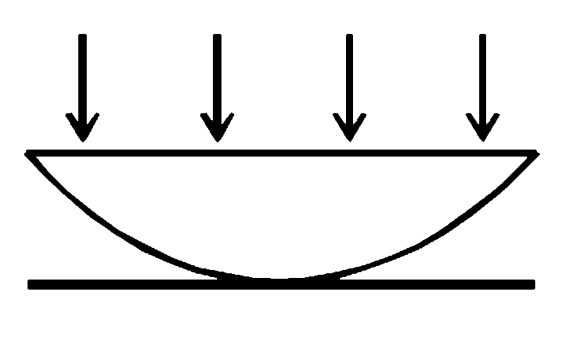
A thin slice is cut out of a glass cylinder along a plane parallel to its axis. The slice is placed on a flat glass plate as shown in Figure. The observed interference fringes from this combination shall be

A

Straight

B

Circular

C

Equally spaced

D

Having fringe spacing which increases as we go outwards

Text Solution

Verified by Experts

The correct Answer is:

A
Promotional Banner

Topper's Solved these Questions

  • WAVE OPTICS

    ERRORLESS |Exercise wave Nature and Interference of Light|1 Videos
  • WAVE OPTICS

    ERRORLESS |Exercise Doppler s Effect of Light|1 Videos
  • RAY OPTICS

    ERRORLESS |Exercise SET|25 Videos

Similar Questions

Explore conceptually related problems

A thin slice is cut out of a glass cylinder along a plane parallel to its axis. The slice is placed on a flat glass plate with the curved surface downwards. Monochromatic light is incident normally from the top. The observed interference fringes from the combination do not follow on of the following statements.

Assertion: A glass hemisphere is placed on a flat plate as shown. The observed interference fringes from this combination shall be circular. Reason: In all cases fringes are circular.

The length of a magnet is large compared to its width and breadth. The time period of its oscillation in a vibration magnetometer is T. The magnet is cut along its length into six parts and these parts are then placed togather as shown in the figure. The time period of this combination will be

A point sources S emitting light of wavelength 600nm is placed at a very small height h above the flat reflecting surface AB (see figure).The intensity of the reflected light is 36% of the intensity.interference firnges are observed on a screen placed parallel to the reflecting surface a very large distance D from it. (A)What is the shape of the interference fringes on the screen? (B)Calculate the ratio of the minimum to the maximum to the maximum intensities in the interference fringes fromed near the point P (shown in the figure) (c) if the intenstities at point P corresponds to a maximum,calculate the minimum distance through which the reflecting surface AB should be shifted so that the intensity at P again becomes maximum.

A convex lens is cut in half along its principal axis and the two halves are separated by a distance of 12cm. An object is placed 6cm in front of the lens as shown in Figure., Two sharp images are formed on the screen placed 80cm from the oject. What is the focal length of the lens?

The two surfaces of a biconvex lens has same radii of curvatures . This lens is made of glass of refractive index 1.5 and has a focal length of 10 cm in air. The lens is cut into two equal halves along a plane perpendicular to its principal axis to yield two plane - convex lenses. The two pieces are glued such that the convex surfaces touch each other. If this combination lens is immersed in water (refractive index = 4/3 ), its focal length (in cm ) is

The concave surface of a thin concavo -convex lens of glass of refractive index 1.5 has a radius of curvature of 20cm .The concave surface has a radius of curvature of 60cm .The covnex side is silvered and placed on a horizontal surface as shown in the figure. A small object is placed on the principal axis of the combination,at a distance of 30cm in front of the mirror.The magnification of the image is

A certain transmission line (very long) is constructed from two thin metal plates (parallel to each other) of width b, which are separated by a very small distance ‘h’ lt lt ‘b’ . The current travels down one strip and back along the other, and it is distributed uniformly over the surface of the plates as shown in figure. Neglect fringing field at ends of plates. Capacitance per unit length of this combination is

ERRORLESS -WAVE OPTICS-SET
  1. A thin slice is cut out of a glass cylinder along a plane parallel to ...

    Text Solution

    |

  2. Following figures shows sources S1 and S2 that emits light of waveleng...

    Text Solution

    |

  3. In a Young's double slit experimental arrangement shown here, if a mic...

    Text Solution

    |

  4. In the set up shown in figure, the two slits S1 and S2 are not equidis...

    Text Solution

    |

  5. The intensity ratio of two coherent sources of light is p. They are i...

    Text Solution

    |

  6. Three waves of equal frequency having amplitudes 10mum, 4mum, 7mum arr...

    Text Solution

    |

  7. Four different independent waves are represented by (i) y(1) = a(1) ...

    Text Solution

    |

  8. A beam of light consisting of two wavelength 650nm and 520nm is used t...

    Text Solution

    |

  9. Two identical radiators have a separation of d=lambda//4 where lambda ...

    Text Solution

    |

  10. In Young’s double slit experiment, the 8 th maximum with wavelength la...

    Text Solution

    |

  11. Light of wavelength 500nm is used to form interference pattern in Youn...

    Text Solution

    |

  12. Two coherent sources of equal intensity produce maximum intensity of 1...

    Text Solution

    |

  13. The path difference between two interfering waves of equal intensities...

    Text Solution

    |

  14. In a Young's double slit experiment, I0 is the intensity at the centra...

    Text Solution

    |

  15. In a Fresnel’s diffraction arrangement, the screen is at a distance of...

    Text Solution

    |

  16. If n represents the order of a half period zone, the area of this zone...

    Text Solution

    |

  17. A screen is placed 50 cm from a single slit, which is illuminated with...

    Text Solution

    |

  18. In Young's double slit experiment, the fringes are displaced index 1.5...

    Text Solution

    |

  19. Two waves of equal amplitude and frequency interfere each other. The r...

    Text Solution

    |

  20. In Young's double-slit experiment , we get 60 fringes in the field of ...

    Text Solution

    |

  21. A parallel- plate capacitor with plate area A and separation between t...

    Text Solution

    |
