Home
Class 12
PHYSICS
In the set up shown in figure, the two s...

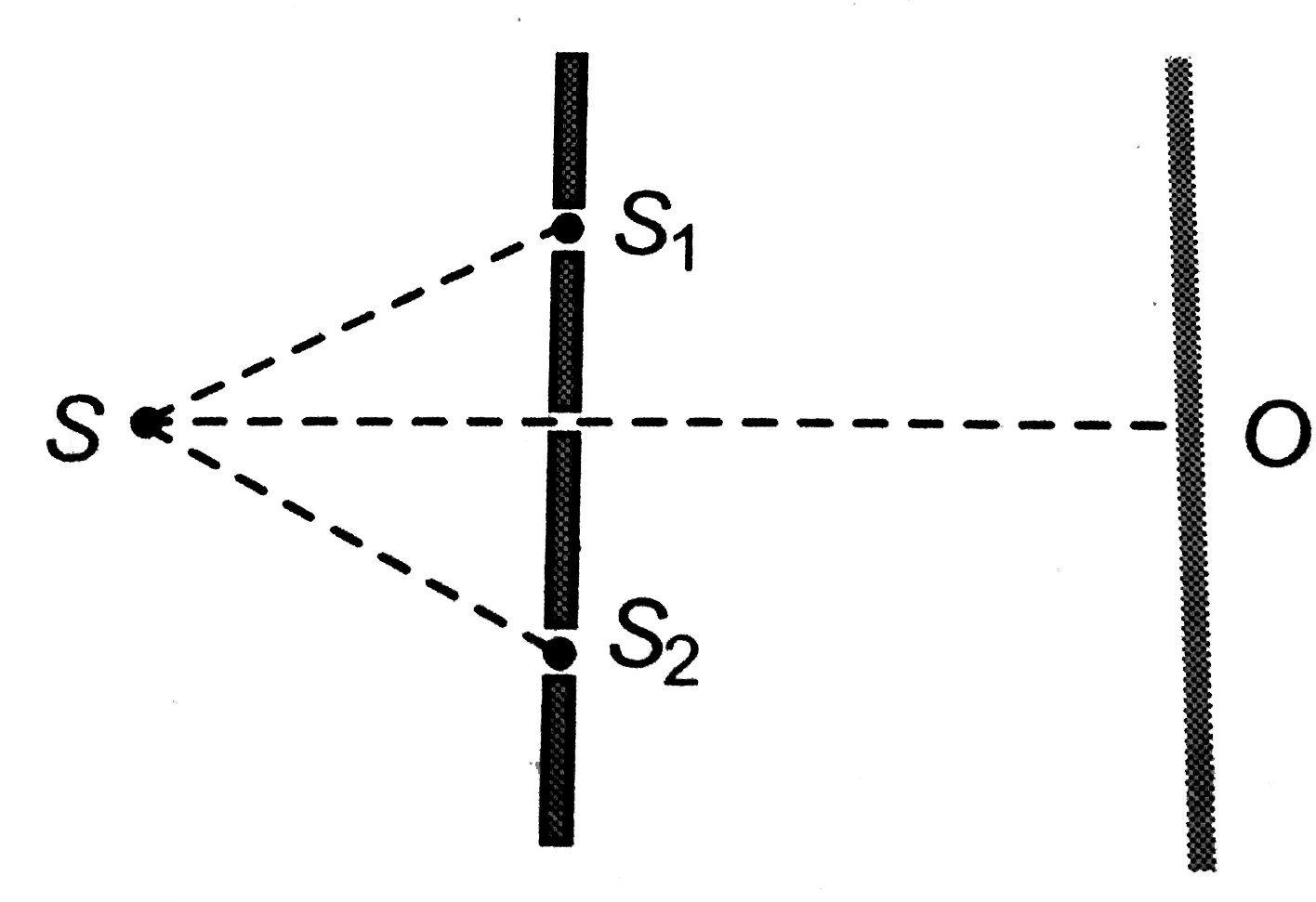
In the set up shown in figure, the two slits `S_1` and `S_2` are not equidistant from the slit S. The central fringe at O is then

A

Always bright

B

Always dark

C

Either dark or bright depending on the position of S

D

Neither dark nor bright.

Text Solution

Verified by Experts

The correct Answer is:

C
Promotional Banner

Topper's Solved these Questions

Similar Questions

Explore conceptually related problems

In an interference experiment, the two slits S_(1) and S_(2) are not equidistant from the source S. then the central fringe at 0 will be

Consider the situation shown in figure-6.35. The two slits S_(1) and S_(2) placed symmetrically around the central line are illuminated by a monochromatic light of wavelength lambda . The separation between the slits is d. The light transmitted by the slits falls on a screen E_(1) placed at a distance D from the slits. The slit S_(3) is at the central line and the slit S_(4) is at a distance z from S_(3) . Another screen E_(2) is placed a further distance D away from E_(1) . Find the ratio of the maximum to minimum intensity observed on E_(2) if z is equal is : (a) (lambdaD)/(2d) " "(b) (lambdaD)/(d)" " (c )(lambdaD)/(4d)

Consider the situation shown in fig. The two slits S_(1) and S_(2) placed symmetrically around the central line are illuminated by monochromatic light of wavelength lambda . The separation between the slit is d. The ligth transmitted by the slits falls on a screen S_(0) placed at a distance D form the slits. The slit S_(3) is at the central line and the slit S_(4) is at a distance z from S_(3) Another screen S_(c) is placed a further distance D away from S_(c) Find the ratio of the maximum to minimum intensity observed on S_(c) If z = (lambda D)/(2 d)

Consider the situation shown in fig. The two slits S_(1) and S_(2) placed symmetrically around the central line are illuminated by monochromatic light of wavelength lambda . The separation between the slit is d. The ligth transmitted by the slits falls on a screen S_(0) placed at a distance D form the slits. The slit S_(3) is at the central line and the slit S_(4) is at a distance z from S_(3) Another screen S_(c) is placed a further distance D away from S_(c) Find the ratio of the maximum to minimum intensity observed on S_(c) If z = (lambda D)/(4 d)

Consider the situation shown in fig. The two slits S_(1) and S_(2) placed symmetrically around the central line are illuminated by monochromatic light of wavelength lambda . The separation between the slit is d. The ligth transmitted by the slits falls on a screen S_(0) placed at a distance D form the slits. The slit S_(3) is at the central line and the slit S_(4) is at a distance z from S_(3) Another screen S_(c) is placed a further distance D away from S_(c) Find the ratio of the maximum to minimum intensity observed on S_(c) If z = (lambda D)/(d)

A monochromatic beam of light fall on YDSE apparatus at some angle (say theta ) as shown in figure. A thin sheet of glass is inserted in front of the lower slit s_(2) . The central bright fringe (path difference = 0 ) will be obtained

Assertion In the YDSE set up shown in figure a glass slab is inserted in front of the slit S_(1) as shown in figure Then zero order maxima (where path difference =0) will lie above point O. Reason Glass slab will produce an extra path difference in the path of the ray passing through S_(1)

In Young’s experiment, monochromatic light through a single slit S is used to illuminate the two slits S_1 and S_2 . Interference fringes are obtained on a screen. The fringe width is found to be w. Now a thin sheet of mica (thickness t and refractive index mu ) is placed near and in front of one of the two slits. Now the fringe width is found to be w’, then :

ERRORLESS -WAVE OPTICS-SET
  1. Following figures shows sources S1 and S2 that emits light of waveleng...

    Text Solution

    |

  2. In a Young's double slit experimental arrangement shown here, if a mic...

    Text Solution

    |

  3. In the set up shown in figure, the two slits S1 and S2 are not equidis...

    Text Solution

    |

  4. The intensity ratio of two coherent sources of light is p. They are i...

    Text Solution

    |

  5. Three waves of equal frequency having amplitudes 10mum, 4mum, 7mum arr...

    Text Solution

    |

  6. Four different independent waves are represented by (i) y(1) = a(1) ...

    Text Solution

    |

  7. A beam of light consisting of two wavelength 650nm and 520nm is used t...

    Text Solution

    |

  8. Two identical radiators have a separation of d=lambda//4 where lambda ...

    Text Solution

    |

  9. In Young’s double slit experiment, the 8 th maximum with wavelength la...

    Text Solution

    |

  10. Light of wavelength 500nm is used to form interference pattern in Youn...

    Text Solution

    |

  11. Two coherent sources of equal intensity produce maximum intensity of 1...

    Text Solution

    |

  12. The path difference between two interfering waves of equal intensities...

    Text Solution

    |

  13. In a Young's double slit experiment, I0 is the intensity at the centra...

    Text Solution

    |

  14. In a Fresnel’s diffraction arrangement, the screen is at a distance of...

    Text Solution

    |

  15. If n represents the order of a half period zone, the area of this zone...

    Text Solution

    |

  16. A screen is placed 50 cm from a single slit, which is illuminated with...

    Text Solution

    |

  17. In Young's double slit experiment, the fringes are displaced index 1.5...

    Text Solution

    |

  18. Two waves of equal amplitude and frequency interfere each other. The r...

    Text Solution

    |

  19. In Young's double-slit experiment , we get 60 fringes in the field of ...

    Text Solution

    |

  20. A parallel- plate capacitor with plate area A and separation between t...

    Text Solution

    |
