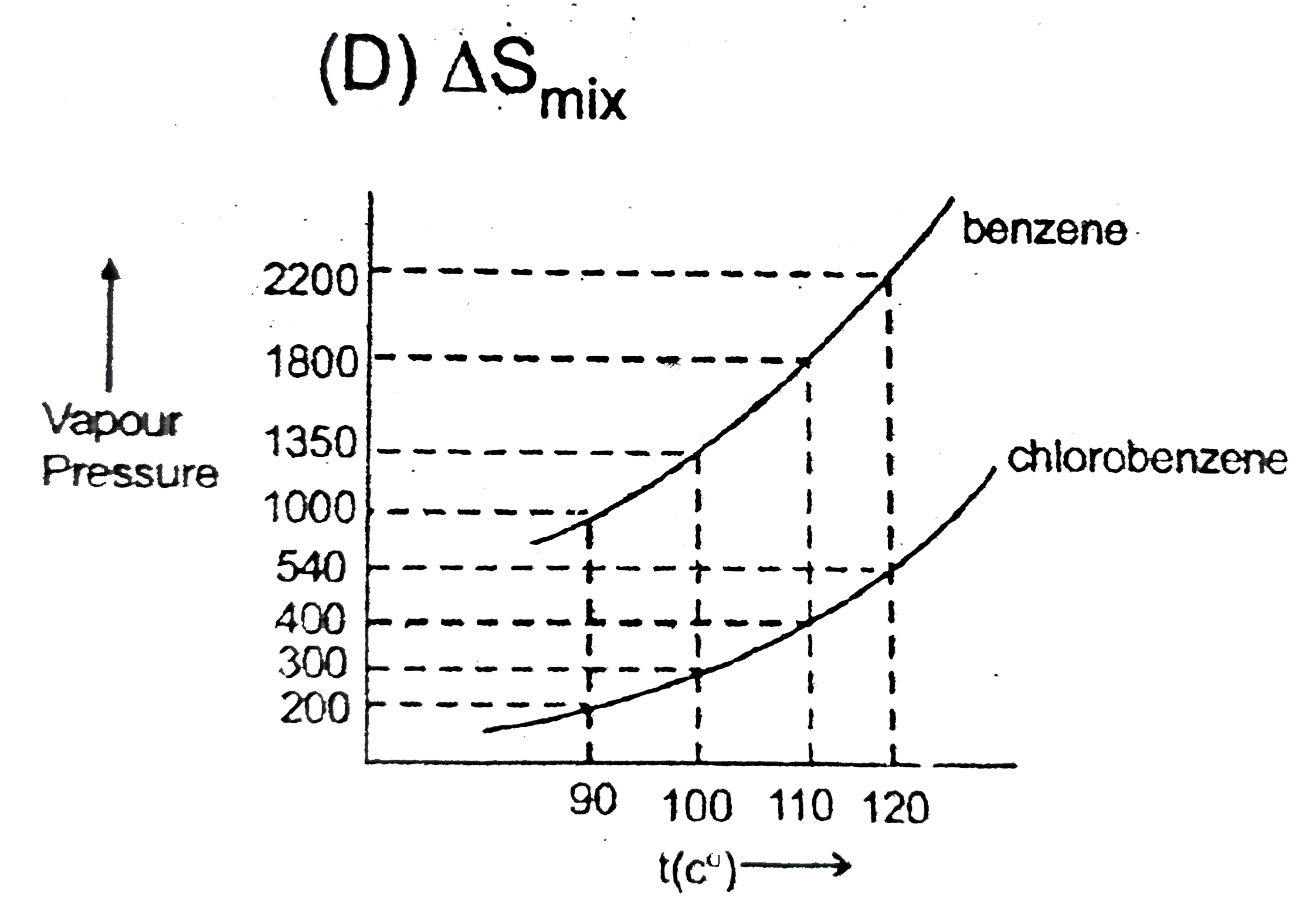
Assuming the formation of an ideal solution, determine the boiling point of `a` mixture containing `1560g` benzene (molar mass `=78`) and `1125g` chlorobenzene (molar mass `=112.5`) using the following against an external pressure of `1000` Torr.
A
`120^(@)C`
B
`110^(@)C`
C
`100^(@)C`
D
`90^(@)C`
Text Solution
Verified by Experts
The correct Answer is:
C
Topper's Solved these Questions
LIQUID SOLUTIONS
GRB PUBLICATION|Exercise 51|3 Videos
LIQUID SOLUTIONS
GRB PUBLICATION|Exercise 53|2 Videos
LIQUID SOLUTIONS
GRB PUBLICATION|Exercise 48|3 Videos
IONIC EQUILIBRIUM
GRB PUBLICATION|Exercise All Questions|526 Videos
METALLUGY
GRB PUBLICATION|Exercise Subjective type|1 Videos
Similar Questions
Explore conceptually related problems
The following is a table of the vapour pressure of pure benzene and chlorobenzene. Determine the boiling point of a mixture containing 40 mole percent of benzene and 60 mole percent of chlorobenzene at a pressure of 1000 mm Hg.
The molarity of solution containing 15.20 g of urea, (molar mass = 60) dissolved in 150 g of water is
Calculate the boiling point of solution containing 0.456g of camphor (molar mass =152 ) dissolved in 31.4g of acetone (boiling point =56.30^(@)C ), if the molar elevation constant per 100g of acetone is 17.2^(@)C.
The molality of solution containing 15.20 g of urea ( molar mass = 60 ) dissolved in 150 g of water is ______.
The boiling of a solution containing 1.5 g of dichlorobenzene in 100 g of benzene was higher by 0.268^(@)C . Calculate the molar mass of dichlorobenzene ( k_(b) for benzene 2.62 degree/molal)
Define boiling point. Write the formula to determine molar mass of a solute using freezing point depression method.