Home
Class 12
PHYSICS
A fish is a little away below the surfac...

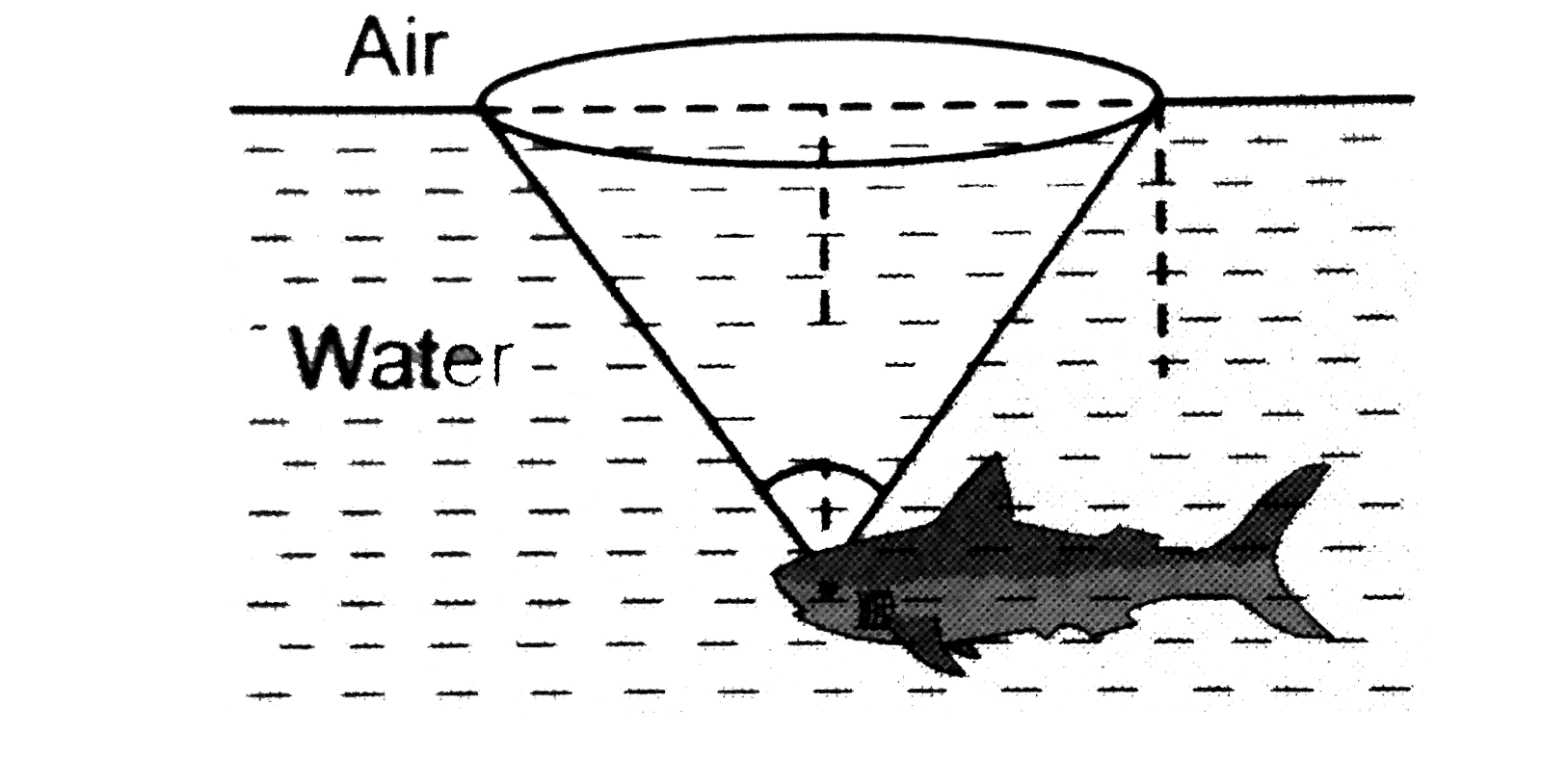
A fish is a little away below the surface of a lake. If the critical angle is `49^(@)` , then the fish could see things above the water surface withing an angular range of `theta^(@)` where

A

`theta=49^(@)`

B

`theta=90^(@)`

C

`theta=98^(@)`

D

`theta=24 1^(@)/2`

Text Solution

Verified by Experts

The correct Answer is:

C
Promotional Banner

Topper's Solved these Questions

  • RAY OPTICS

    ERRORLESS |Exercise Refraction of Light at Plane Surfaces|9 Videos
  • RAY OPTICS

    ERRORLESS |Exercise Refraction at Curved Surface|8 Videos
  • MAGNETISM

    ERRORLESS |Exercise Assertion & Reason|1 Videos
  • WAVE OPTICS

    ERRORLESS |Exercise SET|23 Videos

Similar Questions

Explore conceptually related problems

The length of a vertical pole at the surface of a lake of water (mu=4/3) is 24 cm. Then to an under-water fish just below the water surface the tip of the pole appeard to be

A small fish 0.4 m below the surface of a lake is viewed through a simple converging lens of focal length 3 m.the lens is kep at 0.2 m above the water surface such that the fish lies on the optical axis of the lens. Find the image of the fish seen by the observed. (mu_(water)=(4)/(3))

A man looks down on a fish of length 20 cm. His eye is 2m above the surface of the water (mu = 4//3) and the fish is 2m below the surface as shown in the figure the ratio of angular width Delta theta of the fish as seen by the man in presence of water to the Delta theta in the absence of water is (Delta theta is small)

A small fish 0.4m below the surface of a lake, is viewed through a simple converging lens of focal length 3m . The lens is kept at 0.2m above the water surface such that the fish lies on the optical axis of the lens. Find the distance of the image of the fish from the lens as seen by the observer. The refractive index of water is 4//3 .

The image of an object O due to reflection from the surface of a lake is elongated due to the ripples on the water surface caused by a light breeze. This is because the ripples act as tilted mirrors as shown. Consider the case where O and the observer E are at the same height above the surface of the lake. If the maximum angle that the ripples make with the horizontal is a, the angular extent delta of the image will be

Unpolarized red light is incident on the surface of a lake at incident angle theta_R . An observer seeing the light reflected from the water surface through a polarizer notices that on rotating the polarizer, the intensity of light drops to zero at a certain orientation. The red light is replaced by unpolarized blue light. The observer sees the same effect with reflected blue light at incident angle theta_B . Then

A point source of light is placed at a distance h below the surface of a large deep lake. (a) Show that the fraction f of the light energy that escapes directly from the water surface is independent of h and is given by f=(1)/(2)-(1)/(2n)sqrt(n^(2)-1) where n is the index of refraction of water. (Note: Absorption within the water and reflection at the surface, except where it is total, have been neglected) (b) Evaluate this ratio for n=4//3 .

A small fish, 0.4m below the surface of a lake, is viewed through a simple converging lens of focal length 3m. The lens in kept at 0.2m above the water surface such that the fish lies on the optical axis of the lens. Find the image of the fish seen by the observer. The refractive index of water is 4//3 .

A bird is flying 3m above the surface of water. To a fish underwater, the height of the bird from the water surface appears to be

ERRORLESS -RAY OPTICS-SET
  1. A fish is a little away below the surface of a lake. If the critical a...

    Text Solution

    |

  2. In an astronomical telescope in normal adjustment a straight black lin...

    Text Solution

    |

  3. Three lenses L(1) , L(2) , L(3) are placed co-axially as shown in figu...

    Text Solution

    |

  4. An object is placed at a point distant x from the focus of a convex le...

    Text Solution

    |

  5. The diameter of the eye-ball of a normal eye is about 2.5 cm . The pow...

    Text Solution

    |

  6. In a thin spherical fish bowl of radius 10 cm filled with water of ref...

    Text Solution

    |

  7. A small fish 0.4 m below the surface of a lake is viewed through a sim...

    Text Solution

    |

  8. A water drop in air refractes the light ray as

    Text Solution

    |

  9. Which of the following ray diagram show physically possible refraction...

    Text Solution

    |

  10. Following figure shows the multiple reflections of a light ray along a...

    Text Solution

    |

  11. When the rectangular metal tank is filled to the top with an unknown l...

    Text Solution

    |

  12. A concave mirror and a converging lens (glass with mu = 1.5) both have...

    Text Solution

    |

  13. A ray of light strikes a plane mirror M at an angle of 45^(@) as shown...

    Text Solution

    |

  14. A slab of glass, of thickness 6 cm and refractive index 1.5, is placed...

    Text Solution

    |

  15. A point source of light S is placed at the bottom of a vessel containi...

    Text Solution

    |

  16. A point object is placed midway between two plane mirrors a distance a...

    Text Solution

    |

  17. A convergent beam of light is incident on a convex mirror so as to con...

    Text Solution

    |

  18. PQR is a right angled prism with other angles as 60^(@) and 30^(@). Re...

    Text Solution

    |

  19. When a ray is refracted from one medium to another, the wavelength cha...

    Text Solution

    |

  20. Two this lenses, when in contact, produce a combination of power +10 d...

    Text Solution

    |

  21. The plane faces of two identical plano convex lenses, each with focal ...

    Text Solution

    |
