Home
Class 12
PHYSICS
A negative charge of 20 units is placed ...

A negative charge of 20 units is placed at a distance 50 cm away from a positive charge of 80 unit. Where will the electric field be zero on the line joining the two charges?

Text Solution

Verified by Experts
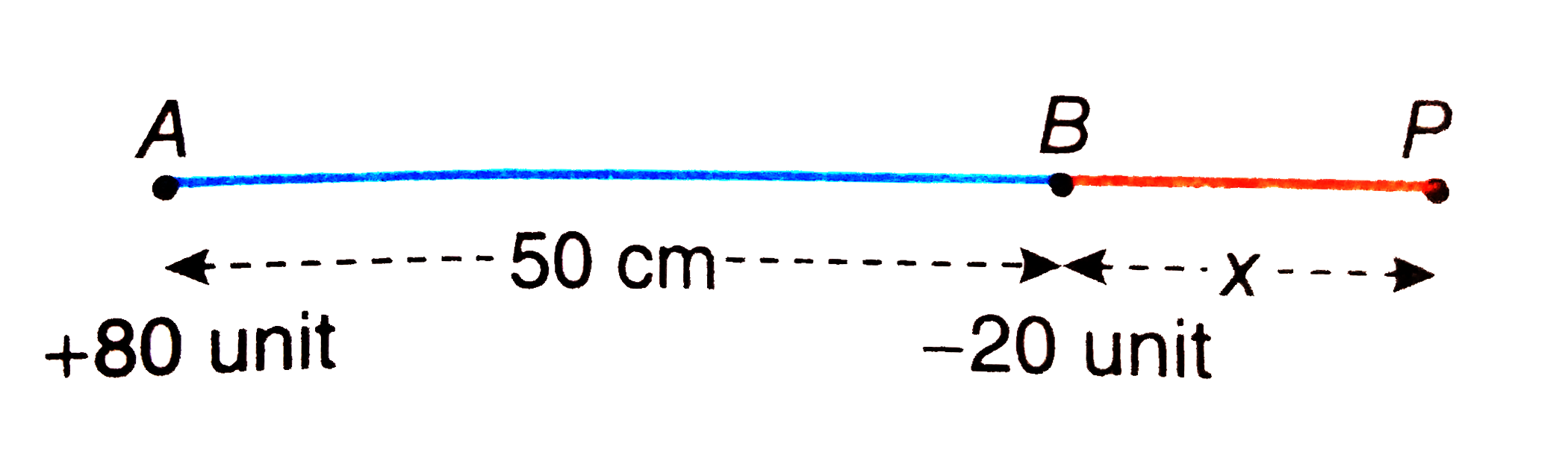
Suppose, +80 unit and -20 unit of charges are place at A and B respectively [Fig 2.24]. The point where the electric field will be zero cannot lie in between A and B, because in that case intensity could be along the same direction, i.e., along `vec(AB)` for both the charges.
As the charge at A is greater, the point where the resultant intensity is zero will be situated on the right side of B, say at P. ltbr gt
Suppose, BP = x
Electric field at P due to the charge at B `=20/(x^(2)),` along `vec(PB)`
Electric field at P due to the charge at A =`80/((50+x)^(2)),` along `vec(AP)`
Since, the resultant intensity at P = 0
`therefore20/(x^(2))=80((50+x)^(2))` or, `x=50,-50/3`
Now, `xne-50/3` cm, because the point in that case would be situated in between A and B.
So, x = 50 cm, the polnt where the field is zero at a distance of 50 cm from the -20 unit charge on its right side.
Promotional Banner

Topper's Solved these Questions

  • ELECTRIC FIELD

    CHHAYA PUBLICATION|Exercise SECTION RELATION QUESTIONS|50 Videos
  • ELECTRIC FIELD

    CHHAYA PUBLICATION|Exercise HIGHER ORDER THINKING SKILL QUESTIONS|33 Videos
  • ELECTRIC ENERGY AND POWER

    CHHAYA PUBLICATION|Exercise CBSE SCANNER|7 Videos
  • ELECTRIC POTENTIAL

    CHHAYA PUBLICATION|Exercise CBSE Scanner|13 Videos

Similar Questions

Explore conceptually related problems

A negative charge of 30 esu is at a distance of 30 cm from a positive charge of 20 esu. What is the potential at a point 10 cm from the first charge on the line joining the two charges? Where will the potential be zero?

Two charges +q and -q are placed at a distance d form each other . At which points the direction of the resultant electric field is parallel to the line joining the two charges ?

Determine the electric field at a distance r from a point charge.

Two charges, + q and -q are separated by a distance d. At which points will the resultant electric field intensity be directed parallel to the line joining the charges ?

Two point charges q_A=3muC and q_B=-3muC are located 20 cm apart in vacuum. What is the electric field at the midpoint of the line AB joining the two charges ?

The electric potential at a certain distance from a point charge is 600V and the electric field is 200 N//C . The distance of the point charge (in metres) is:

Two point charges of +49 esu and +81 esu are placed at a separation of 100 cm in air. Determine the position of the neutral point in the electric fields of the two charges. What is the electric potential at the natural point?

Two point charges e_(1) and e_(2) are placed at a distance d from each other. In between them there is no point where electric field is zero. From this what conclusion can you draw ?

CHHAYA PUBLICATION-ELECTRIC FIELD-CBSE SCANNER
  1. A negative charge of 20 units is placed at a distance 50 cm away from ...

    Text Solution

    |

  2. A charge q is placed at the centre of a cube of side l. What is the el...

    Text Solution

    |

  3. An electric dipole is held in a uniform electric field. Show that th...

    Text Solution

    |

  4. An electric dipole is held in a uniform electric field. The dipole i...

    Text Solution

    |

  5. A charge q is placed at the centre of a cube. What is the electric flu...

    Text Solution

    |

  6. A charge q is placed at the centre of a cube. What is the electric flu...

    Text Solution

    |

  7. Define electric dipole moment. Is it a scalar or a vector? Derive the ...

    Text Solution

    |

  8. Two charges of magnitudes -2Q and +Q are located at points (a, 0) and ...

    Text Solution

    |

  9. Using Gauss' law deduce the expression for the electric field due to a...

    Text Solution

    |

  10. Using Gauss' law deduce the expression for the electric field due to a...

    Text Solution

    |

  11. Why do the electrostatic field lines not form closed loops?

    Text Solution

    |

  12. Deduce the expression for the torque acting on a dipole of dipole mome...

    Text Solution

    |

  13. Consider two hollow concentric spheres S(1) and S(2) enclosing charges...

    Text Solution

    |

  14. Consider two hollow concentric spheres S(1) and S(2) enclosing charges...

    Text Solution

    |

  15. A point charge +Q is placed in the vicinity of a conducting surface. T...

    Text Solution

    |

  16. Define electric electric flux. Write its SI unit.

    Text Solution

    |

  17. Using Gauss' law, obtain the electric flux due to a point charge q enc...

    Text Solution

    |

  18. Show that the electric field due to a uniformly charged infinite plane...

    Text Solution

    |

  19. What is the amount of work done in moving a point charge Q around a ci...

    Text Solution

    |

  20. Find the electric field intensity due to a uniformly charged spherical...

    Text Solution

    |

  21. Find the electric field intensity due to a uniformly charged spherical...

    Text Solution

    |

