Home
Class 12
PHYSICS
An electron of charge 1.6xx10^(-19)C and...

An electron of charge `1.6xx10^(-19)C` and mass `9.1xx10^(-31)` kg, travelling along the X-axis with a uniform velocity of `10^(6)m.s^(-1)`, enters in a uniform electric field of `10^(3)V.m^(-1)` acting perpendicular to the X-axis. If the electric field extends over a length of 2 cm along the X-axis, what will be the deflection of the electron along the direction of the field when it emerges from it?

Text Solution

Verified by Experts
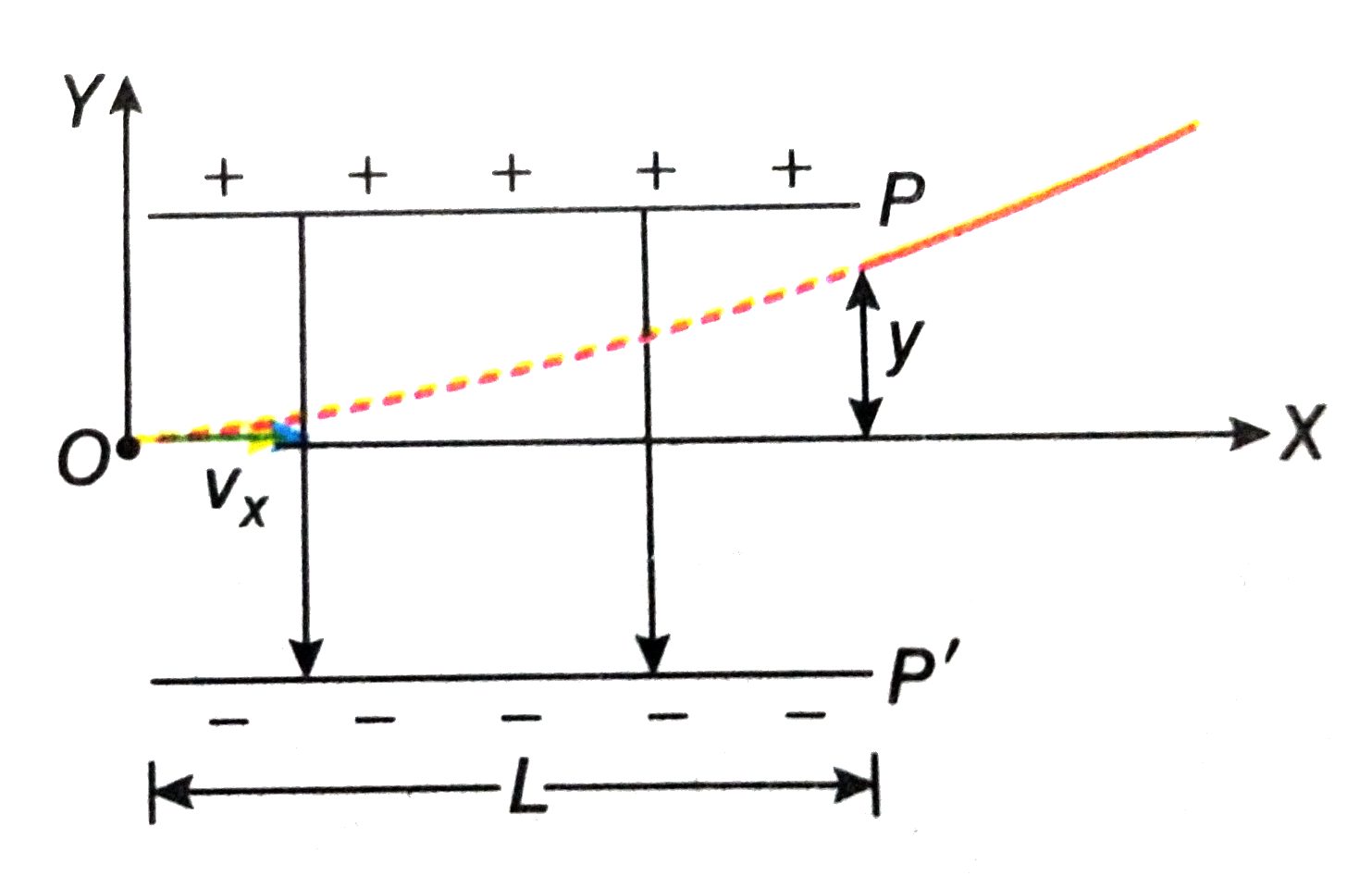
Here, electric field `E=10^(3)` V/m is directed along Y-axis and effective upto a length L = 2 cm along X -axis [Fig. 2.31].
An electron is projected from O with an initial speed of `v_(x)=10^(6)` m/s along + X-axis. Charge of the electron, `e=1.6xx10^(-19)`C and mass of the electron, `m=9.1xx10^(-31)kg`.

If we consider the motion of the electron along Y-axis, the force on the electron due to the electric field, `f_(y)=eE`
`therefore` Acceleration of the electron along Y-axis,`a_(y)=(eE)/m`
Let the deflection of the electron when it is emitted from the electric field be y and the time taken to cover that vertical distance be t.
`thereforey=1/2cdota_(y)t^(2)`
or, `y=1/2cdot(eE)/mt^(2)` ...(1)
Along X-axis, force on the electron, `F_(x)=0`
`therefore` Acceleration, `a_(x)=0`
`therefore` Velocity, `v_(x)=10^(6)m//s` (constant)
Now distance covered along X-axis in time t is L =`v_(x)t`
`thereforet=l/(v_(x))` ..(2)
From equation (1) and (2),
`y=1/2cdot(eE)/mcdot(L^(2))/(v_(x)^(2))`
`=1/2xx(1.6xx10^(-19)xx10^(3)xx(.02)^(2))/(9.1xx10^(-31)xx(10^(6))^(2))=0.0351` m
`=3.51` cm
Thus, required deflection is 3.51 cm.
Promotional Banner

Topper's Solved these Questions

  • ELECTRIC FIELD

    CHHAYA PUBLICATION|Exercise SECTION RELATION QUESTIONS|50 Videos
  • ELECTRIC FIELD

    CHHAYA PUBLICATION|Exercise HIGHER ORDER THINKING SKILL QUESTIONS|33 Videos
  • ELECTRIC ENERGY AND POWER

    CHHAYA PUBLICATION|Exercise CBSE SCANNER|7 Videos
  • ELECTRIC POTENTIAL

    CHHAYA PUBLICATION|Exercise CBSE Scanner|13 Videos

Similar Questions

Explore conceptually related problems

An electron moving with a veloctiy of 10^(7)m.s^(-1) enters a uniform magnetic field of 1 T along a direction parallel to the field. What would be its trajectory?

An electron (charge =-1.6xx10^(-19)C , mass =9.1xx10^(-31)kg ) enters a magnetic field of strength 0.001 T with a velocity of 10^(5)m.s^(-1) at an angle 60^(@) with the direction of the field. What will be the time period and pitch of the electron in that magnetic field?

An electron is moving along X axis and a magnetic field is directed along Y axis. What will he the direction of magnetic force acting on the electron?

An electron (charge =-1.6xx10^(-19)C , mass =9.1xx10^(-31)kg ) enters a uniform electric field of magnitude 10V.m^(-1) with velocity 10^(6)m.s^(-1) normally to the direction of the field. If it covers 10 cm path inside that electric field, determine the displacement of the electron normal to the direction of its initial velocity.

An electron is moving along +ve x-axis in the presence of uniform magnetic field along +Y axis. What is the direction of the force acting on it?

A particle with charge e and mass m, moving along the X-axis with a uniform speed u enters a region where a uniform electric field E is acting along the Y-axis. The particle starts to move in a parabola. Its focal length (neglecting any effect of gravity) is

An electric field of intensity "200 N.C"^(-1) is acting along x - axis. What will be the electric flux passing through a square area in yz - plane of side 20 cm?

In a region, a uniform electric field of 100V.m^(-1) is acting along x-axis and a uniform magnetic field of 10^(-4)T along y-axis. If an electron enters that region along z-axis with a velocity of 10^(5)m.s^(-1) , determine the magnitude and direction of the force acting on it. Charge of an electron =1.6xx10^(-19)C .

A proton is moving with a uniform velocity of 10^(6)m.s^(-1) along the Y-axis, under the joint action of a magnetic field along Z-axis and an electric field of magnitude 2xx10^(4)V.m^(-1) along the negative X-axis. If the electric field is switched off, the proton starts moving in a circle. The radius of the circle is nearly (given: (e)/(m) ratio for proton ~~10^(8)C.kg^(-1) )

An electron (mass =9xx10^(-31)kg , charge= 1.6xx10^(-19)C) enters a magnetic field with velocity 10^(6)m*s^(-1) and starts rotating in a circular path of radius 10 cm. What is the magnetic field ?

CHHAYA PUBLICATION-ELECTRIC FIELD-CBSE SCANNER
  1. An electron of charge 1.6xx10^(-19)C and mass 9.1xx10^(-31) kg, travel...

    Text Solution

    |

  2. A charge q is placed at the centre of a cube of side l. What is the el...

    Text Solution

    |

  3. An electric dipole is held in a uniform electric field. Show that th...

    Text Solution

    |

  4. An electric dipole is held in a uniform electric field. The dipole i...

    Text Solution

    |

  5. A charge q is placed at the centre of a cube. What is the electric flu...

    Text Solution

    |

  6. A charge q is placed at the centre of a cube. What is the electric flu...

    Text Solution

    |

  7. Define electric dipole moment. Is it a scalar or a vector? Derive the ...

    Text Solution

    |

  8. Two charges of magnitudes -2Q and +Q are located at points (a, 0) and ...

    Text Solution

    |

  9. Using Gauss' law deduce the expression for the electric field due to a...

    Text Solution

    |

  10. Using Gauss' law deduce the expression for the electric field due to a...

    Text Solution

    |

  11. Why do the electrostatic field lines not form closed loops?

    Text Solution

    |

  12. Deduce the expression for the torque acting on a dipole of dipole mome...

    Text Solution

    |

  13. Consider two hollow concentric spheres S(1) and S(2) enclosing charges...

    Text Solution

    |

  14. Consider two hollow concentric spheres S(1) and S(2) enclosing charges...

    Text Solution

    |

  15. A point charge +Q is placed in the vicinity of a conducting surface. T...

    Text Solution

    |

  16. Define electric electric flux. Write its SI unit.

    Text Solution

    |

  17. Using Gauss' law, obtain the electric flux due to a point charge q enc...

    Text Solution

    |

  18. Show that the electric field due to a uniformly charged infinite plane...

    Text Solution

    |

  19. What is the amount of work done in moving a point charge Q around a ci...

    Text Solution

    |

  20. Find the electric field intensity due to a uniformly charged spherical...

    Text Solution

    |

  21. Find the electric field intensity due to a uniformly charged spherical...

    Text Solution

    |

