Home
Class 12
PHYSICS
Two negative charges each of 1 unit and ...

Two negative charges each of 1 unit and a positive charge q are placed along a straight line. Find the magnitude and position of q for which all the chargews will remain at equilibrium? Is the equilibrium stable, unstable or neutral in this case?

Text Solution

Verified by Experts
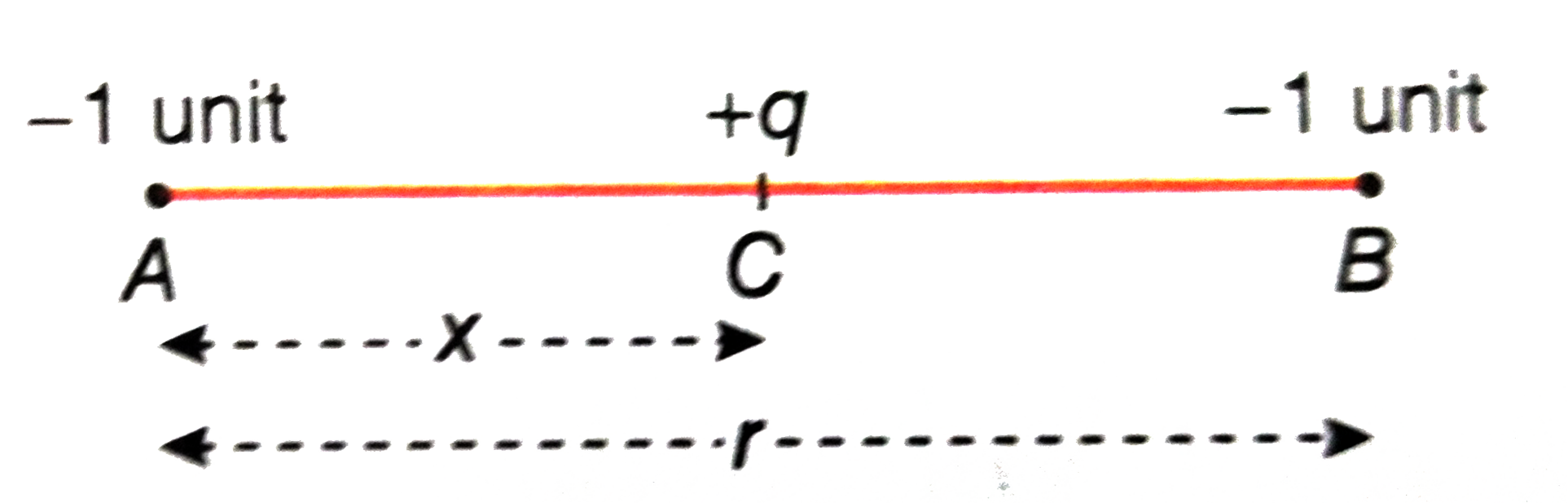
The positive charge q has to be placed somewhere between the negative charges so that the attractive forces due to the negative charges may balance each other.
Let the negative charges be placed at A and B and the charge +q be placed at C [Flg, 2.35]

Let AB =r, AC=x
The attractive force on +q due to the negative charge at `A =q/(x^(2))`.
The attractive force on +q due to the negative charge at
`B=q/((r-x)^(2))`
The charge q is at equilibrium, thus
`q/(r^(2))=q/((r-x)^(2))` or, `x=r/2`
Evidently the negative charges at A and B tend to move away from each other due to repulsion but are held at those points by the attractive forces of q.
At equilibrium, the attractive force between q and any negative = the repulsive force between two negative charges.
`therefore(qxx1)/((r)^(2))=(1xx1)/(r^(2))`
or, `q=1/4=0.25` units
This is an unstable equilbrium, because a slight change in the position of any of the charges disturbs the equilibrium.
Promotional Banner

Topper's Solved these Questions

  • ELECTRIC FIELD

    CHHAYA PUBLICATION|Exercise SECTION RELATION QUESTIONS|50 Videos
  • ELECTRIC FIELD

    CHHAYA PUBLICATION|Exercise HIGHER ORDER THINKING SKILL QUESTIONS|33 Videos
  • ELECTRIC ENERGY AND POWER

    CHHAYA PUBLICATION|Exercise CBSE SCANNER|7 Videos
  • ELECTRIC POTENTIAL

    CHHAYA PUBLICATION|Exercise CBSE Scanner|13 Videos

Similar Questions

Explore conceptually related problems

Two negative charges each of 1 unit and a positive charge q are placed on a straight line. Where should the charge q be placed and what should be its value for equilibrium of the charges? Is this equilibrium stable, unstable or neutral ?

Two negative point charges each of magnitude 8xx10^(-8)C and another positive charge Q are placed on the same straight line. At what position and for what value of Q, the system will remain in equilibrium?

Two negative point charges each of magnitude 2 esu and another point charge q are lying on a straight line. Each of the charges are in equilibrium. Determine the position, value and the nature of the charge q.

Four charges each of -Q , are placed at the four corners of a square. Find out the value of a charge q placed at the centre of the square, such that all the charges would be at equilibrium.

Two charges of equal amount +Q are placed on a line. Another charge q is placed at the mid-point of the line. The system will be in equilibrium if the value of q is

Two charges of equal amount +Q are placed on a line. Another charge q is placed at the mid-point of the line. The system will be in equilibrium if the value of q is

Two point charges each of magnitude +q are placed at a distance r from each other. Draw the lines of force in this case.

Three point charges q , 2q and 8q are to be placed on a 0.09m long straight line. Find the positions of the charges so that the potential energy of this system becomes minimum. In this situation, find the intensity at the position of the charge q due to the other two charges?

Two heavy spheres each of mass 100 kg and radius 0.10 m are placed 1.0 m apart on a horizontal table. What is the gravitational force and potential at the mid-point of the line joining the centres of the spheres ? Is an object placed at that point in equilibrium ? if so, is the equilibrium stable or unstable ?

CHHAYA PUBLICATION-ELECTRIC FIELD-CBSE SCANNER
  1. Two negative charges each of 1 unit and a positive charge q are placed...

    Text Solution

    |

  2. A charge q is placed at the centre of a cube of side l. What is the el...

    Text Solution

    |

  3. An electric dipole is held in a uniform electric field. Show that th...

    Text Solution

    |

  4. An electric dipole is held in a uniform electric field. The dipole i...

    Text Solution

    |

  5. A charge q is placed at the centre of a cube. What is the electric flu...

    Text Solution

    |

  6. A charge q is placed at the centre of a cube. What is the electric flu...

    Text Solution

    |

  7. Define electric dipole moment. Is it a scalar or a vector? Derive the ...

    Text Solution

    |

  8. Two charges of magnitudes -2Q and +Q are located at points (a, 0) and ...

    Text Solution

    |

  9. Using Gauss' law deduce the expression for the electric field due to a...

    Text Solution

    |

  10. Using Gauss' law deduce the expression for the electric field due to a...

    Text Solution

    |

  11. Why do the electrostatic field lines not form closed loops?

    Text Solution

    |

  12. Deduce the expression for the torque acting on a dipole of dipole mome...

    Text Solution

    |

  13. Consider two hollow concentric spheres S(1) and S(2) enclosing charges...

    Text Solution

    |

  14. Consider two hollow concentric spheres S(1) and S(2) enclosing charges...

    Text Solution

    |

  15. A point charge +Q is placed in the vicinity of a conducting surface. T...

    Text Solution

    |

  16. Define electric electric flux. Write its SI unit.

    Text Solution

    |

  17. Using Gauss' law, obtain the electric flux due to a point charge q enc...

    Text Solution

    |

  18. Show that the electric field due to a uniformly charged infinite plane...

    Text Solution

    |

  19. What is the amount of work done in moving a point charge Q around a ci...

    Text Solution

    |

  20. Find the electric field intensity due to a uniformly charged spherical...

    Text Solution

    |

  21. Find the electric field intensity due to a uniformly charged spherical...

    Text Solution

    |

