Home
Class 12
PHYSICS
Two identical balls each of mass m are h...

Two identical balls each of mass m are hung from a point by two silk threads of length l. Each of them has charge q. If the angle between the two threads are negativebly small, show that equillirium distance between the centres of the balls will be ,x`=((2q^(2)l)/(mg))^(1//3)`

Text Solution

Verified by Experts
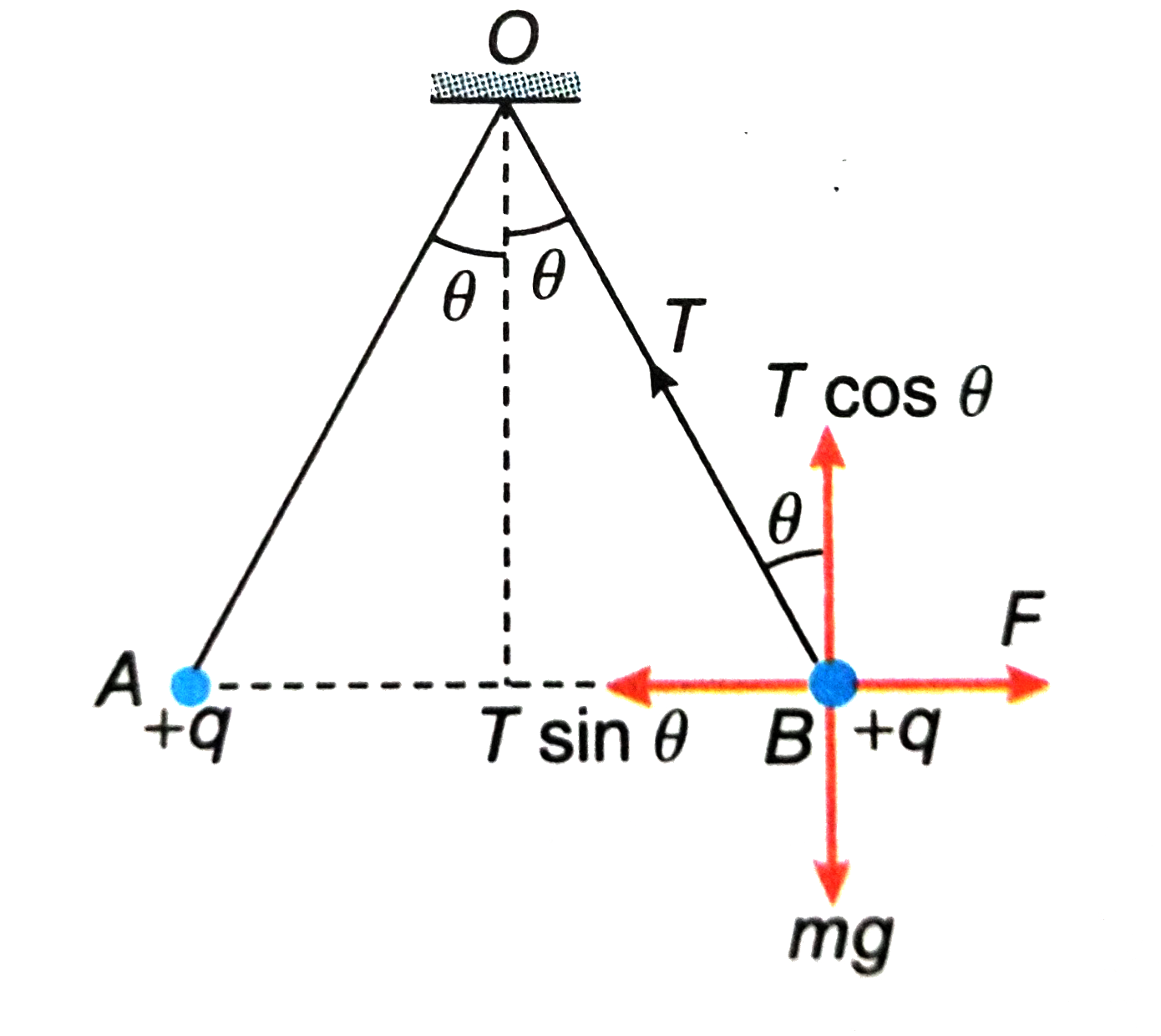
Let at equilibrium, the two balls will be at A and B [Fig. 2.36] OA = OB = l and AB = x.
Also, let the angle made by each thread with the vertical be `theta`.
Three forces act on each ball at equilibrium (i) weight of the ball mg, (ii) tension on threadT and (iii) repulsive force F acting between the balls.

Here, `Tsintheta=F=(q(2))/(x^(2)),Tcostheta=mg`
`thereforetantheta=(q^(2))/(mgx^(2))` or, `sintheta=(q^(2))/(mgx^(2))`
`[because` is small, `tantheta=sintheta]`
or, `x/(2l)=(q^(2))/(mgx^(2))`
`thereforex=((2q^(2)l)/(mg))^(1//3)`
Promotional Banner

Topper's Solved these Questions

  • ELECTRIC FIELD

    CHHAYA PUBLICATION|Exercise SECTION RELATION QUESTIONS|50 Videos
  • ELECTRIC FIELD

    CHHAYA PUBLICATION|Exercise HIGHER ORDER THINKING SKILL QUESTIONS|33 Videos
  • ELECTRIC ENERGY AND POWER

    CHHAYA PUBLICATION|Exercise CBSE SCANNER|7 Videos
  • ELECTRIC POTENTIAL

    CHHAYA PUBLICATION|Exercise CBSE Scanner|13 Videos

Similar Questions

Explore conceptually related problems

Two similar balls are suspended from a point by two silk thread, each of length l. Each ball of mass m contains q amount of charge. If the angle between the two threads is very small, show that the distance between the centres of the two balls at equilibrium is x=((2q^(2)l)/(mg))^(1//3)

Two identical spheres, each of mass m, are suspended from a point by threads. Each sphere carries a charge q. If the angle between the threads is very small, prove that in equilibrium, the distance between the centres of the two spheres is, x=((q^(2)l)/(2pi epsilon_(0)mg))^((1)/(3))

Two spheres, each having mass m are suspended from a common point by two insulating strings of length l. The spheres are identically charged and the separation between the spheres is 'd' . Find the charge on each sphere.

The lengths of radii of two circels are 3.5 cm and 2 cm. They touch each other internally. The distance between the centres of the circels is

Length of radii of two circles are 3.5cm and 2cm. Two circles touch internally. Distance between two centres of the circles is

Two point charges q_1 and q_2 are such that q_1q_2 lt 0 . What is the nature of the force acting between the two charges?

Two large conducting spheres carrying charges Q_1 and Q_2 are brought close to each other. Is the magnitude of the force between them exactly given by (Q_1Q_2) /(4 pi epsilon_0r^2) where r is the distance between their centres ?

Two thin wire rings each having a radius R are placed at a distance d apart with their axes coinciding. The charges on the two rings are +q and -q . The potential difference between the centres of the two rings is

CHHAYA PUBLICATION-ELECTRIC FIELD-CBSE SCANNER
  1. Two identical balls each of mass m are hung from a point by two silk t...

    Text Solution

    |

  2. A charge q is placed at the centre of a cube of side l. What is the el...

    Text Solution

    |

  3. An electric dipole is held in a uniform electric field. Show that th...

    Text Solution

    |

  4. An electric dipole is held in a uniform electric field. The dipole i...

    Text Solution

    |

  5. A charge q is placed at the centre of a cube. What is the electric flu...

    Text Solution

    |

  6. A charge q is placed at the centre of a cube. What is the electric flu...

    Text Solution

    |

  7. Define electric dipole moment. Is it a scalar or a vector? Derive the ...

    Text Solution

    |

  8. Two charges of magnitudes -2Q and +Q are located at points (a, 0) and ...

    Text Solution

    |

  9. Using Gauss' law deduce the expression for the electric field due to a...

    Text Solution

    |

  10. Using Gauss' law deduce the expression for the electric field due to a...

    Text Solution

    |

  11. Why do the electrostatic field lines not form closed loops?

    Text Solution

    |

  12. Deduce the expression for the torque acting on a dipole of dipole mome...

    Text Solution

    |

  13. Consider two hollow concentric spheres S(1) and S(2) enclosing charges...

    Text Solution

    |

  14. Consider two hollow concentric spheres S(1) and S(2) enclosing charges...

    Text Solution

    |

  15. A point charge +Q is placed in the vicinity of a conducting surface. T...

    Text Solution

    |

  16. Define electric electric flux. Write its SI unit.

    Text Solution

    |

  17. Using Gauss' law, obtain the electric flux due to a point charge q enc...

    Text Solution

    |

  18. Show that the electric field due to a uniformly charged infinite plane...

    Text Solution

    |

  19. What is the amount of work done in moving a point charge Q around a ci...

    Text Solution

    |

  20. Find the electric field intensity due to a uniformly charged spherical...

    Text Solution

    |

  21. Find the electric field intensity due to a uniformly charged spherical...

    Text Solution

    |

