Home
Class 12
PHYSICS
The classical concept of atomic stru...

The classical concept of atomic structure is that negative charges are uniformly distributed inside a sphere of radius R keeping the nucleus of positive charge Ze at the centre of that sphere. An atom as a whole is electrically neutral. find out the electric field at a distance r from the nucleus, according do this atomic model.

Text Solution

Verified by Experts
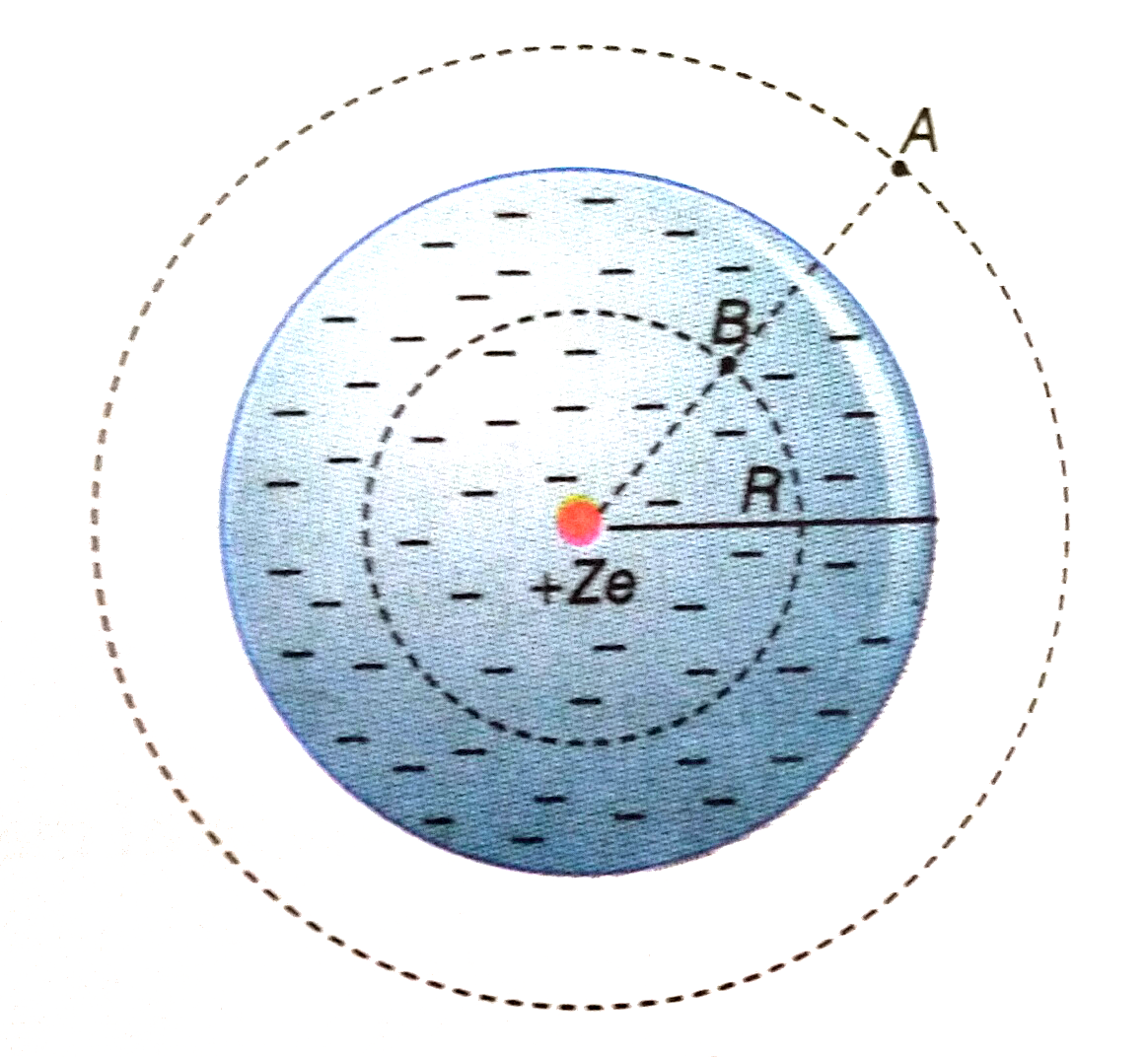
Charge of the nucleus = `+ Ze `
` therefore ` Amount of charge outside the nucleus = ` - Ze`, as an atom is electrically neutral.
Volume density of negative charge inside the sphere,
`rho = ( -Ze )/( (4 ) /( 3 ) pi R ^ 3 ) = - ( 3 Ze ) /( 4 pi R^ 3 ) `
Electric field at external points ` ( r gt R ) ` : Let A be any such point outside the sphere . A concentric sphere of radius r, passing through A, is a convenient Gaussaian surface.
The change enclosed by this Gaussian surface,
`q` = charge of the nucleus + charge distributed inside the sphere of radius R `
` = + Ze+ ( - Ze ) = 0`
` therefore ` From Gauss' theorem, ` oint _ S vecE * dvecS = (q ) /( in _ 0 ) = 0 `
` therefore E = 0`, at all external points.
Electric field at internal points (` r lt R ` ) : Let B be any such point inside the sphere. A concentric sphere of radius r, passing through B , is a convenient Gaussian surface . It is to be noted that this surace encloses the entire positive charge `+ Ze ` of the nucleus, but a part of the negative charge ` - Ze ` remains outside it.
The amount of negative charge inside this Gaussian surface,

` q ' ` = volume of this enclosed sphere ` xx ` volume density ` rho ` of negative charge
` = ( 4 )/(3) pi r ^ 3 ( - (3 Ze )/( 4pi R ^ 3 ) ) = - Ze ( r^ 3 )/( R ^ 3 ) `
` therefore ` Net charge enclosed by the sphere
` q = + Ze + q' = Ze - Ze ( r ^ 3 ) /( R ^ 3 ) = Ze ( 1 - ( r ^ 3 )/( R ^ 3 )) `
For any surface element ` d vecS ` on the Gaussian surface, the electric field ` vec E ` and the area vector ` d vec S ` are parallel to each other
` therefore vec E * d vecS = Ed S cos 0^ @ = EdS `
Again, from symmetry, E is uniform in magniturde over the Gaussian surface. then, from Gauss' theorem,
` oint _ S vec E * d vecS = ( q ) /( in _ 0 ) `
or, ` oint_S EdS = (q )/( in _ 0 ) ` or, ` E oint _ S dS = ( q )/( in _ 0 ) ` or , ` ES = (q ) / ( in _ 0 ) `
or, ` E * 4pi r^ 2 = (1 ) /( in _ 0 ) Ze ( 1 - (r ^ 3 )/( R ^ 3 )) `
or, ` E = ( Ze )/( 4pi in _ 0) * ( 1 ) /( r ^ 2 ) ( 1 - (r^ 3 )/( R ^ 3 ) ) = ( Ze ) /( 4pi in _ 0) (( 1 )/( r^ 2 ) - ( r) /( R ^ 3 )) `
Promotional Banner

Topper's Solved these Questions

  • ELECTRIC FIELD

    CHHAYA PUBLICATION|Exercise SECTION RELATION QUESTIONS|50 Videos
  • ELECTRIC FIELD

    CHHAYA PUBLICATION|Exercise HIGHER ORDER THINKING SKILL QUESTIONS|33 Videos
  • ELECTRIC ENERGY AND POWER

    CHHAYA PUBLICATION|Exercise CBSE SCANNER|7 Videos
  • ELECTRIC POTENTIAL

    CHHAYA PUBLICATION|Exercise CBSE Scanner|13 Videos

Similar Questions

Explore conceptually related problems

Q charge is distributed uniformly through the volume of a sphere of radius R, The energy of the system will be—

A charge Q coulomb is uniformly distributed over a sphere volume of radius R metres. What will be the expression for the energy of the system.

Is it possible for a metal sphere of radius 1 cm to hold a charge of 1C ?

A conducting sphere of radius R is given a charge Q. The electric potential and the electric field at the centre of the sphere respectively are

A conducting sphere of radius R is given a charge Q. The electric potential and the electric field at the centre of the sphere respectively are

The total flux phi comes out of a sphere of radius r. Keeping the amount of charge constant, if the radius of the sphere is made 2r, how much flux will come out of the sphere now?—

A charge Q is distributed over two concentric hollow spheres of radius r and R(gtr) such that the surface densities are equal. The potential at the common centre is

A circular copper ring of radius r, placed in vacuum, has a charge q on it. Find out the electric fields at the centre of the ring.

CHHAYA PUBLICATION-ELECTRIC FIELD-CBSE SCANNER
  1. The classical concept of atomic structure is that negative charg...

    Text Solution

    |

  2. A charge q is placed at the centre of a cube of side l. What is the el...

    Text Solution

    |

  3. An electric dipole is held in a uniform electric field. Show that th...

    Text Solution

    |

  4. An electric dipole is held in a uniform electric field. The dipole i...

    Text Solution

    |

  5. A charge q is placed at the centre of a cube. What is the electric flu...

    Text Solution

    |

  6. A charge q is placed at the centre of a cube. What is the electric flu...

    Text Solution

    |

  7. Define electric dipole moment. Is it a scalar or a vector? Derive the ...

    Text Solution

    |

  8. Two charges of magnitudes -2Q and +Q are located at points (a, 0) and ...

    Text Solution

    |

  9. Using Gauss' law deduce the expression for the electric field due to a...

    Text Solution

    |

  10. Using Gauss' law deduce the expression for the electric field due to a...

    Text Solution

    |

  11. Why do the electrostatic field lines not form closed loops?

    Text Solution

    |

  12. Deduce the expression for the torque acting on a dipole of dipole mome...

    Text Solution

    |

  13. Consider two hollow concentric spheres S(1) and S(2) enclosing charges...

    Text Solution

    |

  14. Consider two hollow concentric spheres S(1) and S(2) enclosing charges...

    Text Solution

    |

  15. A point charge +Q is placed in the vicinity of a conducting surface. T...

    Text Solution

    |

  16. Define electric electric flux. Write its SI unit.

    Text Solution

    |

  17. Using Gauss' law, obtain the electric flux due to a point charge q enc...

    Text Solution

    |

  18. Show that the electric field due to a uniformly charged infinite plane...

    Text Solution

    |

  19. What is the amount of work done in moving a point charge Q around a ci...

    Text Solution

    |

  20. Find the electric field intensity due to a uniformly charged spherical...

    Text Solution

    |

  21. Find the electric field intensity due to a uniformly charged spherical...

    Text Solution

    |

