Home
Class 12
PHYSICS
Two equal negative charges -q are fixed ...

Two equal negative charges -q are fixed at points (0,a) and (0,-a) on the Y-axis. A positive charge Q is released from rest at the point (2a,0) on the X-axis. Will the charge Q execute simple harmonic motion?

Text Solution

Verified by Experts
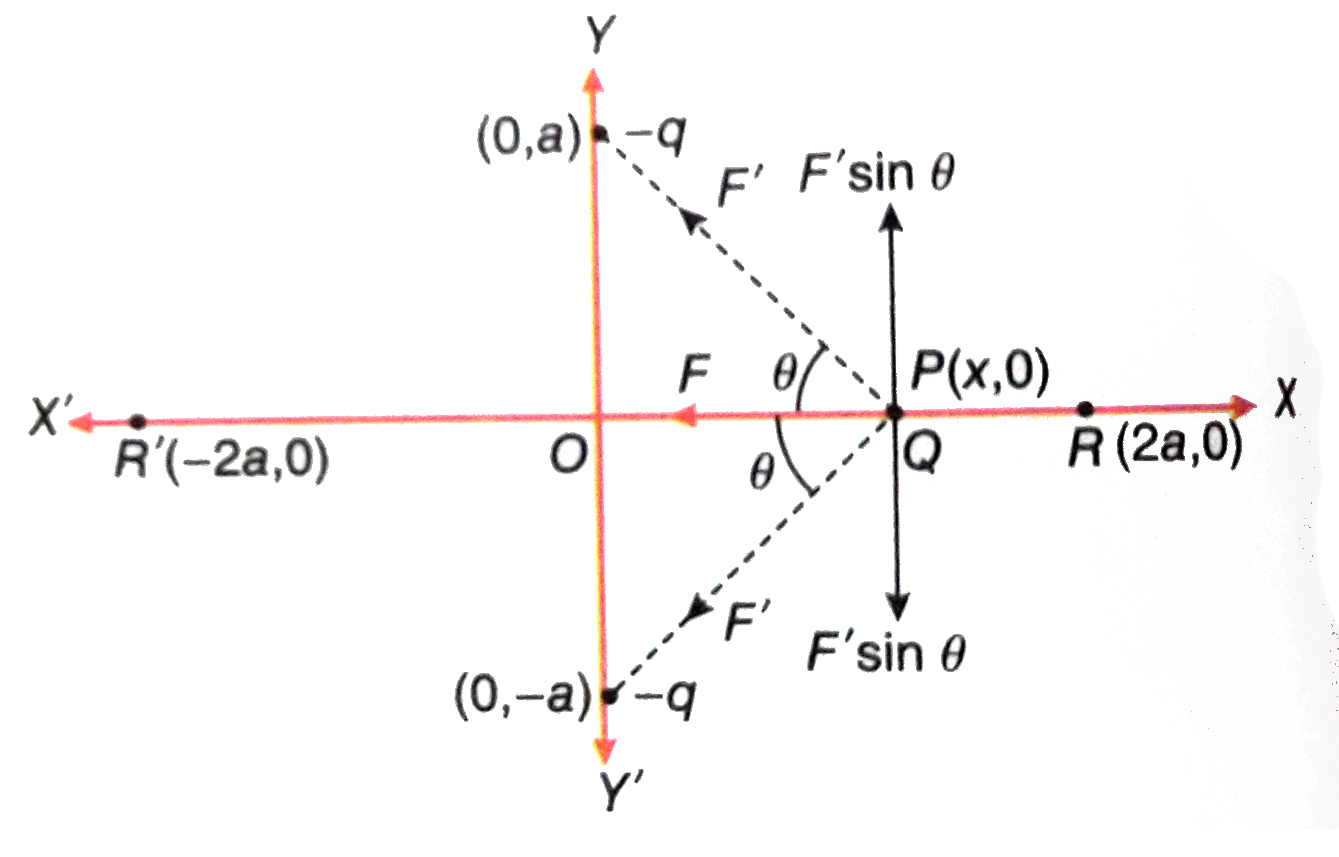
Charge Q will move to and fro along ROR' [Fig.2.72]. The point O is the equilibrium position of the charge Q. Now we shall have to see whether the force acting on the charge Q is proportional to the distance of Q from O.
Let the charge Q be at the point P(x,0) at any instant. At that time each of the two charges -q exerts force F' on Q.

Therefore, from Coulomb's law we get,
`F'prop-(1)/(a^(2)+x^(2))`
Now, `F=2F'costheta=2F'xx(x)/(sqrt(a^(2)+x^(2)))`
or, `F'=(sqrt(a^(2)+x^(2)))/(2x)F`
`:.(Fsqrt(a^(2)+x^(2)))/(2x)prop-(1)/(a^(2)+x^(2))`
or, `Fprop-(x)/((a^(2)+x^(2))^(3//2))`
The condition for a simple harmonic motion, `Fprop-x,` does not match with the above expression. So, the charge Q will not execute a simple harmonic motion.
Promotional Banner

Topper's Solved these Questions

  • ELECTRIC FIELD

    CHHAYA PUBLICATION|Exercise NCERT TEXTBOOK QUESTIONS WITH ANSWER HINT|24 Videos
  • ELECTRIC FIELD

    CHHAYA PUBLICATION|Exercise NCERT EXEMPLAR QUESTIONS WITH ANSWER HINT|7 Videos
  • ELECTRIC FIELD

    CHHAYA PUBLICATION|Exercise SECTION RELATION QUESTIONS|50 Videos
  • ELECTRIC ENERGY AND POWER

    CHHAYA PUBLICATION|Exercise CBSE SCANNER|7 Videos
  • ELECTRIC POTENTIAL

    CHHAYA PUBLICATION|Exercise CBSE Scanner|13 Videos

Similar Questions

Explore conceptually related problems

Two equal -ve charges -q are fixed at the points (0, a) and (0, -a) on the y-axis. A positive charge Q is released from rest at the point (2a, 0) on the x-axis. The charge will

Two equal negative charges each of -q are fixed at the points (0,a) and (0,-a) on the y - axis . A positive charge Q is released from rest at the point (2a,0) on the x-axis. Will the charge Q execute SHM about the origin ?

Two charges -q and +q are located at points (0,0,-a) and (0,0,a) respectively. (a) What is the electrostatic potential at the points (0,0,z) and (x,y,0) ?

A ring of radius R carries a uniformly distributed charge + Q. A point charge - q is placed on the axis of the ring at a distance 2R from its centre and than released. Will the charge -q execute a simple harmonic motion along the axis of the ring ?

Two equal point charges are placed on x=-a and x=+a on the x=axis. Another point charge Q is placed on the origin. IF this charge is displaced a small distance x along x-axis, then the change of potential energy approximately will be proportional to

Two charges -q and +q are located at points (0,0,-a) and (0,0,a) respectively. (b) Obtain the dependence of potential on the distance r of a point from the origin when r gt gt a .

A point-charge q is placed at the origin. How does the electric field due to the charge vary with distance r from the origin?

Two charges -q and +q are located at points (0,0,-a) and (0,0,a) respectively. (c ) How much work is done in moving a small test charge from the point (5, 0, 0) to (-7, 0, 0) along the x-axis?

Two charges -q and +q are located at point A(0, 0, -a) and B(0, 0, +a) respectively. How much work is done in moving a test charge from point P(7, 0, 0 ) to Q(-3, 0, 0)?

CHHAYA PUBLICATION-ELECTRIC FIELD-HIGHER ORDER THINKING SKILL QUESTIONS
  1. Two small balls have equal posltive charges Q (coulomb). They are susp...

    Text Solution

    |

  2. A charge q is placed at the mid-point of the line joining two equal ch...

    Text Solution

    |

  3. Two equal negative charges -q are fixed at points (0,a) and (0,-a) on ...

    Text Solution

    |

  4. A piont charge q moves from point P to point S along the path PQRS [Fi...

    Text Solution

    |

  5. The presence of matter alters the net force acting between two charges...

    Text Solution

    |

  6. What is the difference between the electrical effects due to a point c...

    Text Solution

    |

  7. What is the significance of Gauss' theorem? Is it applicable to any ot...

    Text Solution

    |

  8. Can a field line start from a charged conductor and end on it? Answer ...

    Text Solution

    |

  9. Two lines of force in an electric field never intersect each other. Wh...

    Text Solution

    |

  10. An electric dipole is placed in a uniform electric field in such a way...

    Text Solution

    |

  11. An electric dipole is placed in a uniform electric field in with its a...

    Text Solution

    |

  12. What should be the angle of a field line with the normal to a surface ...

    Text Solution

    |

  13. If an electric dipole is placed in a non-uniform electric field, does ...

    Text Solution

    |

  14. Eight electric dipoles each with charge e are placed inside a cube. Wh...

    Text Solution

    |

  15. A cylinder is lying with axis parallel to uniform electric field vecE...

    Text Solution

    |

  16. An electric dipole is situated in a uniform electric field vecE such t...

    Text Solution

    |

  17. The electric field due to a small dipole of length 2l at distance r ...

    Text Solution

    |

  18. A particle of mass m is attached to one end of missless rigid non-cond...

    Text Solution

    |

  19. A uniform non-conducting rod of mass m and length l has linear charge ...

    Text Solution

    |

  20. Two infinitely large sheets having charge densities sigma(1) and sigm...

    Text Solution

    |

