Home
Class 12
PHYSICS
Two point charges e(1) and e(2) are sepa...

Two point charges `e_(1)` and `e_(2)` are separated by a distance `d` but the electric field is not `0` on any point joining the two points. What can be concluded from this?

Text Solution

Verified by Experts
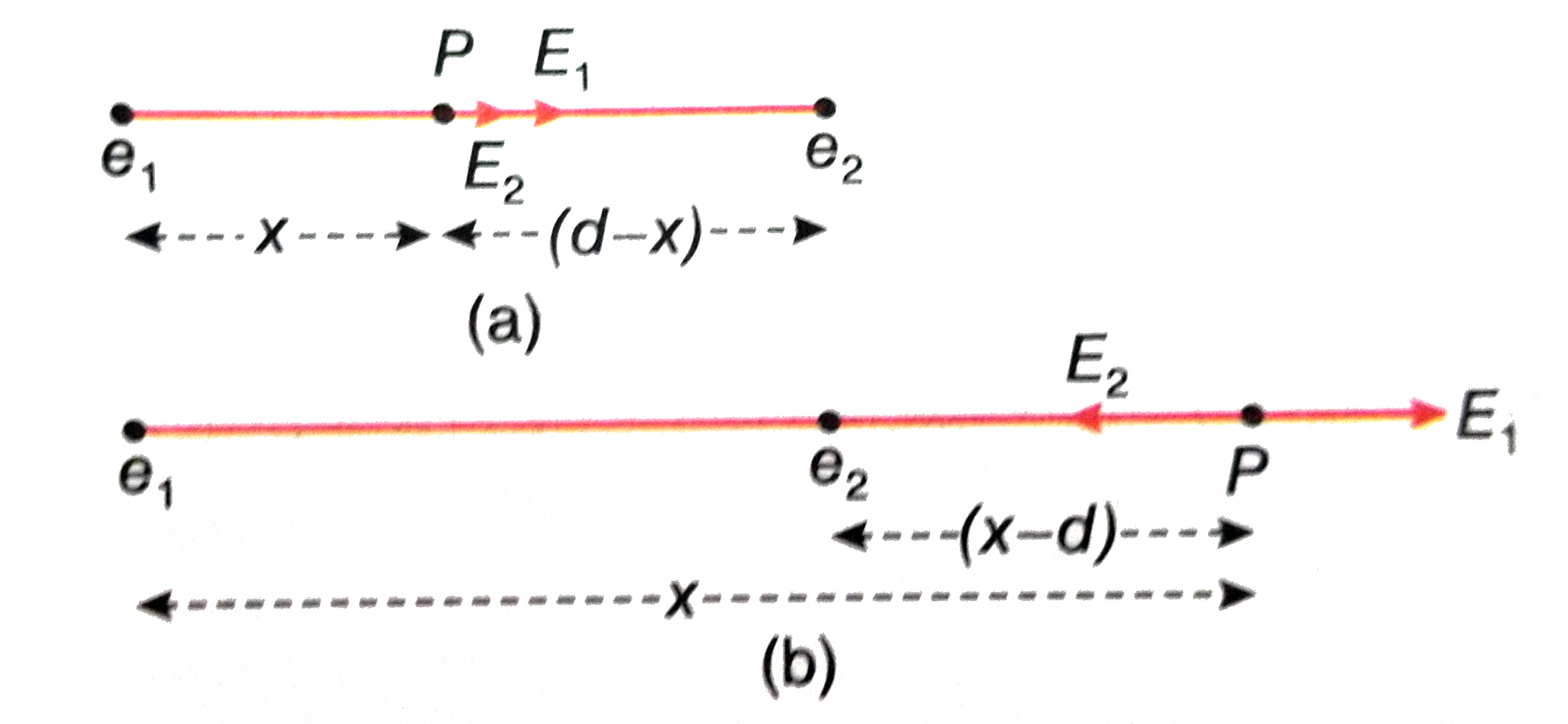
In the first case, let the distance of point P from `e_(1)` is x and from `e_(2)` is (d - x)

Electric field at P due to `e_(1), E_(1)=(e_(1))/(x^(2))`
Electric field at P due to `e_(2), E_(2)=(e_(2))/((d-x)^(2))`
If `e_(1)` and `e_(2)` are oppositely charged, then the directions of `E_(1)` and `E_(2)` at point P will be the same and their resultant field,
`E=(e_(1))/(x^(2))+(e_(2))/((d-x)^(2))`
In this case, E will never be zero.
In the second case, let the distance of point P from `e_(1)` is x and from `e_(2)` is (x - d)
In this case, `E_(1)=(e_(1))/(x^(2)) and E_(2)=(e_(2))/((x-d)^(2))`
If `e_(1) and e_(2)` are oppositely charged. `E_(1) and E_(2)` will act along the opposite directions.
`therefore` Resultant electirc field, `E= (e_(2))/((x-d)^(2))-(e_(1))/(x^(2))`
In this case, if `e_(1)=e_(2)` then `E_(1) and E_(2)` will always be unequal.
E will never be zero.
Therefore, if the electric field is not zero at any point, then `e_(1) and e_(2)` are equal and opposite in nature, i.e., `e_(1)= -e_(2)` .
Promotional Banner

Topper's Solved these Questions

  • ELECTRIC FIELD

    CHHAYA PUBLICATION|Exercise NCERT TEXTBOOK QUESTIONS WITH ANSWER HINT|24 Videos
  • ELECTRIC FIELD

    CHHAYA PUBLICATION|Exercise NCERT EXEMPLAR QUESTIONS WITH ANSWER HINT|7 Videos
  • ELECTRIC FIELD

    CHHAYA PUBLICATION|Exercise SECTION RELATION QUESTIONS|50 Videos
  • ELECTRIC ENERGY AND POWER

    CHHAYA PUBLICATION|Exercise CBSE SCANNER|7 Videos
  • ELECTRIC POTENTIAL

    CHHAYA PUBLICATION|Exercise CBSE Scanner|13 Videos

Similar Questions

Explore conceptually related problems

Two point charges are separated by a certain distance. Electric field intensity is zero at a point in between the two charges. What can we conclude about the charges ?

Two point charges e_(1) and e_(2) are placed at a distance d from each other. In between them there is no point where electric field is zero. From this what conclusion can you draw ?

Determine the electric field at a distance r from a point charge.

Two point charges +q and -q are placed d distance apart. What is the zero potential plane for them?

Two point charges +4q and +q are placed 30 cm apart. The electric field intensity at a point on the line joining the two charges is zero. The point is situated at a distance

Two point charges of 10 esu and 40 esu are located at points A and B seperated by a distance 4 cm. Find the electric field intensity at a point halfway between the charges.

Two point charges q_A=3muC and q_B=-3muC are located 20 cm apart in vacuum. What is the electric field at the midpoint of the line AB joining the two charges ?

Two charges, + q and -q are separated by a distance d. At which points will the resultant electric field intensity be directed parallel to the line joining the charges ?

Two points having charges q_(1) and q_(2) are placed at the coordinates (a, 0, 0) and (0, b, 0) respectively. Find out the electric field intensity of a third point charge placed at (0, 0, c) due to those two charges.

CHHAYA PUBLICATION-ELECTRIC FIELD-HIGHER ORDER THINKING SKILL QUESTIONS
  1. An electric dipole is placed in a uniform electric field in with its a...

    Text Solution

    |

  2. What should be the angle of a field line with the normal to a surface ...

    Text Solution

    |

  3. If an electric dipole is placed in a non-uniform electric field, does ...

    Text Solution

    |

  4. Eight electric dipoles each with charge e are placed inside a cube. Wh...

    Text Solution

    |

  5. A cylinder is lying with axis parallel to uniform electric field vecE...

    Text Solution

    |

  6. An electric dipole is situated in a uniform electric field vecE such t...

    Text Solution

    |

  7. The electric field due to a small dipole of length 2l at distance r ...

    Text Solution

    |

  8. A particle of mass m is attached to one end of missless rigid non-cond...

    Text Solution

    |

  9. A uniform non-conducting rod of mass m and length l has linear charge ...

    Text Solution

    |

  10. Two infinitely large sheets having charge densities sigma(1) and sigm...

    Text Solution

    |

  11. A small charge is placed at a point in a static electric field. Will t...

    Text Solution

    |

  12. Two point charges e(1) and e(2) are separated by a distance d but the ...

    Text Solution

    |

  13. Force between two charges depends on the presence of the material be...

    Text Solution

    |

  14. Charge Q is distributed between two paraticles. What should be the val...

    Text Solution

    |

  15. A free electron and a free proton are placed in an uniform electric fi...

    Text Solution

    |

  16. Why electric fields just outside the surface of a conductor is perpend...

    Text Solution

    |

  17. In case of field outside a uniformly charged sphere, the charge can be...

    Text Solution

    |

  18. How the force acting between two charges will change if the air medium...

    Text Solution

    |

  19. If a positively charged particle is kept at the points A and B in an e...

    Text Solution

    |

  20. If the area of cross section of the cylinder is S , then what will be ...

    Text Solution

    |

