Home
Class 12
PHYSICS
Two charges of magnitudes -2Q and +Q are...

Two charges of magnitudes -2Q and +Q are located at points `(a, 0) and (4a, 0)` respectively. What is the electric flux due to these charges through a sphere of radius 3a with its centre at the origin?

Text Solution

Verified by Experts
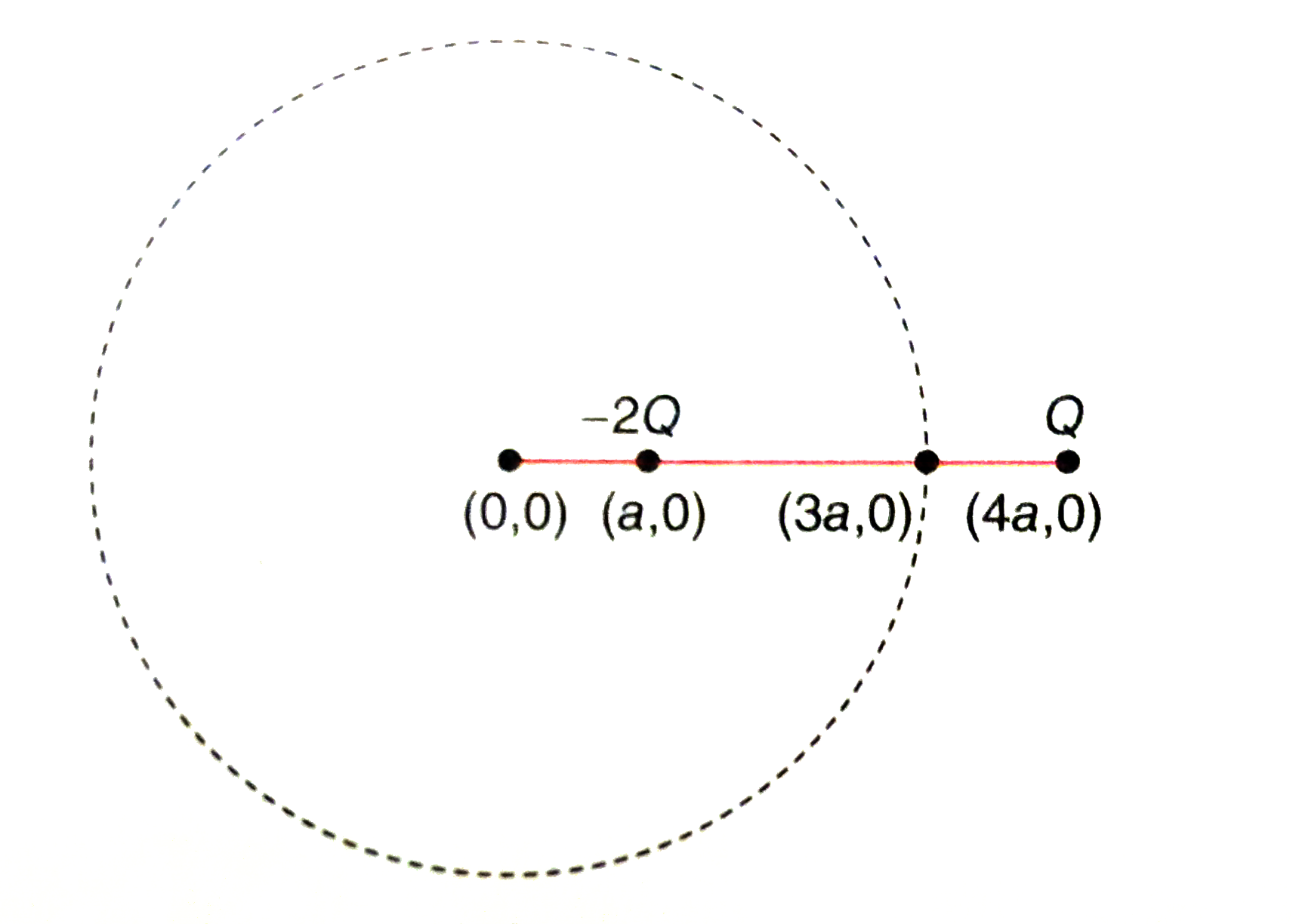
According to Gauss' theorem,
`phi = ("charge enclosed by the surface")/(epsilon_0)`
Since Q is outside the sphere,
flux, `phi = (-2 Q)/(epsilon_0)`
Promotional Banner

Topper's Solved these Questions

  • ELECTRIC FIELD

    CHHAYA PUBLICATION|Exercise EXAMINATION ARCHIVE ( NEET )|4 Videos
  • ELECTRIC ENERGY AND POWER

    CHHAYA PUBLICATION|Exercise CBSE SCANNER|7 Videos
  • ELECTRIC POTENTIAL

    CHHAYA PUBLICATION|Exercise CBSE Scanner|13 Videos

Similar Questions

Explore conceptually related problems

Two charges -q and +q are located at points (0,0,-a) and (0,0,a) respectively. (a) What is the electrostatic potential at the points (0,0,z) and (x,y,0) ?

Two charges 2Q and -Q are placed at the points (a,0,0) and (4a,0,0) respectively. With the two charges situated at the cenres, two spheres of radii 2a and 8a are considered. What is the ratio of electric flux through the surfaces of the two spheres?

Two point charges of magnitude +q and -q are placed at (-d/2, 0, 0) and (d/2, 0,0) respectively. Find the equation of the equipotential surface where the potential is zero.

Two charges -q and +q are located at points (0,0,-a) and (0,0,a) respectively. (b) Obtain the dependence of potential on the distance r of a point from the origin when r gt gt a .

Two points having charges q_(1) and q_(2) are placed at the coordinates (a, 0, 0) and (0, b, 0) respectively. Find out the electric field intensity of a third point charge placed at (0, 0, c) due to those two charges.

A charge q is placed at the centre of a cube. What is the electric flux passing through the cube?

A point-charge q is placed at the origin. How does the electric field due to the charge vary with distance r from the origin?

Two charges -q and +q are located at point A(0, 0, -a) and B(0, 0, +a) respectively. How much work is done in moving a test charge from point P(7, 0, 0 ) to Q(-3, 0, 0)?

Two positive charges Q and 4Q are placed at points A and B respectively where B is at a distance d units to the right of A. The total electric potential due to these charges is minimum at P on the line through A and B. What is (are) the distance (s) of P from A?

CHHAYA PUBLICATION-ELECTRIC FIELD-CBSE SCANNER
  1. A charge q is placed at the centre of a cube. What is the electric flu...

    Text Solution

    |

  2. Define electric dipole moment. Is it a scalar or a vector? Derive the ...

    Text Solution

    |

  3. Two charges of magnitudes -2Q and +Q are located at points (a, 0) and ...

    Text Solution

    |

  4. Using Gauss' law deduce the expression for the electric field due to a...

    Text Solution

    |

  5. Using Gauss' law deduce the expression for the electric field due to a...

    Text Solution

    |

  6. Why do the electrostatic field lines not form closed loops?

    Text Solution

    |

  7. Deduce the expression for the torque acting on a dipole of dipole mome...

    Text Solution

    |

  8. Consider two hollow concentric spheres S(1) and S(2) enclosing charges...

    Text Solution

    |

  9. Consider two hollow concentric spheres S(1) and S(2) enclosing charges...

    Text Solution

    |

  10. A point charge +Q is placed in the vicinity of a conducting surface. T...

    Text Solution

    |

  11. Define electric electric flux. Write its SI unit.

    Text Solution

    |

  12. Using Gauss' law, obtain the electric flux due to a point charge q enc...

    Text Solution

    |

  13. Show that the electric field due to a uniformly charged infinite plane...

    Text Solution

    |

  14. What is the amount of work done in moving a point charge Q around a ci...

    Text Solution

    |

  15. Find the electric field intensity due to a uniformly charged spherical...

    Text Solution

    |

  16. Find the electric field intensity due to a uniformly charged spherical...

    Text Solution

    |

  17. Derive an expression for the electric field E due to a dipole of lengt...

    Text Solution

    |

  18. Draw a graph of E versus r fro r gt gt a.

    Text Solution

    |

  19. Obtain the expression for the torque vec(tau) experienced by an electr...

    Text Solution

    |

  20. What will happen if the field were not uniform?

    Text Solution

    |

