Home
Class 12
PHYSICS
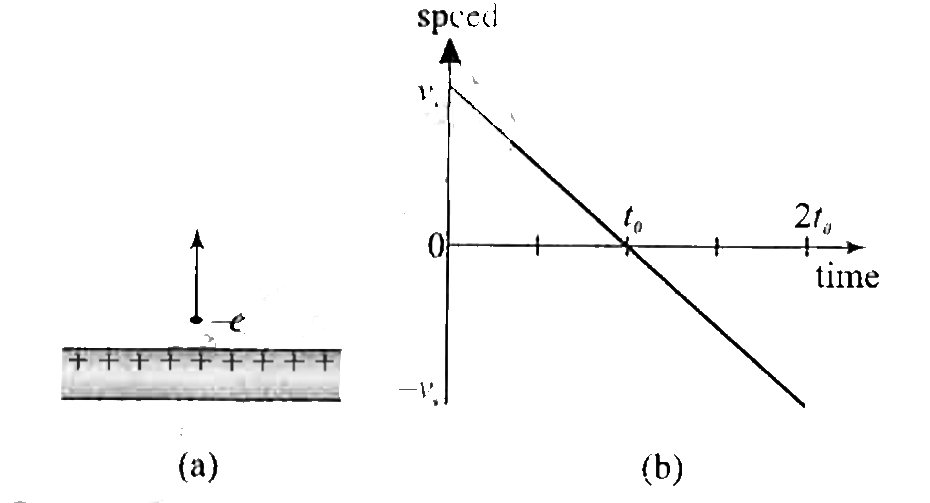
In fig(a) electron is shot directly away...

In fig(a) electron is shot directly away from a uniformly charged plastic sheet, at speed `V_(s)` the sheet is nonconducting flat , and very vertical component versus time t until the return to the launch point. What is the sheet's surface charge density ?

Text Solution

Verified by Experts

The correct Answer is:

`(2epsilon_(0)mv_(s))/(et_(0))`
Promotional Banner

Topper's Solved these Questions

  • ELECTRIC FLUX AND GAUSS LAW

    CENGAGE PHYSICS|Exercise MCQ s|38 Videos
  • ELECTRIC FLUX AND GAUSS LAW

    CENGAGE PHYSICS|Exercise Comprehension|36 Videos
  • ELECTRIC CURRENT AND CIRCUIT

    CENGAGE PHYSICS|Exercise Interger|8 Videos
  • ELECTRIC POTENTIAL

    CENGAGE PHYSICS|Exercise DPP 3.5|14 Videos

Similar Questions

Explore conceptually related problems

A small non-conducting ball of mass m =1mg and charge q=2times10^(-8) C hangs from an insulating thread that makes an angle theta=30^(@) with vertical uniformly charged non-conducting sheet.Considering the gravitational force on the ball and assuming that the sheet extends for vertically and into out of the page.Calculate surface charge density of sheet.

(a) Use Gauss's theorem to find the electric field due to a uniformly charged infinitely Iarge plane thin sheet with surface charge density. Sigma (b) An infinitely large thin plane sheet has a uniform surface charge density + sigma . Obtain the expression for the amount of work done in bringing a point charge q from infinity to a point , distant r, in front of the charged plane sheet.

a)State Gauss’s law in electrostatics. Show that with help of suitable figure that outward flux due to a point charge Q, in vacuum within gaussian surface, is independent of its size and shape. b) In the figure there are three infinite long thin sheets having surface charge density +2sigma, -2sigma and +sigma respectively. Give the magnitude and direction of electric field at a point to the left of sheet of charge density +2sigma and to the right of sheet of charge density +sigma

A salamander of the genus Hydromantes captures prey by launching its tongue as a projectile: The skeletal part of the tongue is shot forward, unfolding the rest of the tongue, until the outer portion lands on the prey, sticking to it. Figure 2-24 shows the acceleration magnitude a versus time t for the acceleration phase of the launch in a typical situation. The indicated accelerations are a_(2)=400 m//s^(2) and a_(1)=100 m//s^(2) . What is the outward speed of the tongue at the end of the acceleration phase ?

A uniform electric field exists in a region between two oppositely charged plates. An electron is released from rest at the surface of the negatively charged plate and strikes the surface of the opposite plate, 3.0 cm away, in a time 1.5 xx 10^(-8) s . Just as the electron strikes the second plate, what are the its (a) momentum magnitude and (b) kinetic energy ? (c ) What is the magnitude of the electric field vec(E) ?

A parallel plate capacitor has square plates of side length L. Plates are kept vertical at separation d between them. The space between the plates is filled with a dielectric whose dielectric constant (K) changes with height (x) from the lower edge of the plates as K = e^(betax) where b is a positive constant. A potential difference of V is applied across the capacitor plates. (i) Plot the variation of surface charge density (s) on the positive plate of the capacitor versus x. (ii) Plot the variation of electric field between the plates as a function of x. (iii) Calculate the capacitance of the capacitor.

Fig. shows a metal rod PQ resting on the rails A, B and positoned between the poles of a permanent magnet. The rails, the rod and the magnetic field are in three mutually perperdicular directions. A galvanometer connects the rails through a switch K. Length of the rod = 15 cm, B = 0.50 T, resistance of closed loop containing the rod = 9.0 m Omega Answer the following questions. (a) Suppose K is open and the rod moves with a speed of 12 cm//s in the direction shown, Give the polarity and magnitude of induced e.m.f (b) Is there on excess charge built up at the ends of rods when K is open ? What if K is closed ? (c ) With K open and the rod moving uniformly, there is no net force on the electron in the rod PQ even though they do experience magnetic froce due to the motion of the rod Explain. (d) What is the retarding force on the rod when K is closed? (e) How much powe s required (by an external agent) to keep the rod moving at the same speed ( = 12 cm//s) when K is closed. (f) How much power is dissipated as heat in the closed circuit ? What is the source of this power? (g) What is the induced e.m.f. in the following in the moving rod when the permanent magnet is rotated to a vertical position so that the field is parallel to the rails instead of being perpendicular ?
