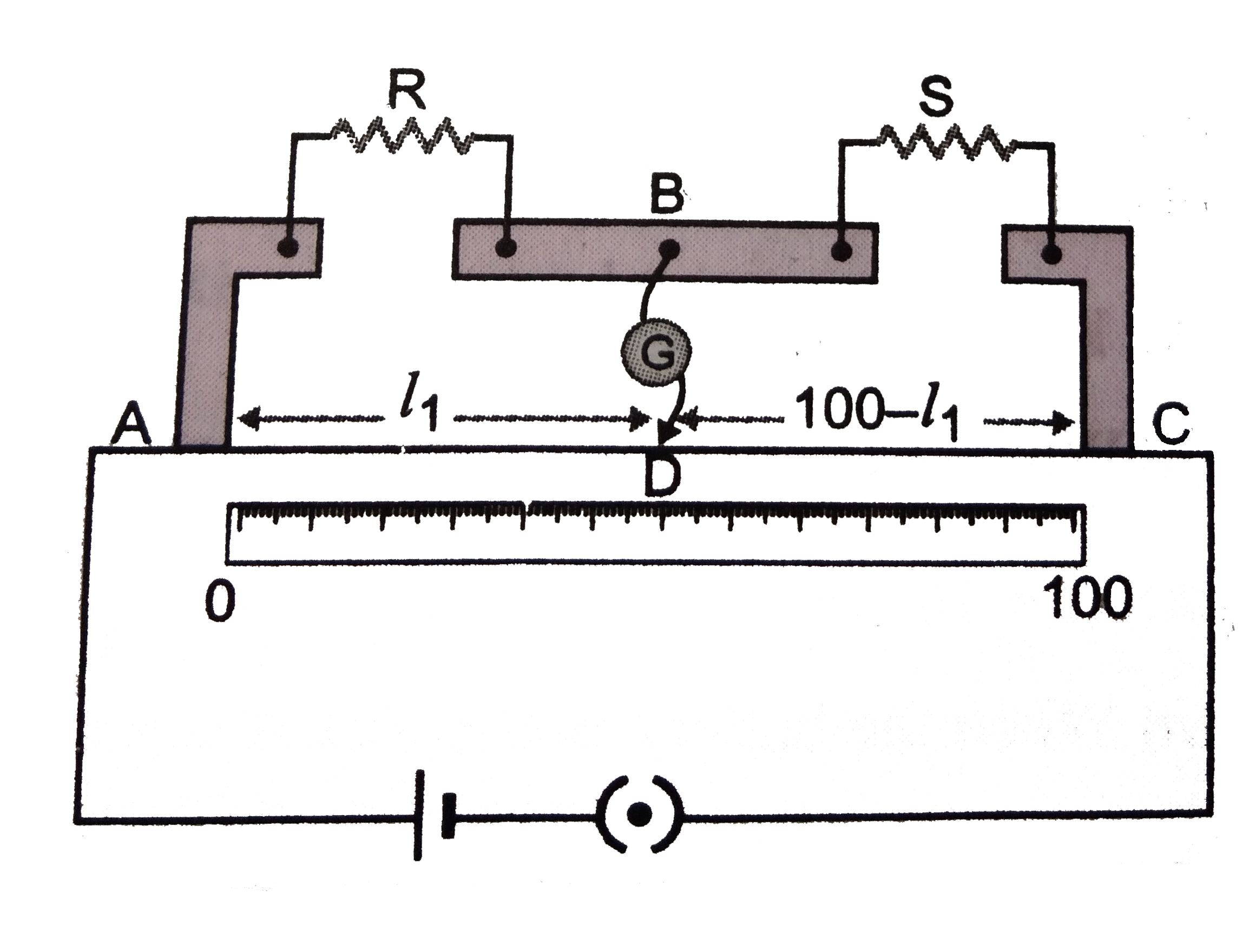
In a meter bridge the point D is a neutral point (Fig. 2(EP).4).
A
The meter bridge can have no other neutral A point for this set of resistances
B
When the jockey contacts a point on meter wire left of D, current flows to B from the wire
C
When the jockey contacts a point on the meter wire to the right of D, current flows from B to the wire through galvanometer
D
When R is increased the neutral points shifts to left
Text Solution
Verified by Experts
The correct Answer is:
A, C
Topper's Solved these Questions
ELECTRICAL MEASURING INSTRUMENTS
CENGAGE PHYSICS|Exercise Integer|8 Videos
ELECTRIC POTENTIAL
CENGAGE PHYSICS|Exercise DPP 3.5|14 Videos
ELECTROMAGENTIC INDUCTION
CENGAGE PHYSICS|Exercise QUESTION BANK|40 Videos
Similar Questions
Explore conceptually related problems
At a neutral point
Neutral Points
In a meter bridge the null point is obtained at the middle point of the wire. If in one gap the resistance is 10 Omega , then the value of resistance in the other gap is :–
In a meter bridge, the null point is found at a distance of 40 cm from A. If a resistance of 12 Omega in connected in parallel with S the null point occurs at 50.0 cm from A Determine the value of R and S
In a meter bridge, the null points is found at a distance of 33.7 cm from A. If now a resistance of 12 Omega is connected in parallel with S, the null point occurs at 51.9 cm. Determine the values of R and S.
In meter bridge, the null points is found at a distance of 60.0 cm front end A. If now a resistance of 5 Omega is connected in series with S, the null point occurs at 50 cm. Determine the values of R and S,
In a meter bridge experiment two unknown resistance X and y are connected to left and right gaps of a meter bridge and the balancing point is obtained at 20 cm from right (XgtY) the new position of the null point from left if one decides balance a resistance of 4 X against Y.