Home
Class 12
PHYSICS
The capacitor of capacitance C in the ci...

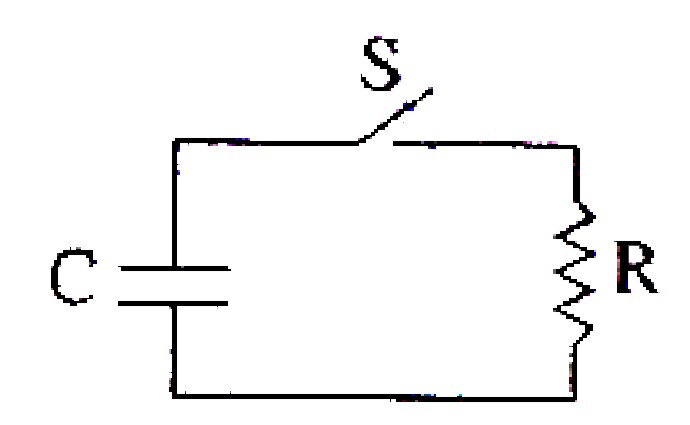
The capacitor of capacitance C in the circuit shown in fully charged initially. Resistance is R.–

After the switch S is closed, the time taken to reduce the stored energy in the capacitor to half its initial value is

A

`RC//2`

B

`2RC` in 2

C

RC ln 2

D

`(RC ln 2)/(2)`

Text Solution

Verified by Experts

The correct Answer is:

D
Promotional Banner

Topper's Solved these Questions

  • KVPY 2021

    KVPY PREVIOUS YEAR|Exercise PART I (Chemistry)|2 Videos

Similar Questions

Explore conceptually related problems

In the circuit shown, the capacitor C_1 is initially charged with charge q_0 . The switch S is closed at time t = 0 . The charge on C_2 after time t is

The two capacitors in the circuit shown in figure are initially uncharged and then connected as shown and switch is closed. What is the potential difference across 3muF capacitor?

The capacitor shown in the figure is initially unchanged, the battery is ideal. The switch S is closed at time t= 0, then the time after which the energy stored in the capacitor becomes one - fourth of the energy stored in it in steady - state is :

In the circuit shown in fig. when the switch is closed, the capacitor charges with a time constant

The circuit consists of two resistors (of resistance R_(1) = 20 Omega and R_(2) = 10 Omega ), a capacitor (of capacitance C =10 muF ) and two ideal cells. In the circuit shown the capacitor is in steady state and the switch S is open The current through the resistor R_(2) just after the switch S is closed is :

LetC be the capacitance of a capacitor discharging through a resistor R. Suppose t_1 is the time taken for the energy stored in the capacitor to reduce to half its initial value and t_2 is the time taken for the charge to reduce to one-fourth its initial value. Then the ratio t_1//t_2 will be

In the circuit shown, the capacitor is initially uncharged. The switch S is closed at t = 0. Time after which voltage across capacitor and resistor are equal is:

KVPY PREVIOUS YEAR-KVPY-All Questions
  1. 150 g of ice is mixed with 100 g of water at temperature 80^(@)C. The...

    Text Solution

    |

  2. An ideal monatomic gas expands to twice its volume. If the process is ...

    Text Solution

    |

  3. The capacitor of capacitance C in the circuit shown in fully charged ...

    Text Solution

    |

  4. A liquid drop placed on a horizontal plane has a near spherical shape ...

    Text Solution

    |

  5. Seven identical coins are rigidly arranged on a flat table in the patt...

    Text Solution

    |

  6. A planet orbits in an elliptical path of eccentricity e around a massi...

    Text Solution

    |

  7. In a Young's double slit experiment the intensity of light at each sli...

    Text Solution

    |

  8. A loop carrying current I has the shape of a regular polygon of n side...

    Text Solution

    |

  9. A conducting rod of mass m and length l is free to move without fricti...

    Text Solution

    |

  10. A steady current I flows through a wire of radius r, length L and resi...

    Text Solution

    |

  11. The ratio of the speed of sound to the average speed of an air molecul...

    Text Solution

    |

  12. In one model of the electron, the electron of mass me is thought to ...

    Text Solution

    |

  13. A body is executing simple harmonic motion of amplitude a and period T...

    Text Solution

    |

  14. Two identical bodies are made of a material for which the heat capacit...

    Text Solution

    |

  15. A particle is acted upon by a force given by F = - alphax^(3) -betax^...

    Text Solution

    |

  16. The potential energy of a point particle is given by the expression V(...

    Text Solution

    |

  17. A ball of mass m suspended from a rigid support by an inextensible mas...

    Text Solution

    |

  18. A particle released from rest is falling through a thick fluid under g...

    Text Solution

    |

  19. A cylindrical steel rod of length 0.10 m and thermal conductivity 50 W...

    Text Solution

    |

  20. A parent nucleus X is decaying into daughter nucleus Y which in turn d...

    Text Solution

    |
