Home
Class 12
PHYSICS
A charged particle initially at rest at ...

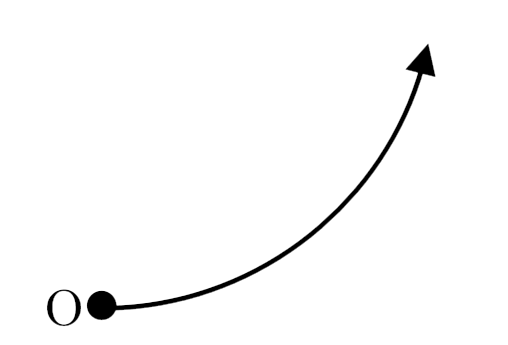
A charged particle initially at rest at O, when released follows a trajectory as shown. Such a trajectory is possible in the presence of

A

electric field of constant magnitude and varying direction.

B

magnetic field of constant magnitude and varying direction

C

electric field of constant magnitude and constant direction

D

electric and magnetic fields of constant magnitudes and constant directions which are parallel to each other

Text Solution

Verified by Experts

The correct Answer is:

A
Promotional Banner

Topper's Solved these Questions

  • KVPY 2021

    KVPY PREVIOUS YEAR|Exercise PART I (Chemistry)|2 Videos

Similar Questions

Explore conceptually related problems

When A Particle follow A Projectile?|Equation Of Trajectory |OMR

A particle initially at rest is released from A as shown in figures. The approximate variation of direction of resultant acceleration as particle moves from A to B is :

A particle with positive charge Q is held fixed at the origen. A second particle with positive charge q is fired at the first paricle, which follows the trajectory as shown in fig. (a) Is the angular momentum of the second particular momentum of the second particle constant about some axis? Why or why not? Give reason to support your answer. (b) Does the Coulomb force that one charge exerts on other charges changes if the other charges are brought nearby?(yes/No)

A charged particle q is moving in the presence of a magnetic field B which is inclined to an angle 30° with the direction of the motion of the particle. Draw the trajectory followed by the particle in the presence of the field and explain how the particle describes this path.

Path traced by a moving particle in space is called trajectory of the particle. Shape of trajectiry is decided by the forces acting on the particle. When a coordinate system is associated with a particle motion, the curve equation in which the particle moves [y=f(x)] is called equation of trajectory. It is just giving us the relation among x and y coordinates of the particle i.e. the locus of particle. To find equation of trajectory of a particle, find first x and y coordinates of the particle as a function of time eliminate the time factor. In above question initial acceleration (i.e. (d^(2)vec(r))/(dt^(2))) of particle is :-

Path traced by a moving particle in space is called trajectory of the particle. Shape of trajectiry is decided by the forces acting on the particle. When a coordinate system is associated with a particle motion, the curve equation in which the particle moves [y=f(x)] is called equation of trajectory. It is just giving us the relation among x and y coordinates of the particle i.e. the locus of particle. To find equation of trajectory of a particle, find first x and y coordinates of the particle as a function of time eliminate the time factor. The position vector of car w.r.t. its starting point is given as vec(r)=at hat(i)- bt^(2) hat(j) where a and b are positive constants. The locus of a particle is:-

Path traced by a moving particle in space is called trajectory of the particle. Shape of trajectiry is decided by the forces acting on the particle. When a coordinate system is associated with a particle motion, the curve equation in which the particle moves [y=f(x)] is called equation of trajectory. It is just giving us the relation among x and y coordinates of the particle i.e. the locus of particle. To find equation of trajectory of a particle, find first x and y coordinates of the particle as a function of time eliminate the time factor. In above the velocity (i.e. (dvec(r))/(dt)) at t=0 is :-

A charged particle of mass m and charge q is released from rest in an electric field of constant magnitude E . The kinetic energy of the particle after time t is

KVPY PREVIOUS YEAR-KVPY-All Questions
  1. Ice is used in a cooler in order to cool its contents. Which of the fo...

    Text Solution

    |

  2. A concave lens made of material of refractive index 1.6 is immersed i...

    Text Solution

    |

  3. A charged particle initially at rest at O, when released follows a tra...

    Text Solution

    |

  4. Two equal charges of magnitude Q each are placed at a distance d apart...

    Text Solution

    |

  5. A bar magnet falls with its north pole pointing down through the axis ...

    Text Solution

    |

  6. Two identical bar magnets are held perpendicular to each other with a ...

    Text Solution

    |

  7. A large number of random snap shots using a camera are taken of a part...

    Text Solution

    |

  8. In 1911, the physical Ernest Rutherford discovered that atoms have a t...

    Text Solution

    |

  9. A uniform thin rod of length 2L and mass m lies on a horizontal table....

    Text Solution

    |

  10. A solid cylinder P rolls without slipping from rest down an inclined p...

    Text Solution

    |

  11. A body moves in a circular orbit of radius R under the action of a cen...

    Text Solution

    |

  12. A simple pendulum is attached to the block which slides without fricti...

    Text Solution

    |

  13. Water containing air bubbles flows without turbulence through a horizo...

    Text Solution

    |

  14. A solid expands upon heating because

    Text Solution

    |

  15. Consider two thermometers T(1) and T(2) of equal length which can be u...

    Text Solution

    |

  16. An ideal gas follows a process described by PV^(2)=C from (P(1), V(1),...

    Text Solution

    |

  17. A whistle emitting a loud sound of frequency 540 Hz is whirled in a ho...

    Text Solution

    |

  18. Monochromatic light passes through a prism. Compared to that in air, i...

    Text Solution

    |

  19. The flat face of a plano-convex lens of focal length 10 cm is silvered...

    Text Solution

    |

  20. Two identical metallic square loops L(1) " and " L(2) are placed next ...

    Text Solution

    |
