

Home
Class 12
PHYSICS
An inclinded plane making an angle of 30...

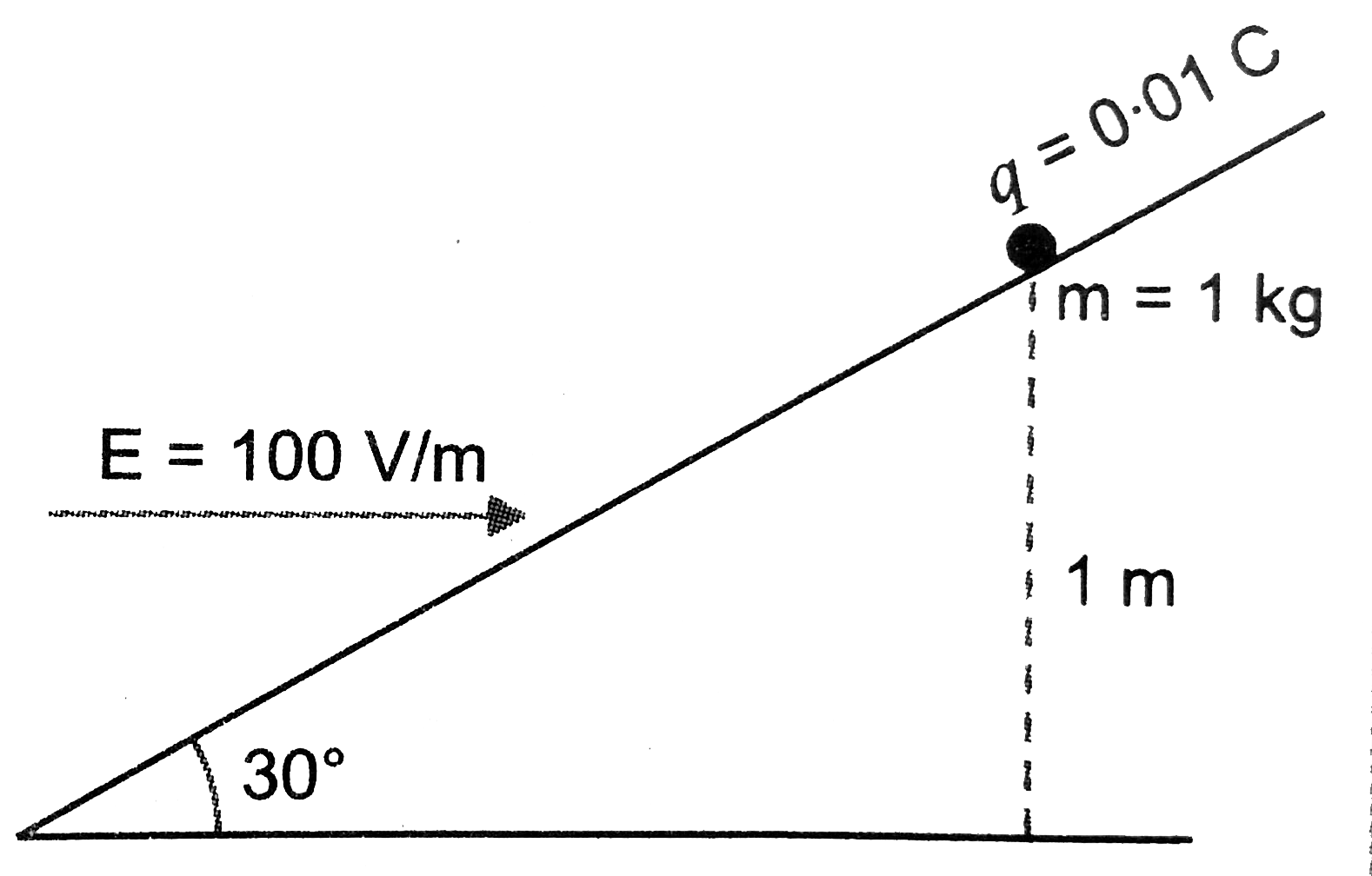
An inclinded plane making an angle of `30^(@)` with the horizontal electric field of `100 Vm^(-1)` as shown in Figure. A particle of mass `1 kg` and charge `0*01 C` is allowed to slide down from rest from a height of `1m`. If the coefficient of friction is `0.2`, find time taken by the particle to reach the bottom.

Promotional Banner

Topper's Solved these Questions

  • ELECTROSTATICS

    PHYSICS GALAXY - ASHISH ARORA|Exercise Partice Exercise 1.1|1 Videos
  • ELECTROSTATICS

    PHYSICS GALAXY - ASHISH ARORA|Exercise Partice Exercise|93 Videos
  • ELECTROMAGNETIC INDUCTION AND ALTERNATING CURRENT

    PHYSICS GALAXY - ASHISH ARORA|Exercise Advance MCQs|33 Videos
  • GEOMETRICAL OPTICS

    PHYSICS GALAXY - ASHISH ARORA|Exercise Unsolved Numerical Problems|107 Videos

Similar Questions

Explore conceptually related problems

An inclined plane making an angle of 30^(@) with the horizontal is placed in a uniform horizontal electric field 200 (N)/(C ) as shown in the figure. A body of mass 1kg and charge 5 mC is allowed to slide down from rest at a height of 1m. If the coefficient of friction is 0.2, find the time taken by the body to reach the bottom. [g=9.8m//s^(2), sin 30^(@)=(1)/(2), cos30^(@)=(sqrt(3))/(2)]

An inclined plane of length 5.60 m making an angle of 45^(@) with the horizontal is placed in a uniform electric field E=100 Vm^(-1) . A particle of mass 1 kg and charge 10^(-2)C is allowed to slide down from rest position from maximum height of slope. If the coefficient of friction is 0.1, then the time taken by the particle to reach the bottom is

A track has two inclined surface AB and DC each of length 3 m and angle of inclination of 30^@ with the horizontal and a central horizontal part of length 4m shown in figure. A block of mass 0.2 kg slides from rest from point A. The inclined surfaces are frictionless. If the coefficient of friction between the block and the horizontal flat surface is 0.2, where will the block finally come to rest ? [in 10^(-1) m ]

When a body slides down from rest along a smooth inclined plane making an angle of 30^(@) with the horizontal, it takes time 20s. When the same body slides down from rest along a rough inclined plane making the same angle and through the same distance, it takes time 20p is, where p is some number greater than 1. The coefficient of friction between the body and the rough plane is

A partical of mass 1kg rests on rought contact with a plane inclined at 30^(@) to the horizontal and is just about to slip, Find the coefficient of friction between the plane and the particle.

A particle is projected from horizontal making an angle of 53^(@) with initial velocity 100 ms^(-1) . The time taken by the particle to make angle 45^(@) from horizontal is

A body is allowed to slide from the top along a smooth inclined plane of length 5m at an angle of inclination 30^(@) .If g=10ms^(-2) , time taken by the body to reach the bottom of the plane is

A particle slides down a smooth in clined plane of elevation theta fixed in an elevastor going up with an acceleration a_0 . The base of the incline has a length L.Find the time taken by the particle to reach the bottom.

A particle of mass m is projected up from the bottom of an inclined plane with initial velocity v_(0) at angle 45^(@) with an inclined plane of inclineation 30^(@) as shown in figure. At the same time a small block of same mass m is released from rest at a height h . The particle hits the block at some point on inclined plane. If the particle sticks to the block after collision, the velocity of block parallel to the inclined plane just after collision will be (take g=10m//s^(2) )

PHYSICS GALAXY - ASHISH ARORA-ELECTROSTATICS-Unsolved Numberical Problems
  1. An inclinded plane making an angle of 30^(@) with the horizontal elec...

    Text Solution

    |

  2. A small sphere is charged uniformly and placed at point A (u, v) so th...

    Text Solution

    |

  3. The electric intensity Eat a point on the axis ofa ring of radius a at...

    Text Solution

    |

  4. Two long wires each oflength I are placed on a smooth horizontal table...

    Text Solution

    |

  5. Four charges +50 xxI0^(-9)C, -12 xx I0^(-19)C, + 36 xx I0^(-9)C " and ...

    Text Solution

    |

  6. A solid conducting sphere of radius R is placed in a uniform electric ...

    Text Solution

    |

  7. Suppose in an insulating medium, having di-electric constant k= 1, vol...

    Text Solution

    |

  8. Two short dipoles phat(k) and P/2 hat(k) are located at (0,0,0) & (1m,...

    Text Solution

    |

  9. Two long straight parallel wires carry charges lambda(1) and lamda(2) ...

    Text Solution

    |

  10. Find the magnitude of uniform electric field E of which the direction ...

    Text Solution

    |

  11. Two short electric dipoles having dipole moment p(1)" and "p(2) are ...

    Text Solution

    |

  12. Three identically charged, small spheres each of mass m are suspended ...

    Text Solution

    |

  13. Two horizontal parallel conducting plates are kept at a separation d =...

    Text Solution

    |

  14. A small cork ball A of mass m is suspended by a thread of length I. An...

    Text Solution

    |

  15. A particle of mass m having negative charge q moves along an ellipse a...

    Text Solution

    |

  16. Two concentric spheres of radii R and 2R are charged. The inner sphere...

    Text Solution

    |

  17. A charged particle of radius 5xx10^(-7)m is located in a horizontal el...

    Text Solution

    |

  18. Two small balls having the same mass and charge and located on the sam...

    Text Solution

    |

  19. What is the percentage change in distance if the force of attraction b...

    Text Solution

    |

  20. two concentric rings of radii r and 2rare placed with centre at origin...

    Text Solution

    |

  21. Find the electric field strength vector at the centre of a ball of rai...

    Text Solution

    |