

Home
Class 12
PHYSICS
Two point charges Q(1) and Q(2) are posi...

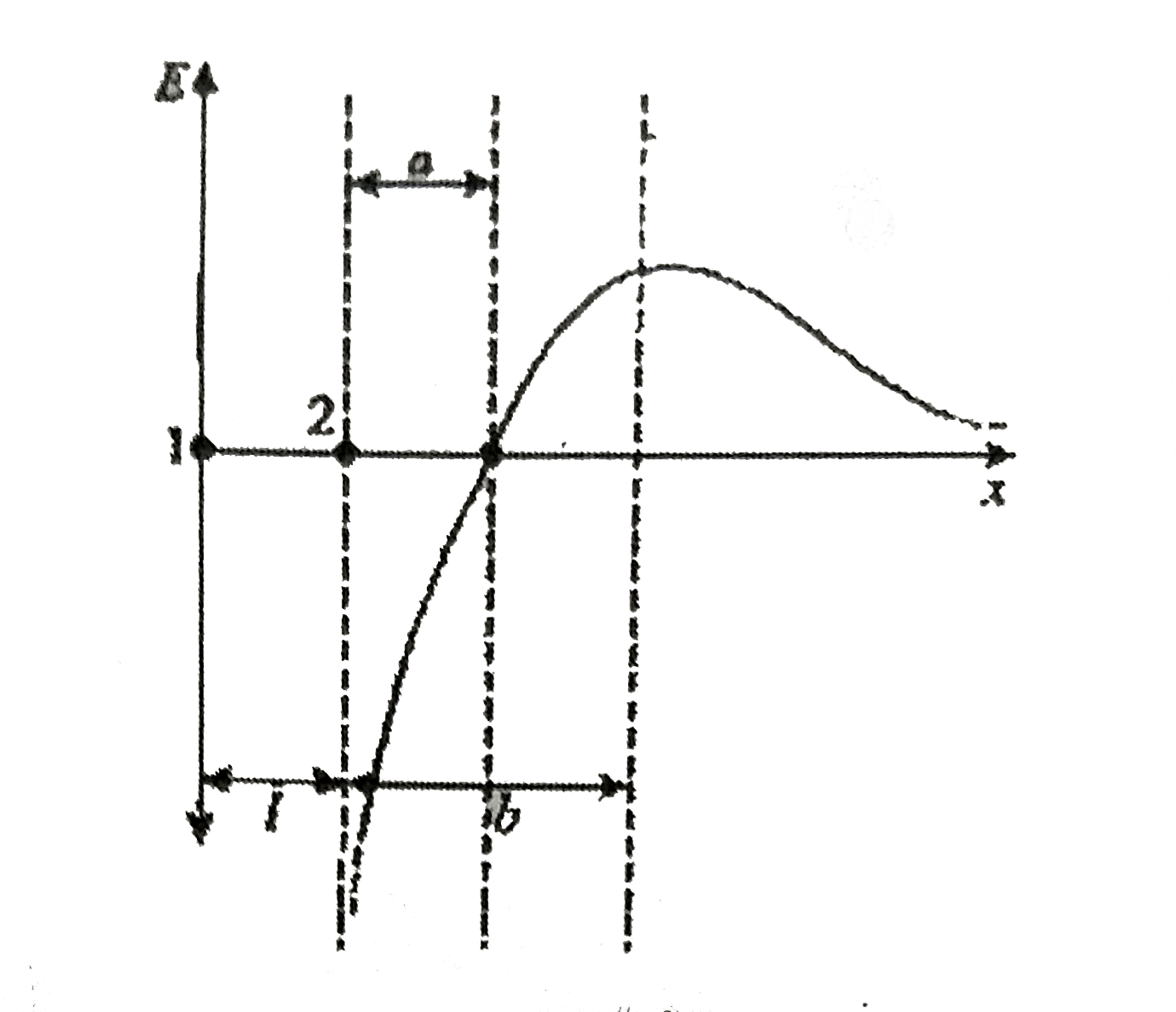
Two point charges `Q_(1)` and `Q_(2)` are positioned at points I and 2. The field intensity to the right of the charge `Q_(2)` on the line that passes through the two charges varies according to a law that is represented in the figure. The field intensity is assumed to be positive if its direction coincides with the positive direction on the x-axis. The distance between the charges is l.

(a) Find the sign of each charge
(b) Find the ratio of the absolute values of the charges `|(Q_(1))/(Q_(2))|`
(c) Find the value of b where the field intensity is maximum
[(a) `Q_(2)` is negative and `Q_(1)` is positive (b) `((l +a)/(a))^(2)`, (c) `(l)/(((l+a)/(a))^(2//3)-1)]`

Promotional Banner

Topper's Solved these Questions

  • ELECTROSTATICS

    PHYSICS GALAXY - ASHISH ARORA|Exercise Partice Exercise 1.2|1 Videos
  • ELECTROSTATICS

    PHYSICS GALAXY - ASHISH ARORA|Exercise Partice Exercise 1.3|1 Videos
  • ELECTROSTATICS

    PHYSICS GALAXY - ASHISH ARORA|Exercise Partice Exercise 1.1|1 Videos
  • ELECTROMAGNETIC INDUCTION AND ALTERNATING CURRENT

    PHYSICS GALAXY - ASHISH ARORA|Exercise Advance MCQs|33 Videos
  • GEOMETRICAL OPTICS

    PHYSICS GALAXY - ASHISH ARORA|Exercise Unsolved Numerical Problems|107 Videos

Similar Questions

Explore conceptually related problems

Two point charge Q_(a) and Q_(b) are positional at point A and B. The field strenght to the right of charge Q_(b) on the line that passes therough the two charges varies according to a law represented schematically in fig. (without employing a definite scale). The field strength is assumed to be positive if its direction coincedes with the positive direction of the x-axis. The distance between the charges is l=21 cm . (a) Find the sign of the charges. (b) Find the ration between the absolute value of charge Q_(a) and Q_(b) . (c ) Find the coordinate x of the point where the field strenght is maximum.

Two point-like charges a and b whose strengths are equal in absolute value are positioned at a certain distance from each other. Assuming the field strength is positive in the direction coinciding with the positive direction of the r axis, determine the signs of the charges for each distribution of the field strength between the charges shown in Figures (a), (b), (c), and (d).

Two point charges+ q and-q are placed at distanced apart. What are the points at which the resultant field is parallel to the line joining the two charges ?

The positions of two point charges q_(1) and q_(2) are vecr_(1) and vecr_(2) , respectively. Find the position of the point where the net field is zero due to thses charges.

A positive charge +q_(1) is located to the left of a negative charge -q_(2) On a line passing through the two charges, there are two places where the total potential is zero. The reference is assumed to be at infinity The first place is between the charges and is 4.00 cm to the left of the negative charge. The second place is 7.00cm to the right of the negative charge if q_(2)=-12muC , what is the value of charge q_(1) in muC

Two point charges (+Q) and (-2Q) are fixed on the X -axis at position a and 2a from origin respectively. At what position on the axis, the resultant electric field is zero

Two point charges (+Q) and (-2Q) are fixed on the X-axis at positions a and 2a from origin respectively. At what positions on the axis, the resultant electric field is zero

PHYSICS GALAXY - ASHISH ARORA-ELECTROSTATICS-Partice Exercise
  1. A circular wire-loop of radius a carries a total charge Q distributed ...

    Text Solution

    |

  2. An electron is constrained to move along the central axis of a ring of...

    Text Solution

    |

  3. Two point charges Q(1) and Q(2) are positioned at points I and 2. The ...

    Text Solution

    |

  4. Two wires AB & CD, each 1m length, carry a total charge of 0.2 microco...

    Text Solution

    |

  5. The diagram shows a uniformly charged hemisphere of radius R. It has v...

    Text Solution

    |

  6. An infinitely long solid cylinder of radius R has a uniform volume ch...

    Text Solution

    |

  7. There are two nonconducting spheres having uniform volume charge densi...

    Text Solution

    |

  8. Suppose the surface charge density over a sphere of radius R depends o...

    Text Solution

    |

  9. The region between two concentric spheres of radii 'a' and 'b', respec...

    Text Solution

    |

  10. A square loop of side 'l' each side having uniform linear charge densi...

    Text Solution

    |

  11. Two concentric rings, one of radius a and the other of radius b, have ...

    Text Solution

    |

  12. An infinite dielectric sheet having charge density sigma has a hole of...

    Text Solution

    |

  13. A uniform rod AB of mass m and length l is hinged at its mid point C. ...

    Text Solution

    |

  14. Two particles each charged with a charge +q are clamped on they axis a...

    Text Solution

    |

  15. An infinite number of charges each equal to q are placed along the x-a...

    Text Solution

    |

  16. A particle having a charge of 1.6 x 10^(-19) C enters midway between t...

    Text Solution

    |

  17. A circular ring of radius R with uniform positive charge density lambd...

    Text Solution

    |

  18. Two thin wire rings each having radius R are placed at distance d apar...

    Text Solution

    |

  19. A positive charge Q is uniformly distributed throughout the volume of ...

    Text Solution

    |

  20. The electric potential at surface of thin non-conducting sheet with ch...

    Text Solution

    |