Home
Class 11
PHYSICS
Three different arrangemnets of matrials...

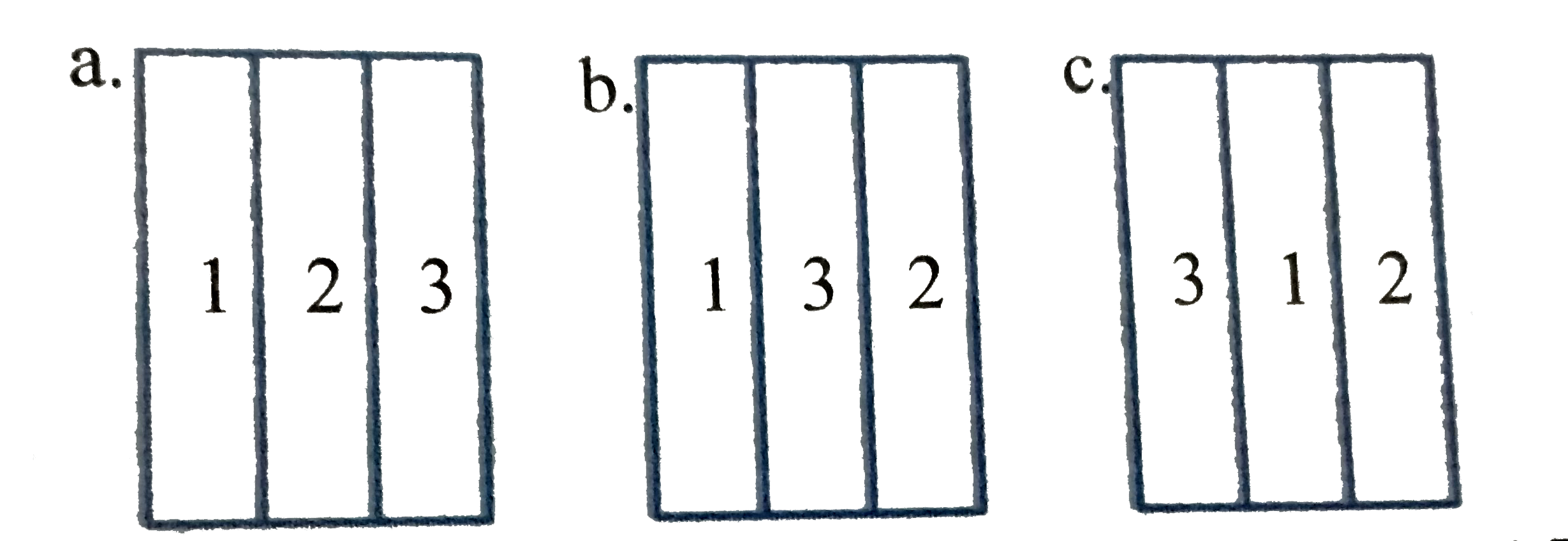
Three different arrangemnets of matrials `1` and `2,3` to from a wall Thremal conductivities are `k_(1) gt k_(2) gt k_(3)` The left side of the wall is `20^(@)C` higher than the right side Temperature difference `DeltaT` across the material 1 has following relation in three cases

A

In steady state, the rate of energy conduction through the wall III is greatest

B

In steady state, the rate of energy conduction though all the walls `(I),(II)` and `(III)` are same

C

In steady state, temperature difference across material l is greatest in wall `II`.

D

In steady state, temperature differnce across material l is same in all the walls

Text Solution

Verified by Experts

The correct Answer is:

B, D
Promotional Banner

Topper's Solved these Questions

  • TRANSMISSION OF HEAT

    CENGAGE PHYSICS|Exercise Comprehension type|3 Videos
  • TRANSMISSION OF HEAT

    CENGAGE PHYSICS|Exercise Fill in the blanks type|6 Videos
  • TRANSMISSION OF HEAT

    CENGAGE PHYSICS|Exercise Single correct|9 Videos
  • THERMODYNAMICS

    CENGAGE PHYSICS|Exercise 24|1 Videos
  • TRAVELLING WAVES

    CENGAGE PHYSICS|Exercise Integer|9 Videos

Similar Questions

Explore conceptually related problems

Two rods A and B of different materials are welded together as shown in figure. Their thermal conductivities are K_(1) and K_(2) . The thermal conductivity of the composite rod will be

Two rods A and B of different materials are welded together as shown in figure. Their thermal conductivities are K_(1) and K_(2) . The thermal conductivity of the composite rod will be

Two identical rods are made of different materials whose thermal conductivities are K_(1) and K_(2) . They are placed end to end between two heat reservoirs at temperatures theta_(1) and theta_(2) . The temperature of the junction of the rod is

Three rods of same dimension are joined in series having thermal conductivity k_1 , k_2 and k_3 . The equivalent thermal conductivity is

A partition wall has two layers of different materials A and B in contact with each other. They have the same thickness but the thermal conductivity of layer A is twice that of layer B. At steady state the temperature difference across the layer B is 50 K, then the corresponding difference across the layer A is

A composite slab consists of two slabs A and B of different materials but of the same thickness placed one on top of the other. The thermal conductivities of A and B are k_(1) and K_(2) respectively. A steady temperature difference of 12^(@)C is maintained across the composite slab. If k_(1) = K_(2)//2 , the temperature difference across slab A will be:

Two slabs A and B of different materials but of the same thicknesss are joined end to end to form a composite slab. The thermal conductivities of A and B are K_(1) and K_(2) respectively. A steady temperature difference of 12^(@) C is maintained across the composite slab. If K_(1) = K_(2)/2 , the temperature difference across slabs A is

A slab consists of two layers of different materials of the same thickness and having thermal conductivities K_(1) and K_(2) . The equivalent thermal conductivity of the slab is
