

Home
Class 11
CHEMISTRY
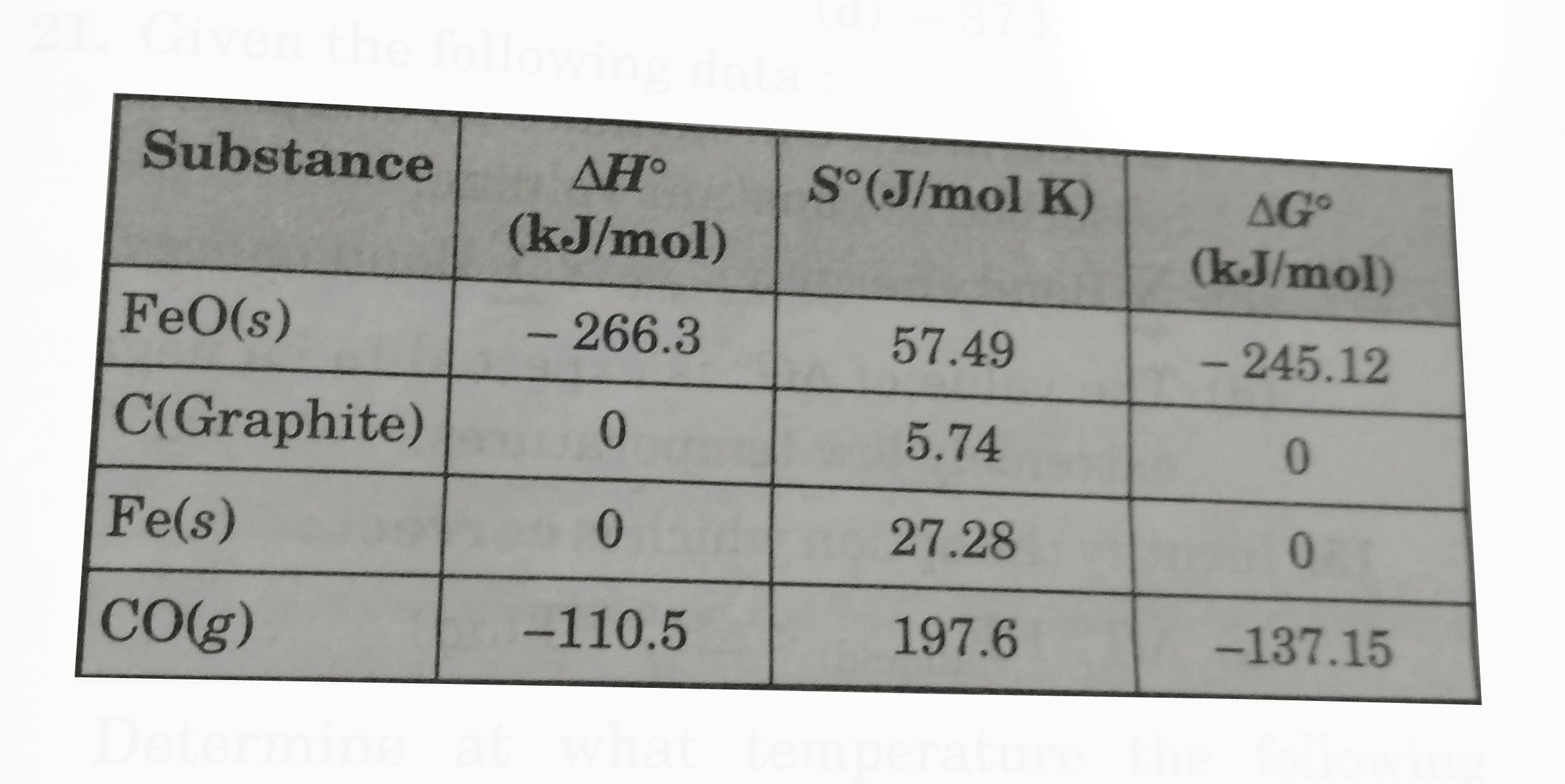
Given the following data : Determin...

Given the following data :

Determine at what temperature the following reaction is spontanous?
`FeO(s)+C_("graphite")toFe(s)+CO(g)`

A

298 K

B

668 K

C

964 K

D

`DeltaG^(@)` is `+ve`, hence the reaction will never be spontaneous

Text Solution

Verified by Experts

The correct Answer is:
C
Promotional Banner

Topper's Solved these Questions

  • SALT ANALYSIS

    GRB PUBLICATION|Exercise Subjective Type|69 Videos

Similar Questions

Explore conceptually related problems

Given the following data {:("Substance",DeltaH^(@)(KJ//mol),S^(@)(J//mol K),DeltaG^(@)(kJ//mol),),(FeO(s),-266.3,57.49,-245.12,),(C("Graphite"),0,5.74,0,),(Fe(s),0,5.74,0,),(CO(g),-110.5,197.6,-137.15,):} Determine at what temperature the following reaction is spontaneous? FeO(s)+C("Graphite")rarrFe(s)+CO(g)

Given the following data: {:("Substance", DeltaH^(@)"(KJ//mol)", S^(@)"(J//mol K)", DeltaG^(@)"(KJ//mol)"),(FeO(s),-266.3,57.49,-245.12),(C("Graphite"), 0, 5.74, 0),(Fe(s),0,27.28,0),(CO(g),-110.5,197.6,-137.15):} Determine at what temperature the following reaction is spontaneous? " "FeO(S) + C("Graphite") rarr Fe(s) + CO(g)

In which of the following cases, the reaction is spontaneous at all temperatures

Which of the following is//are the rate determining step (s) of the given reaction ? .

At 1250 K 2FeO(s)to2Fe(s)+O_(2)(g) , DeltaG=+320kJmol^(-1) of O_(2) 2C(s)+O_(2)(g)to2CO(g) , DeltaG=-430 kJ mol^(-1) of O_(2) The following coupled reaction is spontaneous because 2FeO(s)+2C(s)to2Fe(s)+2CO(g)

Calculate the temperature above which the reaction of lead oxide to lead in the following reaction become spontaneous. PbO(s) + C(s) rarr Pb(s) + CO(g) Given Delta H = 108.4 kJ mol^(-1), Delta S = 190 JK^(-1) mol^(-1)

Calculate the temperature above which the reduction of lead oxide to lead in the following reaction become spontaneous. PbO(s) + C(s) rightarrow Pb(s) + CO(g) Given Delta H = 118.4 kJ mol^(-1), Delta S = 200 JK^(-1) mol^(-1) .

Which of the following statements is (are) correct about the following reaction ? 2Pbo(s) + C(s) to 2Pb(s) + CO_(2) (g)

GRB PUBLICATION-THERMODYNAMICS-All Questions
  1. Calculate DeltaH("combustion"^(@) of C("graphite") if DeltaH(f)^(@) of...

    Text Solution

    |

  2. The bond enthalpies of C-C,C=C and C=C bonds are 348, 610 and 835 kj//...

    Text Solution

    |

  3. Given the following data : Determine at what temperature the foll...

    Text Solution

    |

  4. If DeltaH(f)^(@) for Ag^(+) (infinately diluted), NO(3)^(-) (infinity ...

    Text Solution

    |

  5. IN Haber's process of manufacturing of ammonia : N(2)(g)+3H(2)(g)to2...

    Text Solution

    |

  6. Which of the reaction defines molar DeltaH(f)^(@) ?

    Text Solution

    |

  7. In the reaction, CO(2)(g)=H(2)(g)toCO(g)=H(2)O(g)," "DeltaH=2.8 ...

    Text Solution

    |

  8. Given, H(2)(g)+Br(2)(g)to2HBr(g),DeltaH(1)^(@) and standard enthal...

    Text Solution

    |

  9. For the following reaction, C("diamond")+O(2)toCO(2)(g), DeltaH=-94....

    Text Solution

    |

  10. C(s)+O(2)(g)toCO(2)(g)," "DeltaH=-94.3 kcal//mol CO(g)+(1)/(2)O(2...

    Text Solution

    |

  11. The difference between DeltaH and DeltaE on a molar basis for the comb...

    Text Solution

    |

  12. The standard heat of combustion of solid boron is equal to :

    Text Solution

    |

  13. From the following data of DeltaH, of the following reactions C(s)+(...

    Text Solution

    |

  14. 2 mole of zinc is dissolved in HCl at 25^(@) C. The work done in open ...

    Text Solution

    |

  15. A solution of 500mL of 2M KOH is added to 500mL of 2M HCl and the mixt...

    Text Solution

    |

  16. One mole of anahydrous MgCl(2) dissolves in water and liberates 25 cal...

    Text Solution

    |

  17. C(2)H(6)(g)+3.5O(2)(g)to2CO(2)(g)+3H(2)O(g) DeltaS("vap")(H(2)O,l)=x...

    Text Solution

    |

  18. Consider the DeltaG(f)^(@) and DeltaH(f)^(@) (kJ//mol) for the followi...

    Text Solution

    |

  19. If DeltaG=-177 kcal for " "(1)2Fe(s)+(3)/(2)O(2)t...

    Text Solution

    |

  20. The bond dissociation energy of gaseous H(2),Cl(2) and HCl are 104,58,...

    Text Solution

    |