Home
Class 11
CHEMISTRY
What is the value of Delta s^(@) for th...

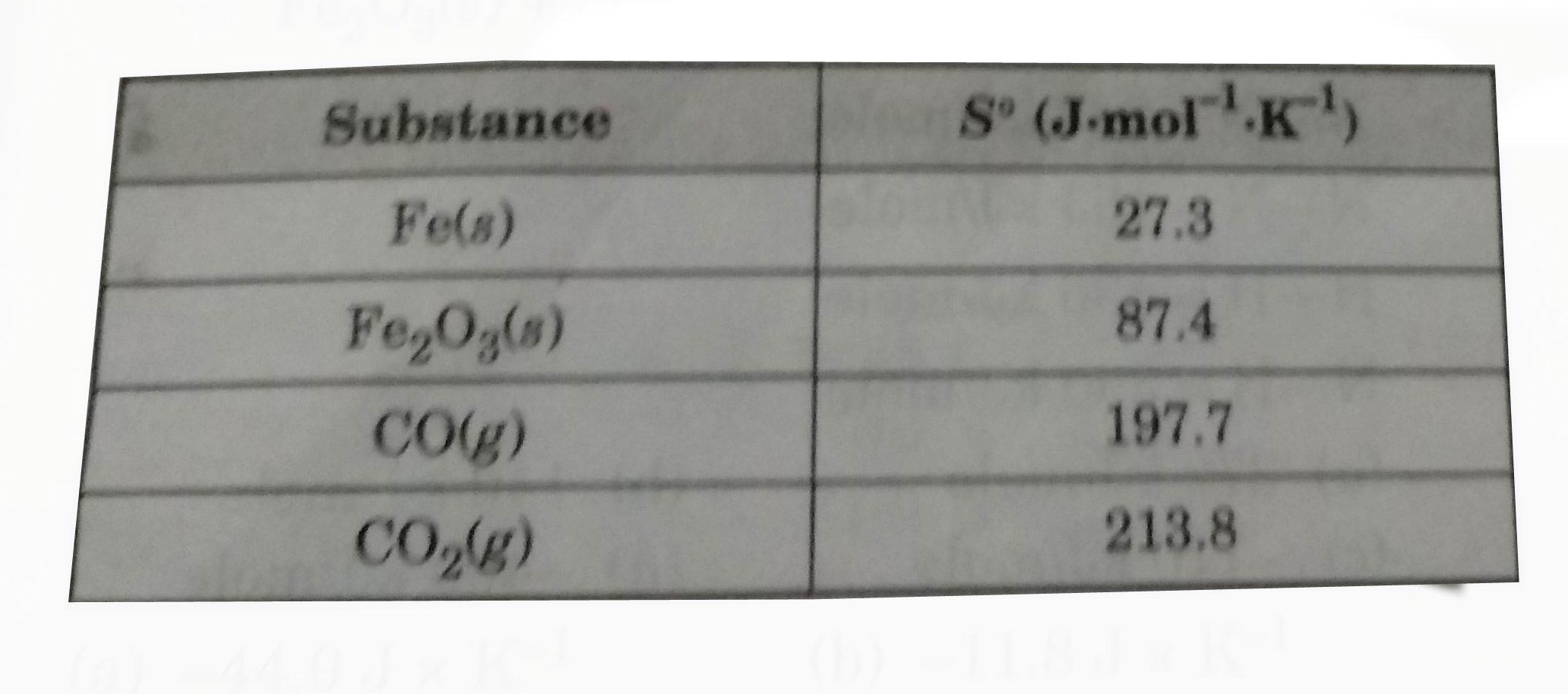
What is the value of `Delta s^(@)` for the reaction below?
`Fe_(2)O_(3)(s)+3CO(g)to2Fe(s)+3CO_(2)(g)`

A

`-44.0JxxK^(-1)`

B

`-11.8JxxK^(-1)`

C

`15.5JxxK^(-1)`

D

`42.8JxxK^(-1)`

Text Solution

Verified by Experts

The correct Answer is:

c
Promotional Banner

Topper's Solved these Questions

  • SALT ANALYSIS

    GRB PUBLICATION|Exercise Subjective Type|69 Videos

Similar Questions

Explore conceptually related problems

The following two reactions are known: Fe_(2)O_(3)(s)+3CO(g)to 2Fe(s)+3CO_(2)(g),DeltaH=-26.8kJ FeO(s)+CO(g) to Fe(s)+CO_(2)(g),DeltaH=-16.5kJ The value of DeltaH for the following reaction Fe_(2)O_(3)+CO(g) to 2FeO(s)+CO_(2)(g) is

The following two reactionas are known FeO_(3)(s)+3CO(g)rarr2Fe(s)+CO_(2)(g) : DeltaH=-26.8KJ FeO(s)+CO(g)rarrFe(s)+CO_(2)(g):DeltaH=-16.5KJ The value of DeltaH for the following reaction Fe_(2)O_(3)(s)+CO(g)rarr2FeO_(2)(s)+CO_(2)(g) is

Given (i) 2Fe_(2)O_(3)(s) rarr 4Fe(s)+3O_(2)(g) , DeltaG^(@)=+1487.0 kj mol^(-1) (ii) 2CI(g)+O_(2) rarr 2CO_(2)(g) , Delta_(r )G^(@)=-514.4 kj mol^(-1) Free energy change Delta_(r)G^(@) for the reaction 2Fe_(2)O_(3)(s)+6CO(g) rarr 4Fe(s)+6cO_(2)(g) will be :

Calculate DeltaH at 85^(@)C for the reaction: Fe_(2)O_(3)(s) +3H_(2)(g) rarr 2Fe(s) +3H_(2)O(l) The data: DeltaH_(298)^(Theta) =- 33.0 kJ mol^(-1) and {:("Substance",Fe_(2)O_(3)(s),Fe(s),H_(2)O(l),H_(2)(g)),(C_(P)^(@)(JK^(-1)mol),103.0,25.0,75.0,28.0):}

The heat of formation of Fe_(2)O_(3)(s) is -824.0 kJ.What will be the Delta H for thereaction: 2Fe_(2)O_(3)(s) to 4Fe(s) + 3O_(2)(g)

The following reaction occurs in the Blast Furnace where ions ore is reduced to iron metal : Fe_(2)O_(3)(s)+3CO(g)hArr 2Fe(l)+3CO_(2)(g) Using the Le Chatelier's principle, predict which one of the following will not disturb the equilibrium?

Fe_(2)O_(2)(s)+(3)/(2)C(s)to(3)/(2)CO_(2)(g)+2Fe(s) DeltaH^(@)=+234.12KJ C(s)+O_(2)(g)toCO_(2)(g) DeltaH^(@)=-393.5KJ Use these equations and DeltaH^(@) value to calculate DeltaH^(@) for this reaction : 4Fe(s)+3O_(2)(g)to2Fe_(2)O_(3)(s)

GRB PUBLICATION-THERMODYNAMICS-All Questions
  1. Determine the enthalpy change for the reaction of 5.00 g Fe(2)O(3)with...

    Text Solution

    |

  2. The energies of the bonds broken in a certain eaction arae greater th...

    Text Solution

    |

  3. What is the value of Delta s^(@) for the reaction below? Fe(2)O(3)(...

    Text Solution

    |

  4. Statement-1: Adiabatic free expansion of any subatance in a cosed syst...

    Text Solution

    |

  5. Statement-1: The heat absorbed during the adiabatic expansion of an a ...

    Text Solution

    |

  6. Consider a reaction : A(g)+2b(g)toC(g) DeltaH(300)^(@)=40KJ, Delta...

    Text Solution

    |

  7. Statement-1: The enthalpy of formation of H(2)O(l)is greater than of H...

    Text Solution

    |

  8. Statement -1: heat of neutralistion of perchoric acid ,HClO(4) with Na...

    Text Solution

    |

  9. Statement -1: When a gas at high pressure expands against vaccum, the...

    Text Solution

    |

  10. Statement -1 in the following reaction : C(s)+O(2)(g)to CO(2) (g), D...

    Text Solution

    |

  11. Staement -1: The heat absorbed during the isothermal expansion of an i...

    Text Solution

    |

  12. Staetement -1: The magniyude of the work involed in an isothermal expa...

    Text Solution

    |

  13. Statement -1: Entropy change in reversible adiabatic expansion of an i...

    Text Solution

    |

  14. Statement -1: The Standard free energy changes of all spontaneously oc...

    Text Solution

    |

  15. Statement -1: Enthalpy and entropy of any elements substance in the st...

    Text Solution

    |

  16. Statement-1: A reaction which is spontaneous and accompained by decrea...

    Text Solution

    |

  17. Statement -1: Many endothermic reactions that are not spontaneous at r...

    Text Solution

    |

  18. Statement-1: Decrease of free energy during the process under constant...

    Text Solution

    |

  19. Statement -1: For every chmical reaction at equilibrium , standard Gid...

    Text Solution

    |

  20. Statement-1: There is a natural asymmetry between work to heat and con...

    Text Solution

    |
