Home
Class 11
PHYSICS
A equilaterial triangle ABC formed from ...

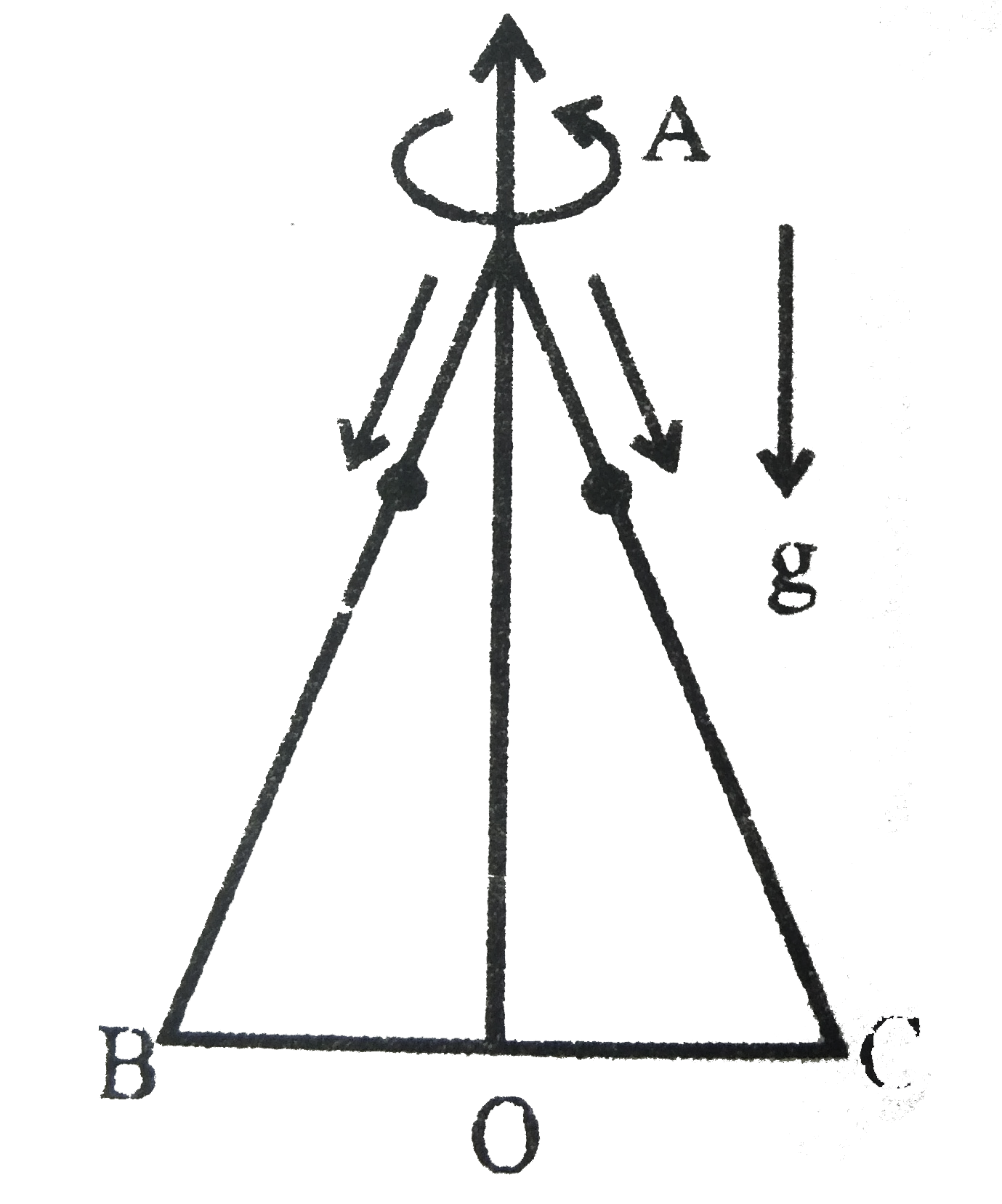
A equilaterial triangle `ABC` formed from a uniform wire has two small identical beads initially located at `A`. The triangle is set rotating about the vertical axis `AO`. Then the beads are released from rest simultaneously and allowed to slide down. one long. `AB` and the other along `AC` as shown. Neglecting frictional effects, the quantities that are conserved as the beads slide down, are.
.

Text Solution

Verified by Experts

The correct Answer is:

B
Promotional Banner

Topper's Solved these Questions

  • RIGID BODY MOTION

    ANURAG MISHRA|Exercise MCQ_TYPE|41 Videos
  • RIGID BODY MOTION

    ANURAG MISHRA|Exercise COMPREHENSION_TYPE|29 Videos
  • RIGID BODY MOTION

    ANURAG MISHRA|Exercise MATCH THE COLUMN|12 Videos
  • IMPULSE AND MOMENTUM

    ANURAG MISHRA|Exercise matching|3 Videos
  • UNIT AND DIMENSIONS

    ANURAG MISHRA|Exercise Matching Type Problem|4 Videos

Similar Questions

Explore conceptually related problems

An equailaral triangle ABC formed from a uniform wire has two small identical beads initially located at A. The triangle is set rotating about the vertical axis AO. Then the beads are released from rest simultaneously and allowed to slide down, one along AB and the other along AC as shown. Neglectig frictional effects, the equatities that are conserved as the beads slids down, are

A massless ring hangs from a thread and two beads of mass m slide it without friction. The beads are released simultaneously from the top of the ring and slide down along possible sides. Find the angle from vertical at which the ring will start to rise.

A wire, which passes through the hole in a small bead, is bent in the form of quarter of a circle. The wire is fixed vertically on ground as shown in the figure. The bead is released from near the top of the wire and it slides along the wire without friction. As the bead moves from A to B, the force it applies on the wire is

A ring of mass M hangs from a thread and two beads of mass m slides on it without friction. The beads are released simultaneously from the top of the ring and slides down in opposite sides. Show that the ring will start to rise, if mgt(3M)/(2) . ltbr.

A smooth wire is bent into a vertical circle of radius a. A bead P can slide smoothly on the wire. The circle is rotated about vertical diameter AB as axis with a speed omega as shown in figure. The bead P is at rest w.r.t. the circular ring in the position shown. then omega^(2) is equal to:

An L shaped thin uniform rod of total length 2l is free to rotate in a vertical plane about a horizontal axis a P as shown in the figure. The bas is released from rest. Neglect air and contact friction. The angular velociyt at the instant it has rotated through 90^@ and reached the dotted position shown is

Two blocks of equal mass, M each, are connected to two ends of a massless string passing over a massless pulley. On one side of the string there is a bead of mass (M)/(2) . (a) When the system is released from rest the bead continues to remain at rest while the two blocks accelerate. Find the acceleration of the blocks. (b) Find the acceleration of the two blocks if it was observed that the bead was sliding down with a constant velocity relative to the string.

A solid uniform sphere of mass M and radius R can rotate about a fixed vertical axis. There is no frictional torque acting at the axis of rotation. A light string is wrapped around the equator of the sphere. The string has exactly 6 turns on the sphere. The string passes over a light pulley and carries a small mass m at its end (see figure). The string between the sphere and the pulley is always horizontal. The system is released from rest and the small mass falls down vertically. The string does not slip on the sphere till 5 turns get unwound. As soon as 5^(th) turn gets unwound completely, the friction between the sphere and the string vanishes all of a sudden. (a) Find the angular speed of the sphere as the string leaves it. (b) Find the change in acceleration of the small mass m after 5 turns get unwound from the sphere.

A horizontal wooden block has a fixed rod OA standing on it. From top point A of the rod, two wires have been fixed to points B and C on the block. The plane of triangle OAB is perpendicular to the plane of the triangle OAC. There are two identical beads on the two wires. One of the wires is perfectly smooth while the other is rough. The wooden block is moved with a horizontal acceleration (a) that is perpendicular to the line OB and it is observed that both the beads do not slide on the wire. Find the minimum coefficient of friction between the rough wire and the bead.

AB is a light rigid rod. Which is rotating about a vertical axis passing through A,A spring of force constant K and natural length l is attached at A and its other end is attached to a small bead of mass m . The bead can slide without friction on the rod. At the initial moment the bead is at rest (w.rt. the rod) and the spring is unstreached Select correct option

ANURAG MISHRA-RIGID BODY MOTION-SCQ_TYPE
  1. A uniform rod is kept vertically on a horizontally smooth surface at ...

    Text Solution

    |

  2. A uniform rod of length l and mass M is suspended on two vertical inex...

    Text Solution

    |

  3. A equilaterial triangle ABC formed from a uniform wire has two small i...

    Text Solution

    |

  4. A translational velocity v(0) is imparted in a horizontal direction to...

    Text Solution

    |

  5. A sphere of mass m is given some angular velocity about a horizontal a...

    Text Solution

    |

  6. A semicircular lamina of mass m and radius 'r' and centre C. Its cente...

    Text Solution

    |

  7. A disc of mass m0 rotates freely about a fixed horizontal axis through...

    Text Solution

    |

  8. A plank P is placed on a solid cylinder S, which rolls on a horizontal...

    Text Solution

    |

  9. A thin wire of length L and uniform linear mass density rho is bent in...

    Text Solution

    |

  10. A round uniform body of radius R, mass M and moment of inertia 'I' rol...

    Text Solution

    |

  11. A thin rod of mass m and length l is hinged at the lower end to a leve...

    Text Solution

    |

  12. A cubical block of side L rests on a rough horizonta surface with coef...

    Text Solution

    |

  13. One quarter sector is cut from a uniform circular disc of radius R. Th...

    Text Solution

    |

  14. A cylinder rolls up an inclined plane, reaches some height, and then r...

    Text Solution

    |

  15. A circular platform is free to rotate in a horizontal plane about a ve...

    Text Solution

    |

  16. Consider a body, shown in figure, consisting of two identical balls, e...

    Text Solution

    |

  17. A particle undergoes uniform circular motion. About which point on the...

    Text Solution

    |

  18. A disc is rolling (without slipping) on a horizontal surface. C is its...

    Text Solution

    |

  19. A child is standing with folded hands at the center of a platform rota...

    Text Solution

    |

  20. A particle moves in a circular path with decreasing speed . Choose the...

    Text Solution

    |
