

Home
Class 11
PHYSICS
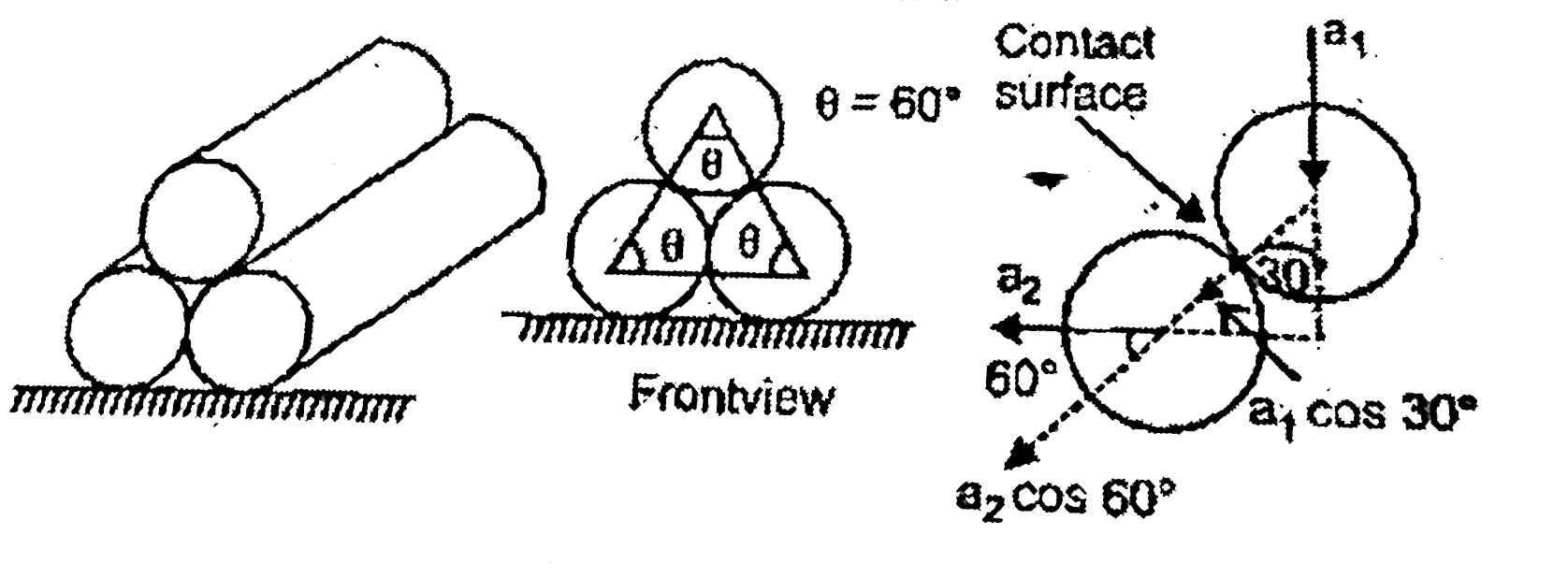
Fig shown three identical cylinders, cyl...

Fig shown three identical cylinders, cylinders are released, find relation between acceleration of cylinders.

Promotional Banner

Topper's Solved these Questions

  • FORCE ANALYSIS

    ANURAG MISHRA|Exercise Example|95 Videos
  • FORCE ANALYSIS

    ANURAG MISHRA|Exercise level 1|103 Videos
  • DESCRIPTION OF MOTION

    ANURAG MISHRA|Exercise Level-3|34 Videos
  • IMPULSE AND MOMENTUM

    ANURAG MISHRA|Exercise matching|3 Videos

Similar Questions

Explore conceptually related problems

In the Fig. shown find relation between acceleration of wedge 1 and 2

A cylinder rolls down an inclined plane of inclination 30^@ , the acceleration of cylinder is

A solid cylinder has a thin string wrapped several times around its circumference. The string is fixed at one end and the cylinder is released. Find the downward acceleration of cylinder and tension in the string.

A string is wrapped several times round a solid cylinder. Then free end of the string is held stationary. If the cylinder is released to move down, then the acceleration of that cylinder is

Two identical solid cylinders are released from the top of two inclined planes of equal angles. If one cylinder is in pure rolling and other is in pure sliding motion then

A uniform solid cylinder of density 0.8g//cm^3 floats in equilibrium in a combination of two non-mixing liquids A and B with its axis vertical. The densities of the liquids A and B are 0.7g//cm^3 and 1.2g//cm^3 , respectively. The height of liquid A is h_A=1.2cm. The length of the part of the cylinder immersed in liquid B is h_B=0.8cm . (a) Find the total force exerted by liquid A on the cylinder. (b) Find h, the length of the part of the cylinder in air. (c) The cylinder is depressed in such a way that its top surface is just below the upper surface of liquid A and is then released. Find the acceleration of the cylinder immediately after it is released.

Find the relation in the accelerations of the three masses shown in fig.

A plank of mass M is placed on a smooth surface over which a cylinder of mass m and radius R is placed as shown in figure-5.63. Now the plank is pulled towards right with an external force F. If cylinder does not slip over the surface of plank find the linear acceleration of plank and cylinder and the angular acceleration of the cylinder.

A force F acts tangentially at the highest point of a solid cylinder of mass m kept on a rough horizontal plane. If the cylinder rolls without slipping, find the acceleration of the center of cylinder.

A cylinder of mass m is kept on an inclined plane haivng an angle of inclination 30^(@) . Axis of the cylinder makes an angle 30^(@) with the line along the greatest slope. Assuming that cylinder rolls without slipping, the acceleration of the cylinder is