

Home
Class 11
PHYSICS
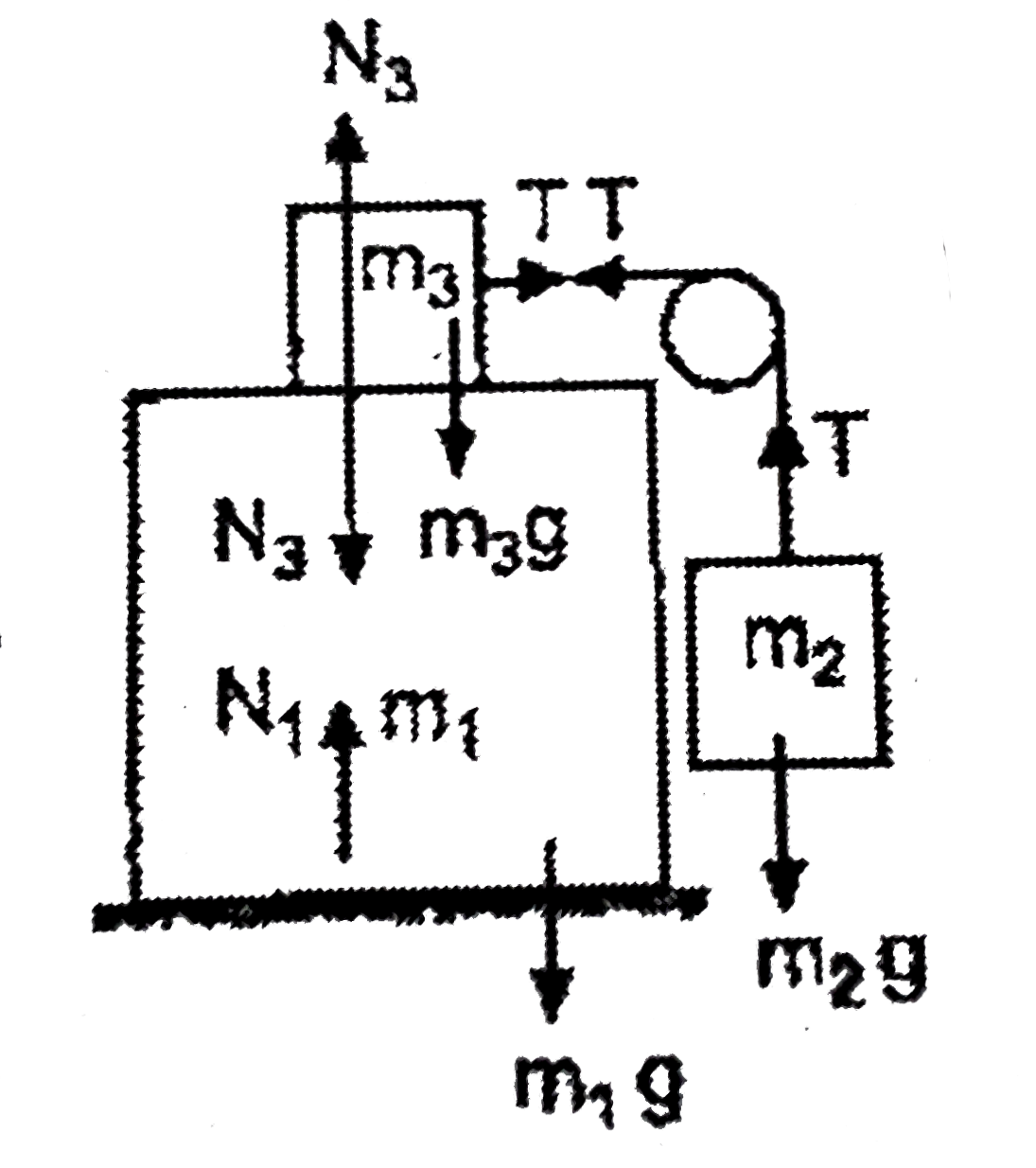
In the system shownin Fig. 2E.5 (a), blo...

In the system shownin Fig. 2E.5 (a), block `m_(2)` is being prevented from descending by pulling `m_(1)` to the right with force F. Assuming all the surfaces to be surfaces to be frictionless, find F.

Promotional Banner

Topper's Solved these Questions

  • FORCE ANALYSIS

    ANURAG MISHRA|Exercise level 1|103 Videos
  • FORCE ANALYSIS

    ANURAG MISHRA|Exercise Level-2|73 Videos
  • FORCE ANALYSIS

    ANURAG MISHRA|Exercise Matching type|13 Videos
  • DESCRIPTION OF MOTION

    ANURAG MISHRA|Exercise Level-3|34 Videos
  • IMPULSE AND MOMENTUM

    ANURAG MISHRA|Exercise matching|3 Videos

Similar Questions

Explore conceptually related problems

The system shown in the Fig. is given an acceleration 'a' towards left. Assuming all the surfaces to be frictionless, find the force on the sphere.

As per the diagram given in fig. The free-body diagram of M is fig. (correct or incorrect). Assume all surface are frictionless.

Figure-2.57 shows a large block of mass M, supporting two small mass m_(1) and m_(2) , connected by a light, frictionless thread. A force F is acting on M, such that the block m_(1) is sliding down, with an acceleration a_(1) . Find the force F applied on M and also the acceleration of M. Assuming all surfaces are frictionless.

Find the mass of the hanging block in which will prevent the smaller block of mass m from slipping over the triangular block of mass M. All the surfaces are frictionless and the strings and the pulleys are light

Arrangement of two block system is as shown. The net force acting on 1 kg and 2 kg block are (assuming the surfaces to be frictionless) respectively -

Find the mass (in kg) of the hanging block which will prevent the smaller block from slipping over the triangular block. All the surfaces are frictionless and the strings and the pulleys are light. Given m=M=1kg,cottheta=2 ,

Three block A,B,and C of mass m_(1),m_(2) and m_(3) , respectively are resting one on top of the other as shown in fig. A horizontal force F is applied on block B. Assuming all the surfaces are frictionless, calculate (1) acceleration of block A, block B, and block C, (2) normal reactions between A and B, B and C, and between C and ground .

A block of mass M is being pulled with the help of a string of mass m and length L. the horizontal force applied by the man on the string is F. Determine (a) Find the force exerted by the string on the block and acceleration of system. (b) Find the tension at the mid point of the string. (c ) Find the tension at a distance x from the end at which force is applied. Assume that the block is kept on a frictionless horizontal surface and the mass is uniformly distributed in the string.

In fig. mass m is being pulled on the incline of a wedge of mass M. All the surfaces are smooth. Find the acceleration of the wedge.

ANURAG MISHRA-FORCE ANALYSIS-Example
  1. A bucket is suspended by two light ropes a and b as shown in fig. 2E.3...

    Text Solution

    |

  2. (a) shows a block of mass m(1) sliding on a block of mass m(2), with m...

    Text Solution

    |

  3. In the system shownin Fig. 2E.5 (a), block m(2) is being prevented fro...

    Text Solution

    |

  4. A block of mass m(1) on a smooth, horizontal· swface is: connected to ...

    Text Solution

    |

  5. A small cubical block is placed on a triangular block M so that ,they ...

    Text Solution

    |

  6. A block of mass 1 kg is kept on the tilted floor ofa lift moving, down...

    Text Solution

    |

  7. A particle of mass 10 kg is acted upon by a force F along the line of ...

    Text Solution

    |

  8. A homogeneous and flexible chain rests on a wedge whose side edges mak...

    Text Solution

    |

  9. A body A weighting P(1) descends down inclined plane D fixed of a wedg...

    Text Solution

    |

  10. The pull P is is just sufficient to keep the 14 N block in equilibrium...

    Text Solution

    |

  11. For the equilibrium situation shown, the cords are strong enough to wi...

    Text Solution

    |

  12. Two block a and B having masses m(1)=1 kg, m(2)=4 kg are arranged as s...

    Text Solution

    |

  13. In the figure find the velocity and acceleration of B, if instaneous v...

    Text Solution

    |

  14. In the figure shown, friction force between the bend and the light str...

    Text Solution

    |

  15. In Fig. shown, both blocks are released from rest. Length of 4 kg bloc...

    Text Solution

    |

  16. A bead C can move freely on a horizontal rod. The bead is connected by...

    Text Solution

    |

  17. A lift goes up with 10 m/s. a pulley P is fixed to the ceiling of the ...

    Text Solution

    |

  18. In the situation given all surfaces are frictionless, pulley is ideal ...

    Text Solution

    |

  19. Three blocks shown in move vertically with constant velocities The rel...

    Text Solution

    |

  20. System is shown in figure. All the surface are smooth. Rod is move by ...

    Text Solution

    |