

Home
Class 11
PHYSICS
In the figure shown, friction force betw...

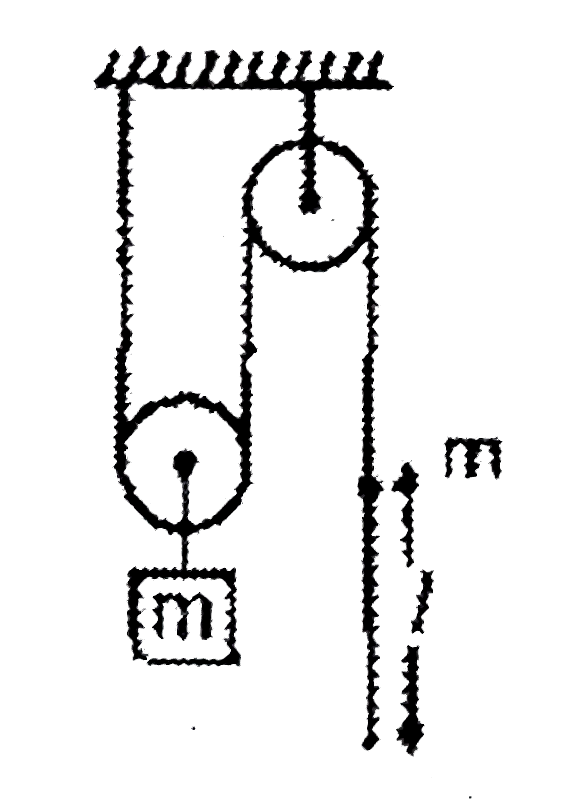
In the figure shown, friction force between the bend and the light string is `(mg)/4`. Find the time in which the bead loose contact with the string after the system is released from rest.

Promotional Banner

Topper's Solved these Questions

  • FORCE ANALYSIS

    ANURAG MISHRA|Exercise level 1|103 Videos
  • FORCE ANALYSIS

    ANURAG MISHRA|Exercise Level-2|73 Videos
  • FORCE ANALYSIS

    ANURAG MISHRA|Exercise Matching type|13 Videos
  • DESCRIPTION OF MOTION

    ANURAG MISHRA|Exercise Level-3|34 Videos
  • IMPULSE AND MOMENTUM

    ANURAG MISHRA|Exercise matching|3 Videos

Similar Questions

Explore conceptually related problems

In the fig shown below, friction force between the bead and the light string is (mg)/4 if t=sqrt((nl)/(7g)) where t is the time in which the bead loose contact with the string after the system is released from rest, find n

In the figure shown, the frictional coefficient between the table and the block is 0.2. Find the ratio of tensions in the right and the left strings.

The friction coefficient between the table and the block shown in figure is 0.2. Find the tension in the two strings.

Block A of mass m and block B of mass 2m are placed on a fixed triangular wedge by means of a light and inextensible string and a frictionless pulley as shown in fig . The wedge is inclined at 45^(@) to the horizontal on both sides . The coefficient of friction between the block A and the wedge is 2//3 and that between the block B and the wedge is 1//3 .If the system of A and B is released from rest then find . a. the acceleration of A b. tension in the string c.the magnitude and direction of the frictional force acting on A

In the system shown in the figure , a bead of mass m can slide on the string. There is friction beween the bead and the string. Block B has mass equal to twice that of the bead. The system is released from rest with lenth l=18.75m of the string hanging below the bead. Assuming the pulley and string to be massless. Find the distance (in meter) moved by the block B before the bead slips out of the thread.

In the system shown in the fig., the bead of mass m can slide on the string. There is friction between the bead and the string. Block has mass equal to twice that of the bead. The system is released from rest with length l of the string hanging below the bead. Calculate the distance moved by the block before the bead slips out of the thread. Assume the string and pulley to be massless.

An arrangement of the masses and pulleys is shown in the figure. Strings connecting masses A and B with pulley are horizontal and all pulleys and strings are light. Friction coefficient between the surface and the block B is 0.2 and between block A and B is 0.7 . The system is released from rest. (use g=10m//s^(2))

In the arrangements shown in the figure there is friction only between the light string and the sharp spike at the point P. when the blocks are in motion, the tensions in the vertical and horizontal sections of the string are 4N and 3N respectively. The co-efficient of friction between the string and the spike is equal to

In the system shown in the given figure, the inline is frictionless, the string is massless, and inextensible pulley is light and frictionless. The system is released from rest.

ANURAG MISHRA-FORCE ANALYSIS-Example
  1. Two block a and B having masses m(1)=1 kg, m(2)=4 kg are arranged as s...

    Text Solution

    |

  2. In the figure find the velocity and acceleration of B, if instaneous v...

    Text Solution

    |

  3. In the figure shown, friction force between the bend and the light str...

    Text Solution

    |

  4. In Fig. shown, both blocks are released from rest. Length of 4 kg bloc...

    Text Solution

    |

  5. A bead C can move freely on a horizontal rod. The bead is connected by...

    Text Solution

    |

  6. A lift goes up with 10 m/s. a pulley P is fixed to the ceiling of the ...

    Text Solution

    |

  7. In the situation given all surfaces are frictionless, pulley is ideal ...

    Text Solution

    |

  8. Three blocks shown in move vertically with constant velocities The rel...

    Text Solution

    |

  9. System is shown in figure. All the surface are smooth. Rod is move by ...

    Text Solution

    |

  10. Find the tension to hold the car equilibrium, if there is no friction.

    Text Solution

    |

  11. A steel ball is suspended from the ceiling of an accelerating carriage...

    Text Solution

    |

  12. A block of mass 10 kg is kept on ground. A vertically upward force F=(...

    Text Solution

    |

  13. The system of two weights with masses m(1) and m(2) are connected with...

    Text Solution

    |

  14. An object of mass m is suspended in equilibrium using a string of leng...

    Text Solution

    |

  15. The system shown in the Fig. is in equilibrium. Find the initial accel...

    Text Solution

    |

  16. The mass in the fig. can slide on a frictionless surface. The mass is ...

    Text Solution

    |

  17. Block A of mass m is placed over a wedge of same mass m. Both the bloc...

    Text Solution

    |

  18. In the pulley system shown in figure the movable pulleys A, B and C ar...

    Text Solution

    |

  19. Two identical blocks each having a mass of 20 kg are connected to each...

    Text Solution

    |

  20. Three blocks A, B, & C are arranged as shown. Pulley and strings are i...

    Text Solution

    |