

Home
Class 11
PHYSICS
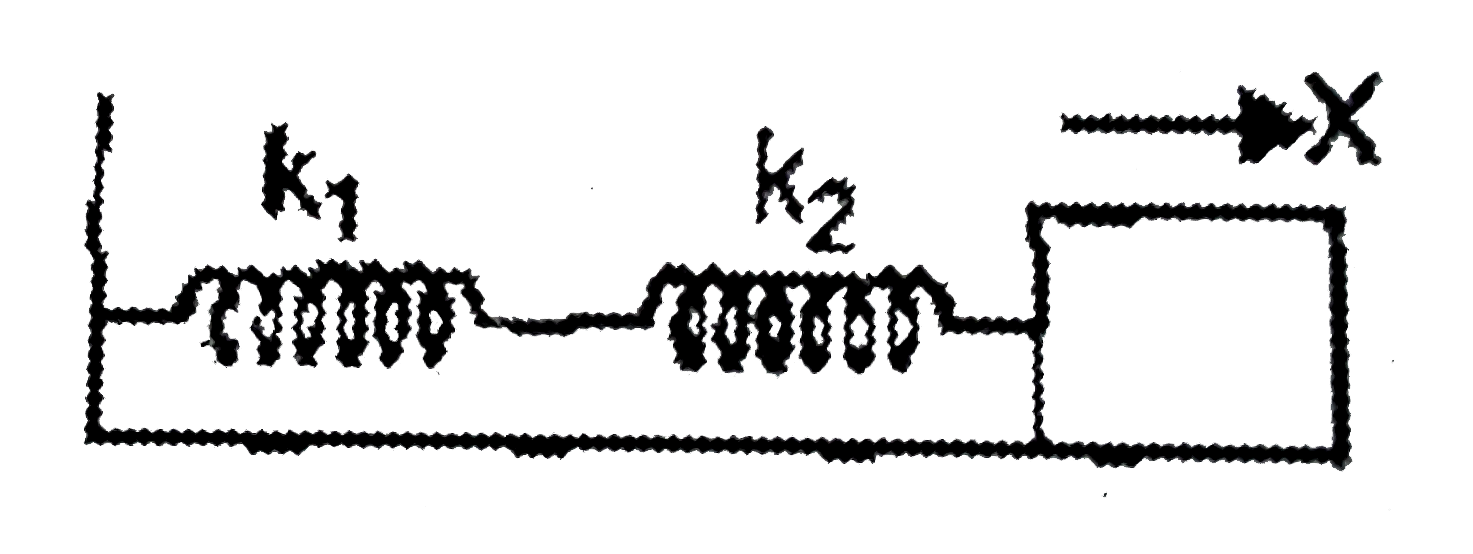
The mass in the fig. can slide on a fric...

The mass in the fig. can slide on a frictionless surface. The mass is pulled out by a distance `x`. The spring constants are `k_(1)` and `k_(2)` respectively. Find the force pulling back on the mass and orce on the wall.

Promotional Banner

Topper's Solved these Questions

  • FORCE ANALYSIS

    ANURAG MISHRA|Exercise level 1|103 Videos
  • FORCE ANALYSIS

    ANURAG MISHRA|Exercise Level-2|73 Videos
  • FORCE ANALYSIS

    ANURAG MISHRA|Exercise Matching type|13 Videos
  • DESCRIPTION OF MOTION

    ANURAG MISHRA|Exercise Level-3|34 Videos
  • IMPULSE AND MOMENTUM

    ANURAG MISHRA|Exercise matching|3 Videos

Similar Questions

Explore conceptually related problems

The mass in the figure can slide on a frictionless surface. When the mass is pulled out, spring 1 is stretched a distance x_(1) and spring 2 is stretched a distance x_(2). The spring constants are k_(1) and k_(2) respectively. Magnitude of spring force pulling back on the mass is

A mass M is suspended by two springs of force constants K_(1) and K_(2) respectively as shown in the diagram. The total elongation (stretch) of the two springs is

Three masses are connected as shown in figure on a horizontal frictionless surface and pulled by a force of 60 N. The tensions T_1 and T_2 are in the ratio

Two blocks (1 and 2) of equal mass m are connected by an ideal string (see figure shown) over a frictionless pulley. The blocks are attached to the ground by springs having spring constants k_(1) and k_(2) such that k_(1) gt k_(2) Initially, both springs are unstretched. The block 1 is slowly pulled down a distance x and released. Just after the release the possible values of the magnitude of the acceleration of the blocks a_(1) and a_(2) can be–

Two masses m_1 and m_2 re connected by a spring of spring constnt k and are placed on as frictionless horizontal surface. Initially the spring is tretched through a distance x_0 when the system is released from rest. Find the distance moved by the tow masses before they again come to rest.

A mass m is suspended from the two coupled springs connected in series. The force constant for spring are k_(1) and k_(2) . The time period of the suspended mass will be:

As shown in the figure, two light springs of force constant k_(1) and k_(2) oscillate a block of mass m. Its effective force constant will be

A block is placed on a frictionless horizontal table. The mass of the block is m and springs are attached on either side with force constants K_(1) and K_(2) . If the block is displaced a little and left to oscillate, then the angular frequency of oscillation will be

In Fig. three identical massless springs are kept horizontal. The left end of the first is tied to a wall. The left end of the second spring is tied to a block of mass m placed on rough ground and the ,eft end of the third spring is tied to a block of mass m placed frictionless ground. The right end of each spring is pulled by a force that is increased gradually from zero to F. Extensions in these springs are x_(1) , x_(2) and x_(3) , respectively. Find the relationship between x_(1) , x_(2) , and x_(3)

ANURAG MISHRA-FORCE ANALYSIS-Example
  1. An object of mass m is suspended in equilibrium using a string of leng...

    Text Solution

    |

  2. The system shown in the Fig. is in equilibrium. Find the initial accel...

    Text Solution

    |

  3. The mass in the fig. can slide on a frictionless surface. The mass is ...

    Text Solution

    |

  4. Block A of mass m is placed over a wedge of same mass m. Both the bloc...

    Text Solution

    |

  5. In the pulley system shown in figure the movable pulleys A, B and C ar...

    Text Solution

    |

  6. Two identical blocks each having a mass of 20 kg are connected to each...

    Text Solution

    |

  7. Three blocks A, B, & C are arranged as shown. Pulley and strings are i...

    Text Solution

    |

  8. The system shown in the Fig. is given an acceleration 'a' towards left...

    Text Solution

    |

  9. The block B starts from rest and slides on the wedge A which can move ...

    Text Solution

    |

  10. In the Fig. shown, mass 'm' is being pulled on the incline of a wedge ...

    Text Solution

    |

  11. A rod 'A' constrained to move in vertical direction rests on a wedge B...

    Text Solution

    |

  12. A block weighing 20 N rests on a horizontal surface. The: coefficient ...

    Text Solution

    |

  13. A wedge of mass M makes an angle theta with the horizontal. The wedge ...

    Text Solution

    |

  14. Find the acceleration of the block and magnitude and direction of fric...

    Text Solution

    |

  15. The 10 kg block is resting on the horizontal surface when the force 'F...

    Text Solution

    |

  16. A force F = 20 N is applied to a block (at rest) as shown in figure. A...

    Text Solution

    |

  17. Find the contact force on the 1 kg block.

    Text Solution

    |

  18. Blocks A and Bin the Fig. 2E.46 .(a) are connected With a string of ne...

    Text Solution

    |

  19. In the Fig. shown a time dependent force F expressed as F=kt is applie...

    Text Solution

    |

  20. m=20 kg, mu(s)=0.5, find friction on block.

    Text Solution

    |