

Home
Class 11
PHYSICS
In the pulley system shown in figure the...

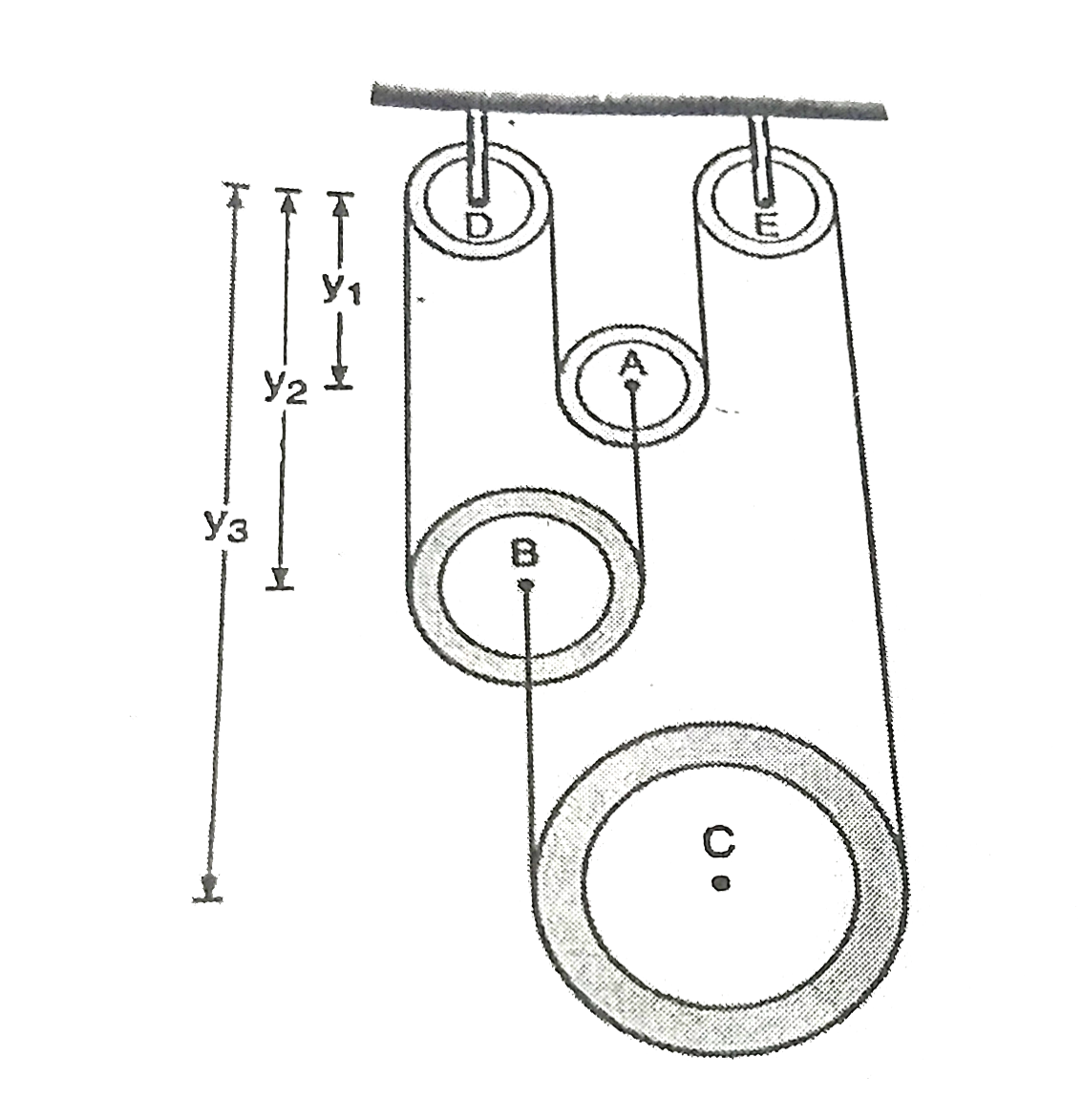
In the pulley system shown in figure the movable pulleys A, B and C are of 1 kg each D and E are fixed pulleys. The strings are light and inextensible find the accelerations of the pulleys and tension in the string.

Promotional Banner

Topper's Solved these Questions

  • FORCE ANALYSIS

    ANURAG MISHRA|Exercise level 1|103 Videos
  • FORCE ANALYSIS

    ANURAG MISHRA|Exercise Level-2|73 Videos
  • FORCE ANALYSIS

    ANURAG MISHRA|Exercise Matching type|13 Videos
  • DESCRIPTION OF MOTION

    ANURAG MISHRA|Exercise Level-3|34 Videos
  • IMPULSE AND MOMENTUM

    ANURAG MISHRA|Exercise matching|3 Videos

Similar Questions

Explore conceptually related problems

In the pulley system shown the movable pulleys A,B and C have mass m each, D and E are fixed pulleys. The strings are vertical light and inextensible Then .

All pulleys are massless The string is light and inextensible Find acceleration of centre of pulley 'p' in m//s^(2)

Find the acceleration blocks in fig. The pulley and the string are massless.

The strings are inextensible and light : the pulleys are smooth and light. Find the acceleration of each block and tensions in the strings.

Consider4 the situation shown in figure. Bothe the pulleys and the string are light and all the surfaces are friction less. a. Find the acceleration of the mass M. b. Find the tension in the string c. Calculate the force exerted by the clamp on the pulley A in the figure.

In the arrangement shown, the pulleys and the strings are ideal.The acceleration of the block B is

The tension in the string in the pulley system shown in .

In the situation shown in figure F=500 newton applied on the pulley m_(1)=50 kg and m_(2) = 10 kg and pulley and strings are massless and frictionless. Then the acceleration of the pulley is : [g = 10 m//s^(2)]

Consider the situation shown in figure .Both the pulleys and the string and light and all the surfaces are smooth. (a) Find the acceleration of 1kg block. (b) Find the tension in the string. (g = 10 m//s^(2)) .

ANURAG MISHRA-FORCE ANALYSIS-Example
  1. The mass in the fig. can slide on a frictionless surface. The mass is ...

    Text Solution

    |

  2. Block A of mass m is placed over a wedge of same mass m. Both the bloc...

    Text Solution

    |

  3. In the pulley system shown in figure the movable pulleys A, B and C ar...

    Text Solution

    |

  4. Two identical blocks each having a mass of 20 kg are connected to each...

    Text Solution

    |

  5. Three blocks A, B, & C are arranged as shown. Pulley and strings are i...

    Text Solution

    |

  6. The system shown in the Fig. is given an acceleration 'a' towards left...

    Text Solution

    |

  7. The block B starts from rest and slides on the wedge A which can move ...

    Text Solution

    |

  8. In the Fig. shown, mass 'm' is being pulled on the incline of a wedge ...

    Text Solution

    |

  9. A rod 'A' constrained to move in vertical direction rests on a wedge B...

    Text Solution

    |

  10. A block weighing 20 N rests on a horizontal surface. The: coefficient ...

    Text Solution

    |

  11. A wedge of mass M makes an angle theta with the horizontal. The wedge ...

    Text Solution

    |

  12. Find the acceleration of the block and magnitude and direction of fric...

    Text Solution

    |

  13. The 10 kg block is resting on the horizontal surface when the force 'F...

    Text Solution

    |

  14. A force F = 20 N is applied to a block (at rest) as shown in figure. A...

    Text Solution

    |

  15. Find the contact force on the 1 kg block.

    Text Solution

    |

  16. Blocks A and Bin the Fig. 2E.46 .(a) are connected With a string of ne...

    Text Solution

    |

  17. In the Fig. shown a time dependent force F expressed as F=kt is applie...

    Text Solution

    |

  18. m=20 kg, mu(s)=0.5, find friction on block.

    Text Solution

    |

  19. Find theta at which slipping will start. mu(s) is coefficient of stati...

    Text Solution

    |

  20. Blocks are given velocities as shown at t=0, find velocity and positio...

    Text Solution

    |