

Home
Class 12
PHYSICS
A concave mirror of focal length 20 cm i...

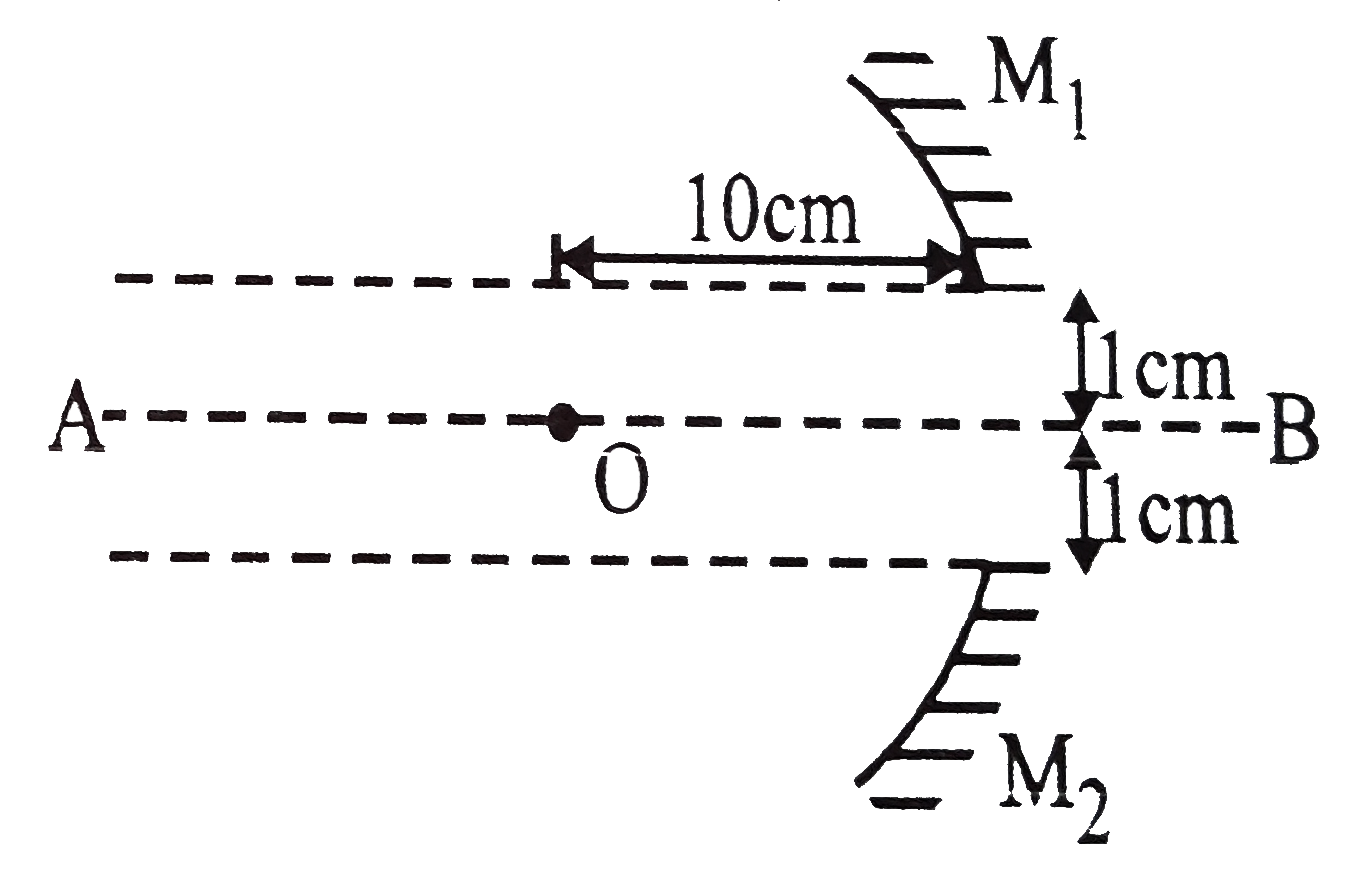
A concave mirror of focal length `20 cm` is cut into two parts from the middle and the two parts are moved perpendicularly by a distance `1 cm` from the previous principal axis `AB` .find the distance between the images formed by the two parts?

Promotional Banner

Topper's Solved these Questions

  • GEOMETRICAL OPTICS

    PHYSICS GALAXY - ASHISH ARORA|Exercise Practive Exercise 5.1|10 Videos
  • GEOMETRICAL OPTICS

    PHYSICS GALAXY - ASHISH ARORA|Exercise Practive Exercise 5.2|6 Videos
  • ELECTROSTATICS

    PHYSICS GALAXY - ASHISH ARORA|Exercise Unsolved Numberical Problems|73 Videos
  • HEAT AND THERMAL EXPANSION

    PHYSICS GALAXY - ASHISH ARORA|Exercise UNSOLVED NUMRICAL PROBLEMS FOR PREPARATION OF NSEP, INPhO & IPhO|82 Videos

Similar Questions

Explore conceptually related problems

A concave mirror of focal length 20cm is cut into two parts from the middle and the two parts are moved perpendicularly bya distanc e 1cm from the previous principal axis AB .find the distance between the images fromed by the two parts?

A concave mirror forms real image of a point source lying on the optical axis at a distance of 50cm from the mirror. The focal length of the mirror is 25cm. The mirror is cut in two, and its halves are drawn at a distance of 1 cm apart in a direction perpendicular to the optical axis. Q. The distance between the two images formed by the two halves of the mirror is

An object is placed between two identical convex mirrors X and Y of focal length 15 cm a the midpoint on their common principal axis. If the two mirrors are separated by a distance of 20 cm, determine the distance of the first two images formed in the mirror Y .

An object is placed at a distance of 20 cm from the pole of a concave mirror of focal length 10 cm. The distance of the image formed is

A symmetrical converging convex lens of focal length 10 cm & diverging concave symmetrical lens of focal length -20 cm are cut from the middle and perpendicularly and symmetrically to their principal axis. The parts thus obtained are arrenged as shown in the figure. Find the focal length (in cm ) of this arragement

An object is located at a distance 30cm on principal axis from the pole of a concave mirror of focal length 20cm. Suddenly the mirror is displaced by a distance 1.5 cm in the direction normal to its principal axis. Calculate the displacement of image produced by the mirror due to this.

Concave mirror forms the real image of a point source lying on the optical axis at a distance of 50 cm from the mirror. The focal length of the mirror is 25 cm. The mirror is cut into and its halves are drawn a distance of 1 cm apart in a direction perpendicular to the optical axis. How will the image formed by the halves of the mirror be arranged?

A point object is placed at a distance 20 cm from the focus of a concave mirror of radius of curvature 20 cm. Find the distance (in cm) of the image from the focus.

PHYSICS GALAXY - ASHISH ARORA-GEOMETRICAL OPTICS-Unsolved Numerical Problems
  1. A concave mirror of focal length 20 cm is cut into two parts from the ...

    Text Solution

    |

  2. The left end of a long glass rod of index 1.6350 is grounded and polis...

    Text Solution

    |

  3. Focal length of a convex lense in air is 10cm. Find its focal length...

    Text Solution

    |

  4. Find the distance of an object from a convex lens if image is two ti...

    Text Solution

    |

  5. A pile 4m high driven into the bottom of a lake is 1m above the wat...

    Text Solution

    |

  6. An object is placed 12 cm to the left of a diverging lens of focal len...

    Text Solution

    |

  7. A solid glass sphere with radius R and an index of refraction 1.5 is s...

    Text Solution

    |

  8. A glass sphere with 10 cm radius has a 5 cm radius spherical hole at i...

    Text Solution

    |

  9. A source of light is located at double focal length from a convergent ...

    Text Solution

    |

  10. A parallel beam of rays is incident on a consisting pf three thin lens...

    Text Solution

    |

  11. A ray of light is incident on the left vertical face of glass cube of ...

    Text Solution

    |

  12. One face of a prism with a refrective angle of 30^@ is coated with sil...

    Text Solution

    |

  13. In an isosceles prism of prism angle 45^(@), it is found that when the...

    Text Solution

    |

  14. An astronomical telescope with objective of focal length 100 cm and ey...

    Text Solution

    |

  15. Figure shows a right angled prism ABC having refractive mu(g)=(3)/(2) ...

    Text Solution

    |

  16. An equilateral prism deviates a ray through 40° for two angles of inci...

    Text Solution

    |

  17. A ray of light strikes a glass slab of thickness t. (i) Prove that i...

    Text Solution

    |

  18. A plano-convex lens has thickness 4cm. When places on a horizontal tab...

    Text Solution

    |

  19. An image Y is formed of a point object x by a lens whose optic axis is...

    Text Solution

    |

  20. A thin plano-convex lens.of focal length f is split into two halves : ...

    Text Solution

    |

  21. The focal lengths of the objective and the eye piece of a compound mic...

    Text Solution

    |