

Home
Class 12
PHYSICS
A concave mirror of radius 40 cm lies on...

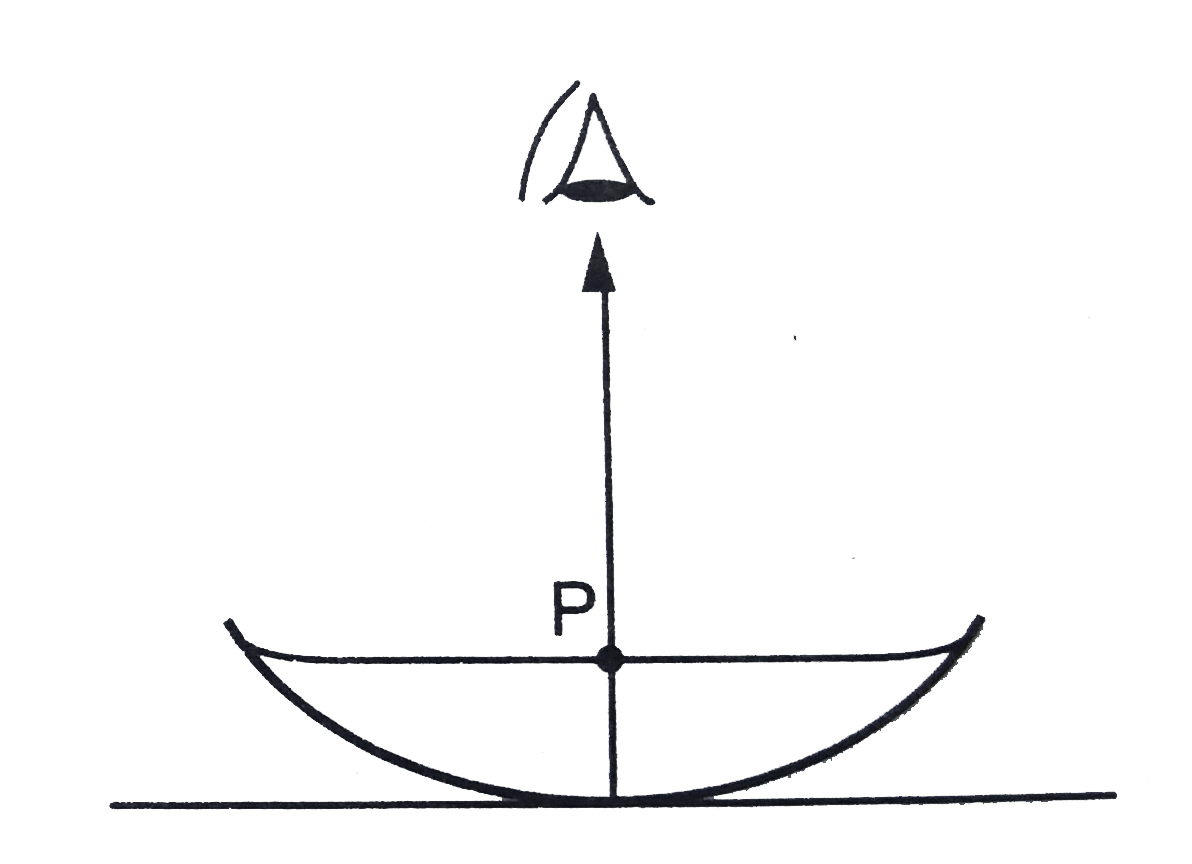
A concave mirror of radius 40 cm lies on a horizontla tale and wateis filled in it up t a heightof 5.00 cm. A small dust particle floats on the water surface at a point P vertically above tge pointof contact of the miror with the table. Locate the image of the dust particle as seen from a point directly above it. tEh refractie index of water is 1.33.

Promotional Banner

Topper's Solved these Questions

  • GEOMETRICAL OPTICS

    PHYSICS GALAXY - ASHISH ARORA|Exercise Practive Exercise 5.1|10 Videos
  • GEOMETRICAL OPTICS

    PHYSICS GALAXY - ASHISH ARORA|Exercise Practive Exercise 5.2|6 Videos
  • ELECTROSTATICS

    PHYSICS GALAXY - ASHISH ARORA|Exercise Unsolved Numberical Problems|73 Videos
  • HEAT AND THERMAL EXPANSION

    PHYSICS GALAXY - ASHISH ARORA|Exercise UNSOLVED NUMRICAL PROBLEMS FOR PREPARATION OF NSEP, INPhO & IPhO|82 Videos

Similar Questions

Explore conceptually related problems

A point source of light is located at the bottom of a steel tank, and an opaque circular card of radius 6.00 cm is placed horizontally over it. A transparent fluid is gently added to the tank so that the card floats on the fluid surface with its center directly above the light source. No light is seen by an observer above the surface until the fluid is 5.00 cm deep. What is the index of refraction of the fluid ?

A long cylindrical tube containing water in closed by an equinvex lens of local length 10 cm in air. A point source is placed along the axis of the tube outside it at a distance of 21 cm from the lens. Locate the final image of the source. Refractive index of the materials of the lens =1.5 and that of water =1.33.

A container is filled with water (mu = 1.33) up to height of 33.2 cm . A concave mirror is placed 15 cm above the water level. Image of an object placed at the bottom is formed at the same place. The focal length of mirror is :

A small object is at the bottom of a container which has water filled up to a height of 20 cm. There is a plane mirror inclined at 45° to the horizontal above the container. A convex lens having focal length 15 cm is at a distance of 50 cm from the mirror. The horizontal principal axis of the lens is at a distance of 45 cm from the bottom of the container. Find the distance of the image (from the lens) of the object as seen by an observer to the left of the lens. Light rays from the object hit the lens only after they are reflected from the mirror. (use mu_("water") = 4//3)

A transparent solid sphere of radius 2 cm and density rho floats in a transparent liquid of density 2rho kept in a beaker. The bottom of the beaker is spherical in shape with radius of curvature 8 cm and is silvered to make it concave mirror as shown in the figure. When an object is placed at a distance of 10 cm directly above the centre of the sphere C, its final image coincides with it. Find h (as shown in the figure ), the height of the liquid surface in the beaker from the apex of the bottom. Consider the paraxial rays only. The refractive index of the sphere is 3//2 and that of the liquid is 4//3.

Water is filled in a container upto a height of 5cm . There is a concave mirror of radius of curvature 40cm . A person just above the surface observes image of 'A' . The distance of image from water surface is (mu_("water")=1.33) :

A beaker is filled with water as shown in figure (a). The bottom surface of the beaker is a concave mirror of large radius of curvature and small aperture. The height of water is h = 40 cm . It is found that when an object is placed 4 cm above the water surface, the image coincides with the object. Now the water level h is reduced to zero but there will still be some water left in the concave part of the mirror as shown in figure (b). The new height of the object h' above the new water surface so that the image again coincides with the object, will be (Refractive index of water = 4//3 )

A particle lies on the bottom of a tank T filled with water upto s height of 90 cm . The medium above the surface of water is of R.I = 1.2 above which there is mirror M . Beyond the mirror M the region contains air ( mu =1 ). The distance of the image formed by the mirrro after reflection of the rays coming from P is ____ cm (w.r.t mirror). .

PHYSICS GALAXY - ASHISH ARORA-GEOMETRICAL OPTICS-Unsolved Numerical Problems
  1. A concave mirror of radius 40 cm lies on a horizontla tale and wateis ...

    Text Solution

    |

  2. The left end of a long glass rod of index 1.6350 is grounded and polis...

    Text Solution

    |

  3. Focal length of a convex lense in air is 10cm. Find its focal length...

    Text Solution

    |

  4. Find the distance of an object from a convex lens if image is two ti...

    Text Solution

    |

  5. A pile 4m high driven into the bottom of a lake is 1m above the wat...

    Text Solution

    |

  6. An object is placed 12 cm to the left of a diverging lens of focal len...

    Text Solution

    |

  7. A solid glass sphere with radius R and an index of refraction 1.5 is s...

    Text Solution

    |

  8. A glass sphere with 10 cm radius has a 5 cm radius spherical hole at i...

    Text Solution

    |

  9. A source of light is located at double focal length from a convergent ...

    Text Solution

    |

  10. A parallel beam of rays is incident on a consisting pf three thin lens...

    Text Solution

    |

  11. A ray of light is incident on the left vertical face of glass cube of ...

    Text Solution

    |

  12. One face of a prism with a refrective angle of 30^@ is coated with sil...

    Text Solution

    |

  13. In an isosceles prism of prism angle 45^(@), it is found that when the...

    Text Solution

    |

  14. An astronomical telescope with objective of focal length 100 cm and ey...

    Text Solution

    |

  15. Figure shows a right angled prism ABC having refractive mu(g)=(3)/(2) ...

    Text Solution

    |

  16. An equilateral prism deviates a ray through 40° for two angles of inci...

    Text Solution

    |

  17. A ray of light strikes a glass slab of thickness t. (i) Prove that i...

    Text Solution

    |

  18. A plano-convex lens has thickness 4cm. When places on a horizontal tab...

    Text Solution

    |

  19. An image Y is formed of a point object x by a lens whose optic axis is...

    Text Solution

    |

  20. A thin plano-convex lens.of focal length f is split into two halves : ...

    Text Solution

    |

  21. The focal lengths of the objective and the eye piece of a compound mic...

    Text Solution

    |