


Topper's Solved these Questions
GEOMETRICAL OPTICS
PHYSICS GALAXY - ASHISH ARORA|Exercise Practive Exercise 5.1|10 VideosGEOMETRICAL OPTICS
PHYSICS GALAXY - ASHISH ARORA|Exercise Practive Exercise 5.2|6 VideosELECTROSTATICS
PHYSICS GALAXY - ASHISH ARORA|Exercise Unsolved Numberical Problems|73 VideosHEAT AND THERMAL EXPANSION
PHYSICS GALAXY - ASHISH ARORA|Exercise UNSOLVED NUMRICAL PROBLEMS FOR PREPARATION OF NSEP, INPhO & IPhO|82 Videos
Similar Questions
Explore conceptually related problems
PHYSICS GALAXY - ASHISH ARORA-GEOMETRICAL OPTICS-Unsolved Numerical Problems
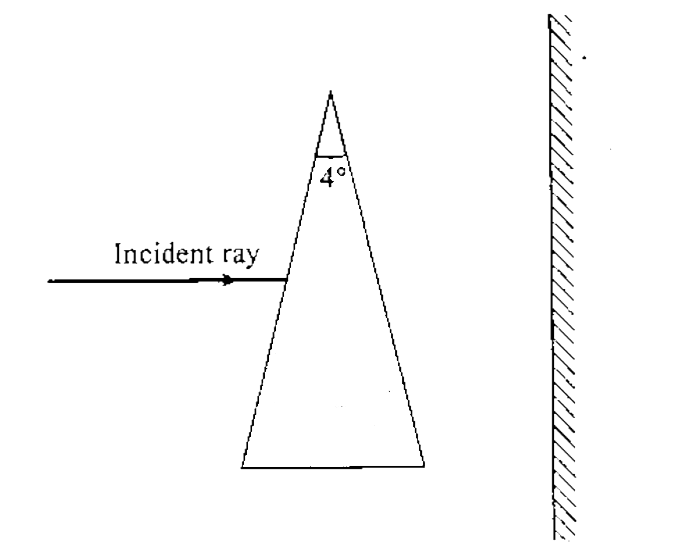
- Figure shows a small angles prism angle 4^(@)and mu = (3)/(2). A light...
Text Solution
|
- The left end of a long glass rod of index 1.6350 is grounded and polis...
Text Solution
|
- Focal length of a convex lense in air is 10cm. Find its focal length...
Text Solution
|
- Find the distance of an object from a convex lens if image is two ti...
Text Solution
|
- A pile 4m high driven into the bottom of a lake is 1m above the wat...
Text Solution
|
- An object is placed 12 cm to the left of a diverging lens of focal len...
Text Solution
|
- A solid glass sphere with radius R and an index of refraction 1.5 is s...
Text Solution
|
- A glass sphere with 10 cm radius has a 5 cm radius spherical hole at i...
Text Solution
|
- A source of light is located at double focal length from a convergent ...
Text Solution
|
- A parallel beam of rays is incident on a consisting pf three thin lens...
Text Solution
|
- A ray of light is incident on the left vertical face of glass cube of ...
Text Solution
|
- One face of a prism with a refrective angle of 30^@ is coated with sil...
Text Solution
|
- In an isosceles prism of prism angle 45^(@), it is found that when the...
Text Solution
|
- An astronomical telescope with objective of focal length 100 cm and ey...
Text Solution
|
- Figure shows a right angled prism ABC having refractive mu(g)=(3)/(2) ...
Text Solution
|
- An equilateral prism deviates a ray through 40° for two angles of inci...
Text Solution
|
- A ray of light strikes a glass slab of thickness t. (i) Prove that i...
Text Solution
|
- A plano-convex lens has thickness 4cm. When places on a horizontal tab...
Text Solution
|
- An image Y is formed of a point object x by a lens whose optic axis is...
Text Solution
|
- A thin plano-convex lens.of focal length f is split into two halves : ...
Text Solution
|
- The focal lengths of the objective and the eye piece of a compound mic...
Text Solution
|