

Home
Class 12
PHYSICS
Two parallel beams of light P and Q (sep...

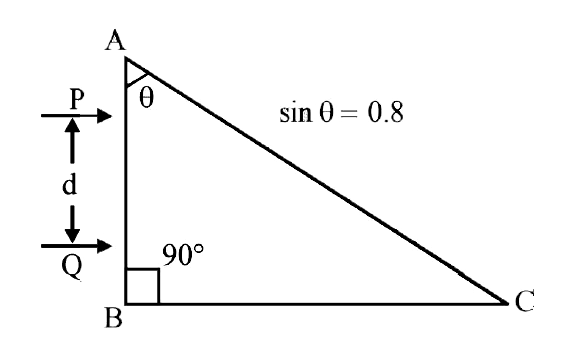
Two parallel beams of light P and Q (separation d) containing radiation of wavelengths `4000A` and `5000A` (which are mutually coherent in each wavelength separately) are incident normally on a prism as shown in fig. The refractive index of the prism as a function of wavelength is given by the relation. `mu(lamda)=1.20+(b)/(lamda^(2))` Where `lamda` is in `A` and b is positive constant. The value of b is such that the condition wave length and is not satisfied for the other.
(a) Find the value of b.
(b) find the deviation of the beams transmitted through the face AC. (c) A convergent lens is used to bring these transmitted beams into focus. If the intensities of transmission form the face AC, are 41 and I respectively, find the resultant intensity at the focus. `

Promotional Banner

Topper's Solved these Questions

  • GEOMETRICAL OPTICS

    PHYSICS GALAXY - ASHISH ARORA|Exercise Practive Exercise 5.1|10 Videos
  • GEOMETRICAL OPTICS

    PHYSICS GALAXY - ASHISH ARORA|Exercise Practive Exercise 5.2|6 Videos
  • ELECTROSTATICS

    PHYSICS GALAXY - ASHISH ARORA|Exercise Unsolved Numberical Problems|73 Videos
  • HEAT AND THERMAL EXPANSION

    PHYSICS GALAXY - ASHISH ARORA|Exercise UNSOLVED NUMRICAL PROBLEMS FOR PREPARATION OF NSEP, INPhO & IPhO|82 Videos

Similar Questions

Explore conceptually related problems

Two parallel beams of light P and Q (separation d) containing radiations of wavelengts 4000Å and 5000 Å (which are mutually coherent in each wavelength separately) are incident normally on a prism as shown in figure the refractive index of the prism as a function of wavelength is given by the relation mu(lamda)=1.20+(b)/(lamda^(2)) where lamda is in Å and b is a positive constant. The value of b is such that the condition for total reflection at the face AC is just satisfied for one wavelength and is not satisfied for the other. A convergent lens is used to bring these transmitted beams into focus. If the intensities of the upper and the lower beams immediately after transmission from the face AC, are 4I and I respectively, find the resultant intensity at the focus.

The energy of a photon of wavelength lamda is given by

Show that the do Broglie wavelength lamda of an electron of energy E is given by the relation lamda = =h/(sqrt2mE)

According to Cauchy's formula, the refractive index mu of a material is related to wavelength lamda as………. .

Some energy levels of a molecule are shown in the figure. The ratio of the wavelength r=lamda_(1)lamda_(2) ,is given by:

The refractive index of light in glass varies with its wavelength according to equation mu (lambda) = a+ (b)/(lambda^(2)) where a and b are positive constants. A nearly monochromatic parallel beam of light is incident on a thin convex lens as shown. The wavelength of incident light is lambda_(0) +-Delta lambda where Delta lambda lt lt lambda_(0) . The light gets focused on the principal axis of the lens over a region AB. If the focal length of the lens for a light of wavelength lambda_(0) is f_(0) , find the spread AB.

Find the thickness of a plate which will produce a change in optical path equal to half the wavelength lamda of the light passing through it normally. The refractive index of the plate is mu .

The refractive index of a medium is given by mu=A+(B)/(lambda^(2)) where A and B are constants and lambda is the wavelength of light. Then the dimensions of B are the same as that of

When light of wavelength lambda on an equilateral prism, kept on its minimum deviation position, it is found that the angle of deviation equals the angle the angle of the prism itself. The refractive index of the material of the prism for the wavelength lambda is

Find the speed of light of wavelength lambda =780nm (in air) in a medium of refractive index mu=1.55. (b) What is the wavelength of this light in the given medium ?

PHYSICS GALAXY - ASHISH ARORA-GEOMETRICAL OPTICS-Unsolved Numerical Problems
  1. Two parallel beams of light P and Q (separation d) containing radiatio...

    Text Solution

    |

  2. The left end of a long glass rod of index 1.6350 is grounded and polis...

    Text Solution

    |

  3. Focal length of a convex lense in air is 10cm. Find its focal length...

    Text Solution

    |

  4. Find the distance of an object from a convex lens if image is two ti...

    Text Solution

    |

  5. A pile 4m high driven into the bottom of a lake is 1m above the wat...

    Text Solution

    |

  6. An object is placed 12 cm to the left of a diverging lens of focal len...

    Text Solution

    |

  7. A solid glass sphere with radius R and an index of refraction 1.5 is s...

    Text Solution

    |

  8. A glass sphere with 10 cm radius has a 5 cm radius spherical hole at i...

    Text Solution

    |

  9. A source of light is located at double focal length from a convergent ...

    Text Solution

    |

  10. A parallel beam of rays is incident on a consisting pf three thin lens...

    Text Solution

    |

  11. A ray of light is incident on the left vertical face of glass cube of ...

    Text Solution

    |

  12. One face of a prism with a refrective angle of 30^@ is coated with sil...

    Text Solution

    |

  13. In an isosceles prism of prism angle 45^(@), it is found that when the...

    Text Solution

    |

  14. An astronomical telescope with objective of focal length 100 cm and ey...

    Text Solution

    |

  15. Figure shows a right angled prism ABC having refractive mu(g)=(3)/(2) ...

    Text Solution

    |

  16. An equilateral prism deviates a ray through 40° for two angles of inci...

    Text Solution

    |

  17. A ray of light strikes a glass slab of thickness t. (i) Prove that i...

    Text Solution

    |

  18. A plano-convex lens has thickness 4cm. When places on a horizontal tab...

    Text Solution

    |

  19. An image Y is formed of a point object x by a lens whose optic axis is...

    Text Solution

    |

  20. A thin plano-convex lens.of focal length f is split into two halves : ...

    Text Solution

    |

  21. The focal lengths of the objective and the eye piece of a compound mic...

    Text Solution

    |