Home
Class 12
PHYSICS
Monochromatic light rays parallel to x-a...

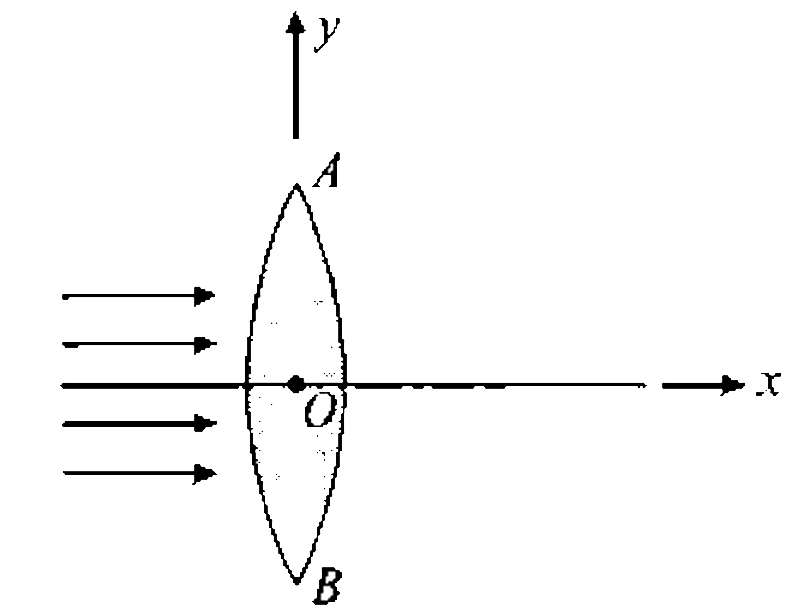
Monochromatic light rays parallel to x-axis strike a convex lens AB of refractive index `0.5`. If the lens oscillates such that AB tilts upto a small angle `theta` (in radian) on either side of y-axis, then find the distance between extreme positions of oscillating image:

A

`fsectheta`

B

`fsec^(2)theta`

C

`f(sectheta-1)`

D

The image will not move

Text Solution

Verified by Experts

Promotional Banner

Topper's Solved these Questions

  • GEOMETRICAL OPTICS

    PHYSICS GALAXY - ASHISH ARORA|Exercise Numerical MCQs Single Options Correct|51 Videos
  • GEOMETRICAL OPTICS

    PHYSICS GALAXY - ASHISH ARORA|Exercise Advance MCQs with One or More Options Correct|30 Videos
  • GEOMETRICAL OPTICS

    PHYSICS GALAXY - ASHISH ARORA|Exercise Discussion Question|29 Videos
  • ELECTROSTATICS

    PHYSICS GALAXY - ASHISH ARORA|Exercise Unsolved Numberical Problems|73 Videos
  • HEAT AND THERMAL EXPANSION

    PHYSICS GALAXY - ASHISH ARORA|Exercise UNSOLVED NUMRICAL PROBLEMS FOR PREPARATION OF NSEP, INPhO & IPhO|82 Videos

Similar Questions

Explore conceptually related problems

Monochromatic light rays parallel to the principal axis (the x axis) are incident on a convex lens of focal length f. If the lens oscillates such that it tilts up to a small angle theta on either side of the y axis, then find the distance between the exterme positions of the image. Take sec theta ~~ 1 + (theta^(2))/(2) for small theta .

A parallel beam of light is incident on a lens of focal length 10 cm. A parallel slab of refractive index 1.5 and thickness 3 cm is placed on the other side of the lens. Find the distance of the final image from the lens. .

A horizontal parallel beam of light passes though a vertical convex lens of focal length 40 cm. Behind the lens there is a plane mirror making an angle theta with the principal axis of the lens. The mirror intersects the principal axis at M. Distance between the optical centre of the lens and point M is OM = 20 cm . The light beam reflected by the mirror converges at a point P. Distance OP is 20 cm. Find theta .

Two rays travelling parallel to the principal axis strike a thick large plano-convex lens having a refracive index of 1.60 .If the spherical face has a radius of curvature of magnitude 20.0 cm and th two rays are h_(1)=0.500cm and h_(2)=12.0cm from the principal axis ,find the difference in the positions where they cross the principal axis .Assume that the ray incident at height h_(2) is incident at the periphery.

A small point object is placed at O at a distance of 0.60 metre in air from a convex spherical surface of refractive index 1.5 .If the radius of the curvature is 25cm then what is the position of the image on the principal axis.

Fig. shows an equiconvex lens (of refractive index 1.5 ) in contact with a liquid layer on top of a plane mirror. A small needle with its tip on the principal axis is moved along the axis until its inverted image is found at the position of the needle. The distance of the needle from the lens is measured to be 45.0 cm . The liquid is removed and the experiment is repeated. The new distance is measured to be 30.0 cm . What is the refractive index of the liquid ?

A double convex thin lens made of glass (refractive index mu = 1.5 ) has both radii of curvature of magnitude 20 cm . Incident light rays parallel to the axis of the lens will converge at a distance L such that

An object is placed at a distance of 10cmm to the left on the axis of convex lens A of focal length 20cm. A second convex lens of focal length 10cm is placed coaxially to the right of the lens A at a distance of 5cm from A. Find the position of the final image and its magnification. Trace teh path of the rays.

A point object O is placed at a distance of 41 cm from a convex lens of focal length f = 20 cm on its principal axis. A glass slab of thickness 3 cm and refractive index mu = 1.5 is placed between the lens and the object with its faces perpendicular to the principal axis of the lens. Image of the object is formed at point I_(1) . Now the glass slab is tilted by an angle of theta = 1° (as shown in the Figure) and the final image is formed at I_(2) . Calculate the distance between points I_(1) and I_(2) . Consider only paraxial rays for the lens and near normal incidence for the glass slab.

PHYSICS GALAXY - ASHISH ARORA-GEOMETRICAL OPTICS-Conceptual MCQs Single Option Correct
  1. The position of a real point object and its point image are as shown i...

    Text Solution

    |

  2. The image of the moon is produced bya convex lens of focal length f. T...

    Text Solution

    |

  3. A converging lens of focal length 20cmand diameter5cmis cut along the ...

    Text Solution

    |

  4. A man stands on a glass slab of height h and inside an elevator accele...

    Text Solution

    |

  5. When an object is at a distance u(1) and u(2) from the optical centre ...

    Text Solution

    |

  6. A liquid of refractive index 1.33 is placed between two identical plan...

    Text Solution

    |

  7. Two particles A & B of mass m(1) and m(2) respectively start moving fr...

    Text Solution

    |

  8. A mango tree is at the bank of a river and one of the branch of tree e...

    Text Solution

    |

  9. A plane mirror having a mass m is tied to the free end of a mass less ...

    Text Solution

    |

  10. An observer can see through a pin-hole the top end of a thin rod of he...

    Text Solution

    |

  11. A ray of light is incident on the left vertical face of glass cube of ...

    Text Solution

    |

  12. Two plane mirrors are inclined to each other at an angle theta. A ray ...

    Text Solution

    |

  13. Two plane mirrors are inclined to each other such that a ray of light ...

    Text Solution

    |

  14. A slab of high quality flat glass, with parallel faces, is placed in t...

    Text Solution

    |

  15. A parallel glass slab of refractive index sqrt3 is placed in contact w...

    Text Solution

    |

  16. The mirror of length L moves horizontally as shown in the figure with ...

    Text Solution

    |

  17. Monochromatic light rays parallel to x-axis strike a convex lens AB of...

    Text Solution

    |

  18. The focal length of convex tens is f and the distance of an object fro...

    Text Solution

    |

  19. A light ray gets reflected from a pair of mutually | mirrors, not nece...

    Text Solution

    |

  20. A ray is incident on the first prism at an angle of incidence 53^(@) a...

    Text Solution

    |

