Home
Class 11
PHYSICS
Two straight lines l(1) and l(2) cross e...

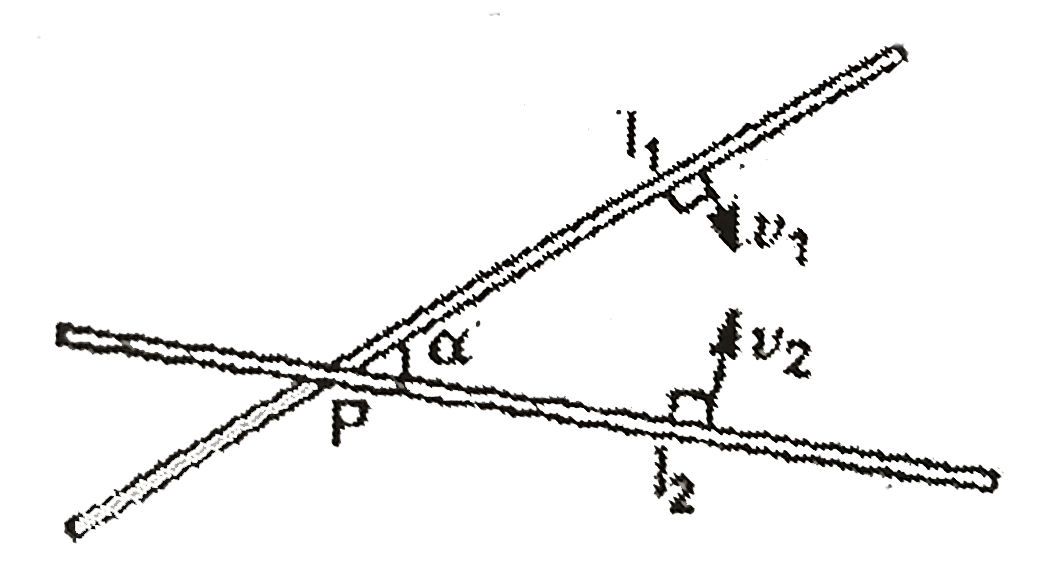
Two straight lines `l_(1)` and `l_(2)` cross each other ar point P The line `l_(1)` is moving at a speed `v_(1)` perpendicular to itself & line `l_(2)` is moving at a speed `v_(2)` in the similar fashion. The speed of point P is :

A

`sqrt((v_(1)v_(2))/(sinalpha))`

B

`sqrt(v_(1)^(2)+v_(2)^(2)+2(v_(1)+v_(2))^(2)cosalpha)/(cosalpha)`

C

`sqrt(v_(1)^(2)+v_(2)^(2)+2(v_(1)+v_(2))^(2)cosalpha)/(sinalpha)`

D

`((v_(1)+v_(2))+sqrt(v_(1)v_(2))cosalpha)/(cosalpha)`

Text Solution

Verified by Experts

The correct Answer is:

C
Promotional Banner

Topper's Solved these Questions

  • DESCRIPTION OF MOTION

    ANURAG MISHRA|Exercise Level-3|34 Videos
  • DESCRIPTION OF MOTION

    ANURAG MISHRA|Exercise Level-1|86 Videos
  • FORCE ANALYSIS

    ANURAG MISHRA|Exercise Matching type|13 Videos

Similar Questions

Explore conceptually related problems

Draw a line l. Take any point P on the line. Using a set square, draw a line perpendicular to the line l at the point p.

If lines l_(1), l_(2) and l_(3) pass through a point P, then they are called…………. Lines.

Let D is a point on the line l_(1):x+y=2=0 and S(3, 3) is a fixed point. The line l_(2) is perpendicular to DS and passes through S. If M is another point on the line l_(1) (other than D), then the locus of the point of intersection of l_(2) and the angle bisector of the angle MDS is

If the direction cosines of two lines are l_(1), m_(1), n_(1) and l_(2), m_(2), n_(2) , then find the direction cosine of a line perpendicular to these lines.

A line L is perpendicular to the curve y=(x^(2))/(4)-2 at its point p and passes through (0,-1). The coordinates of the point p are

Let D is a point on the line l_(1):x+y-2=0, S(3, 3) is a fixed point and line l_(2) is the perpendicular to DS and passing through S. If MK is another point on the line l_(1) (other than D), then the locus of the point of intersection of l_(2) and angle bisector of the angle MDS is a conic whose length of latus rectus rectum is equal to

If points (h,k) (1,2) and (-3, 4) lie on line L_(1) and points (h,k) and (4,3) lie on L_(2). If L_(2) is perpendicular to L_(1), then value of (h)/(k) is

ANURAG MISHRA-DESCRIPTION OF MOTION-Level-2
  1. A particle P is sliding down a frictionless hemispherical bowl. It pas...

    Text Solution

    |

  2. Two partides. are thrown from the same point in the same vertical plan...

    Text Solution

    |

  3. A particle of mass m moves on the x- axis as follows : it starts fro...

    Text Solution

    |

  4. The magnitude of acceleration of a particle as seen by observer A is a...

    Text Solution

    |

  5. An aeroplane moving horizontally from west to east with some velocity ...

    Text Solution

    |

  6. Two balls are thrown from an inclined plane at angle of projection alp...

    Text Solution

    |

  7. A particle moves in the xy-plane according to the law x = a sin(omegat...

    Text Solution

    |

  8. Mark correct statements.

    Text Solution

    |

  9. An aeroplane at a constant speed releases a bomb.As the bomb drops awa...

    Text Solution

    |

  10. Two straight lines l(1) and l(2) cross each other ar point P The line ...

    Text Solution

    |

  11. The velocity-time graph of a particle moving along a straight line is ...

    Text Solution

    |

  12. A ball is dropped from a certain height on a horizontal floor. The coe...

    Text Solution

    |

  13. The speed -time graph of the ball in the above situation is.

    Text Solution

    |

  14. In a car race, car A takes a time t less than car B at the finish and ...

    Text Solution

    |

  15. Two particles are projected with speed 4m//s and 3m//s simultaneously ...

    Text Solution

    |

  16. The motion of a body falling from rest in a resisting medium is descri...

    Text Solution

    |

  17. Which of the following statement is//are correct ?

    Text Solution

    |

  18. A car is moving with uniform acceleration along a straight line betwee...

    Text Solution

    |

  19. A particle moves along x-axis with constant acceleration and its x-pos...

    Text Solution

    |

  20. The velocity versus time of two particles moving along x-axis varies a...

    Text Solution

    |
