Home
Class 11
PHYSICS
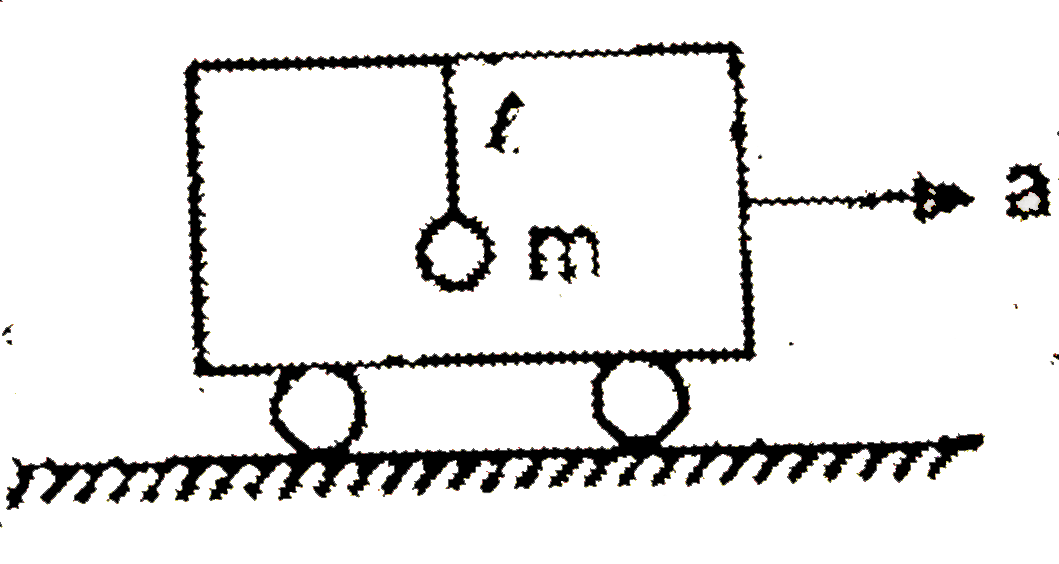
In shown figure, the trolley starts acce...

In shown figure, the trolley starts accelerating with acceleration a. The maximum angle deflected by thread from vertical will be:

A

`tan^(-1) ((a)/(g))`

B

`tan^(-1) ((2a)/(g))`

C

`2 tan^(-1) ((a)/(g))`

D

`tan^(-1) ((a)/(2g))`

Text Solution

Verified by Experts

The correct Answer is:

C
Promotional Banner

Topper's Solved these Questions

  • WORK AND ENERGY

    ANURAG MISHRA|Exercise Level 2|18 Videos
  • WORK AND ENERGY

    ANURAG MISHRA|Exercise Level 3|34 Videos
  • WORK AND ENERGY

    ANURAG MISHRA|Exercise Eample|47 Videos
  • UNIT AND DIMENSIONS

    ANURAG MISHRA|Exercise Matching Type Problem|4 Videos

Similar Questions

Explore conceptually related problems

A pendulum of mass m and length l is suspended from the ceiling of a trolley which has a constant acceleration a in the maximum deflection theta of the pendulum from the vertical.

The ring shown in fig. is given a constant horizontal acceleration (a_(0)=gsqrt(3)) . The maximum deflection of the string from the vertical is theta_(0) . Then

If trolley accelerates horizontally with acceleration a then bob is displaced backward from its initial vertical position. The angular deflection of the bob in equilibrium is

In the figure shown, find out acceleration of each block.

A ball of mass in m= 1 kg is hung vertically by a thread of length l = 1.50 m . Upper end of the thread is attached to the ceiling of a trolley of mass M= 4 kg . Initially, the trolley is stationary and it is free to move along horizontal rails without friction. A shell of mass m=1 kg , moving horizontally with velocity v_(0) = 6 m//s collides with the ball and gets stuck with it. As a result, the thread starts to deflect towards right. The maximum deflection of the thread with the vertical is

A shell of mass 1kg is projected with velocity 20m//s at an angle 60^@ with horizontal. It collides inelastically with a ball of mass 1kg which is suspended through a thread of length 1m . The other end of the thread is attached to the ceiling of a trolley of mass 4/3kg as shown in figure. Initially the trolley is stationary and it is free to move along horizontal rails wihtout any friction. What is the maximum deflection of the thread with vertical? String does not slack. Take g=10m//s^2 .

When the trolley show in figure is given a horizontal acceleration a , the pendulem bob of mass m gets deflected to a maximum deflection , the net acceleration of the bob with respect to trolley is

A ball of mass m = 1 kg is hung vertically by a thread of length 1=1.50 m . Upper end of the thread is attached to the ceiling of a trolley of mass M = 4kg . Initially, the trolley is stationary and it is free to move along horizontal rails with out friction. A shell of mass m=1 kg , moving horizontally with velocity v_(0) = 6m//s collides with thread starts to deflect towards right At the time a maximum deflection of the thread with vertical, the trolley will move with velocity

A ball of mass in m= 1 kg is hung vertically by a thread of length l = 1.50 m . Upper end of the thread is attached to the ceiling of a trolley of mass M= 4 kg . Initially, the trolley is stationary and it is free to move along horizontal rails without friction. A shell of mass m=1 kg , moving horizontally with velocity v_(0 )= 6 m//s collides with the ball and gets stuck with it. As a result, the thread starts to deflect towards right. At the time of maximum deflection of the thread with vertical, the trolley will move with velocity

a small sphere of mass m susopended by a thread is first taken aside so that the thread forms the right angle with the verticle and then realease. (a) find the total acceleration of the sphere and the thread tension as a function of theta , the angle of deflection of the thread from the vertical. (b) Find the angle theta between the thread and the vertical. at the moment when the total acceleration vector of the sphere is directed (i) horizontally (ii)vertically upward and (iii) vertically downward.

ANURAG MISHRA-WORK AND ENERGY-Level 1
  1. Two equal masses are attached to the two ends of a spring of spring co...

    Text Solution

    |

  2. The negative of the work done 'by the conservative internal forces on ...

    Text Solution

    |

  3. The work done by the external forces on a system equals the change in

    Text Solution

    |

  4. The work done by all the forces (external and internal) on a system eq...

    Text Solution

    |

  5. of a two particle system depends only on the separation between the tw...

    Text Solution

    |

  6. A block of mass m slides down a smooth vertical circular track. During...

    Text Solution

    |

  7. A particle is rotated in a vertical circle by connecting it to a strin...

    Text Solution

    |

  8. In the shown diagram mass of A is m and that of B is 2 m. All the surf...

    Text Solution

    |

  9. In above question, speed of block A, when the extension in spring is (...

    Text Solution

    |

  10. A chain of length L and mass Mis arranged as shown in following four c...

    Text Solution

    |

  11. A block of mass m is pulled by a constant powert P placed on a rough h...

    Text Solution

    |

  12. Forces acting on a particle moving in a straight line varies with the ...

    Text Solution

    |

  13. A pendulum of mass 1 kg and length  = 1m is released from rest at ang...

    Text Solution

    |

  14. A system consists of two identical cubes, each of mass m, linked toget...

    Text Solution

    |

  15. In the shown figure, the mass in sticks to the string just after it st...

    Text Solution

    |

  16. A circular tube of mass M placed veticlly on a horizontal surface as s...

    Text Solution

    |

  17. A spring mass system is held at rest with the spring relaxed at a heig...

    Text Solution

    |

  18. In shown figure, the trolley starts accelerating with acceleration a. ...

    Text Solution

    |

  19. A force F=-K(yhati+xhatj) (where K is a positive constant) acts on a p...

    Text Solution

    |

  20. A particle free to move along the (x - axis) hsd potential energy give...

    Text Solution

    |
