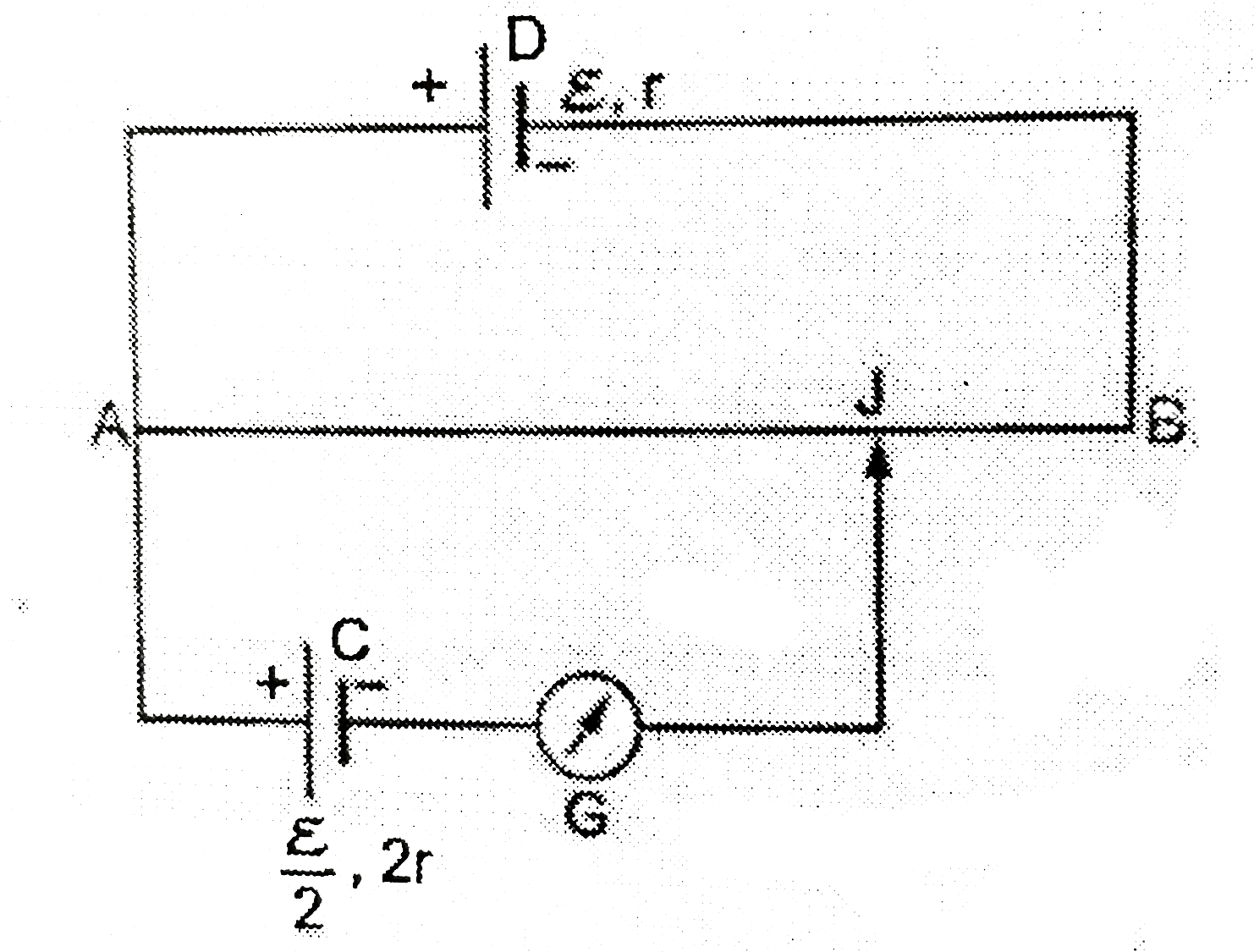
In the figure, the potentiometer wire AB of length L and resistance 9r is joined to the cell D fo emf E and internal resistance r. The emf of the cell C is E/2 and its internal resistance is 2r. The galvanometer G will show no deflection when the length AJ is
A
`(4L)/(9)`
B
`(5L)/(9)`
C
`(7L)/(18)`
D
`(11L)/(18)`
Text Solution
Verified by Experts
The correct Answer is:
B
Topper's Solved these Questions
PRACTICE WORKSHEET 1
D MUKHERJEE|Exercise Assertion- Reason Type|3 Videos
PRACTICE WORKSHEET 1
D MUKHERJEE|Exercise Linked- Comprehension Type|3 Videos
OPTICS
D MUKHERJEE|Exercise All Questions|47 Videos
PRACTICE WORKSHEET 2
D MUKHERJEE|Exercise Linked- Comprehension Type|4 Videos
Similar Questions
Explore conceptually related problems
In the figure, the potentiometer wire of length l = 100 cm and resistance 9 Omega is joined to a cell of emf cell of emf E_(2) = 5 V and internal resistance r_(2) = 2 V is connected as shown. The galvanometer is show no deflection when the length AC is
A potentiometer wire AB having length L and resistance 12 r is joined to a cell D of emf epsi//2 and internal resistance 3r is connected. The length AJ at which the galvanometer as shown in fig. Shows no deflection is :
In the petentiometer arrangemeter shown, the driving cell A has emf epsilon and internal resistance r . The emf of the cell B is (epsilon)/(2) and internal resistance 2r . The petentiometer wire CD is 100 cm long. If balance is obtained with length CJ = l , then
If n cells each of emf E and internal resistance rare connected in parallel, then the total emf and internal resistances will be
The maximum power dissipated in an external resistance R, when connected to a cell of emf E and internal resistance r, will be
The potentiometer wire of resistance R is connected in series with a cell of e.m.f. E and of resistance R_(h) . The current flowing through the potentiometer wire is
D MUKHERJEE-PRACTICE WORKSHEET 1-Matrix-Matching Type