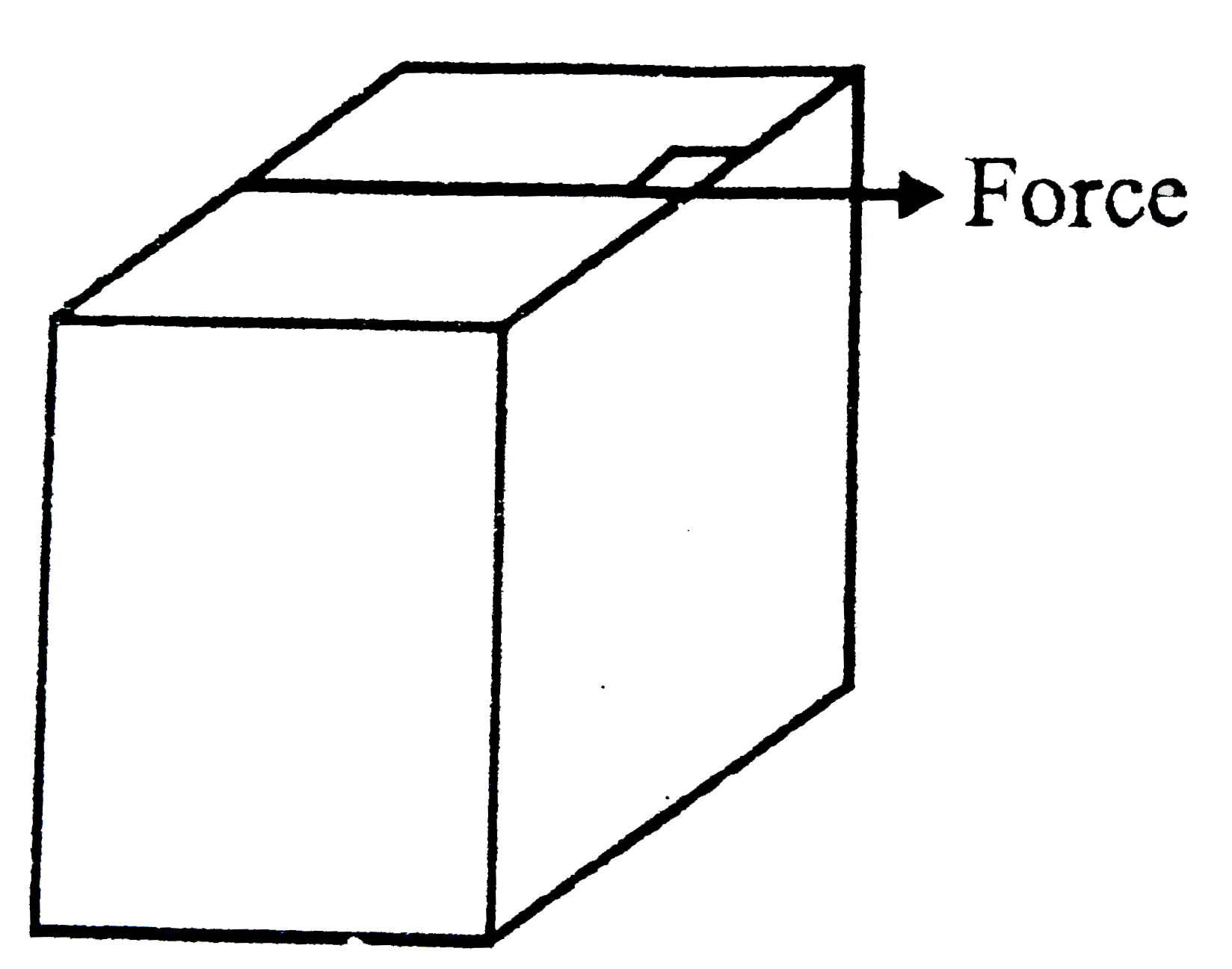
In the figure, a solid uniform cube is placed on a horizontal surface. The co-efficient of friction between them is `mu` where `mu lt 1/2`. A variable horizontal force perpendicular to one edge and passing through the midnight of that applied on the cube's upper face. The maximum acceleration with which it can move without toppling is
A
`mug`
B
`2mug`
C
`g(1-2mu)`
D
`(mu+(1)/(2))g`
Text Solution
Verified by Experts
The correct Answer is:
C
Topper's Solved these Questions
PRACTICE WORKSHEET 3
D MUKHERJEE|Exercise Assertion- Reason Type|3 Videos
PRACTICE WORKSHEET 3
D MUKHERJEE|Exercise Linked- Comprehension Type|3 Videos
PRACTICE WORKSHEET 2
D MUKHERJEE|Exercise Linked- Comprehension Type|4 Videos
PROPERTIES OF MATTER,FLUIDS
D MUKHERJEE|Exercise Type 2|35 Videos
Similar Questions
Explore conceptually related problems
A solid cube is placed on a horizontal surface. The coefficient of friction between them is mu=0.25 . A variable horizontal force is applied on the cube’s upper face, perpendicular to one edge and passing through the mid-point of edge, as shown in figure. The maximum acceleration with which it can move without toppling is (take g=10m//s^(2) )
A block of mass m is placed on a rough horizontal surface. The coefficent of friction between them is mu . An external horizontal force is applied to the block and its magnitude is gradually increased. The force exerted by the block on the surface is R.
A block of mass m is placed on a horizontal surface. The coefficient of frication between them is mu . The block has to be moved by applying a single external force on it. The force may be applied in my direciton. The minimum value of this force must be
A uniform rod ABC of mass M is placed vertically on a rough horizontal surface. The coefficient of kinetic friction between the rod and the surface is mu . A force F (gt mu mg) is applied on the rod at point B at distance l//3 below centre of the rod as shown in figure. The initial acceleration of point A is
A solid sphere of mass 10 kg is placed on a rough surface having coefficient of friction mu = 0.1 . A constant force F = 7 N is applied along a line passing through the centre of the sphere as shown in the figure. The value of frictional force on the sphere is. .
A solid cube of mass 5 kg is placed on a rough horizontal surface, in xy-plane as shown. The friction coefficient between the surface and the cube is 0.4. An external force vecF=6hati+8hatj+20hatkN is applied on the cube. (use g=10(m)/(s^2) )
A solid cube of mass 2 kg is placed on rough horizontal surface, in xy- plane as shown. The friction coefficient between the surface and the cube is 0.2 . An external force 3hat(i)+4hat(j)+5hat(k) N is applied on the cube. (use g = 10 m//s^(2) )
Two block A and B of masses 6 kg and 3 kg rest on a smooth horizontal surface as shown in figure If coefficient of friction between A and Bb is 0.4 the maximum horizontal force which can make them move without separation is
A block of mass m is placed on another block of mass M which itself is lying on a horizontal surface .The coefficient of friction between two blocks is mu_(1) and that between the block of mass M and horizontal surfece is mu_(2) What maximum horizontal force can be applied to the lower block move without separation?
A block of mass m is placed on another block of mass M lying on a smooth horizontal surface as shown in the figure. The co-efficient of friction between the blocks is mu . Find the maximum horizontal force F (in Newton) that can be applied to the block M so that the blocks together with same acceleration? (M=3kg, m=2kg, mu=0.1, g=10m//s^(2))
D MUKHERJEE-PRACTICE WORKSHEET 3-Matrix-Matching Type