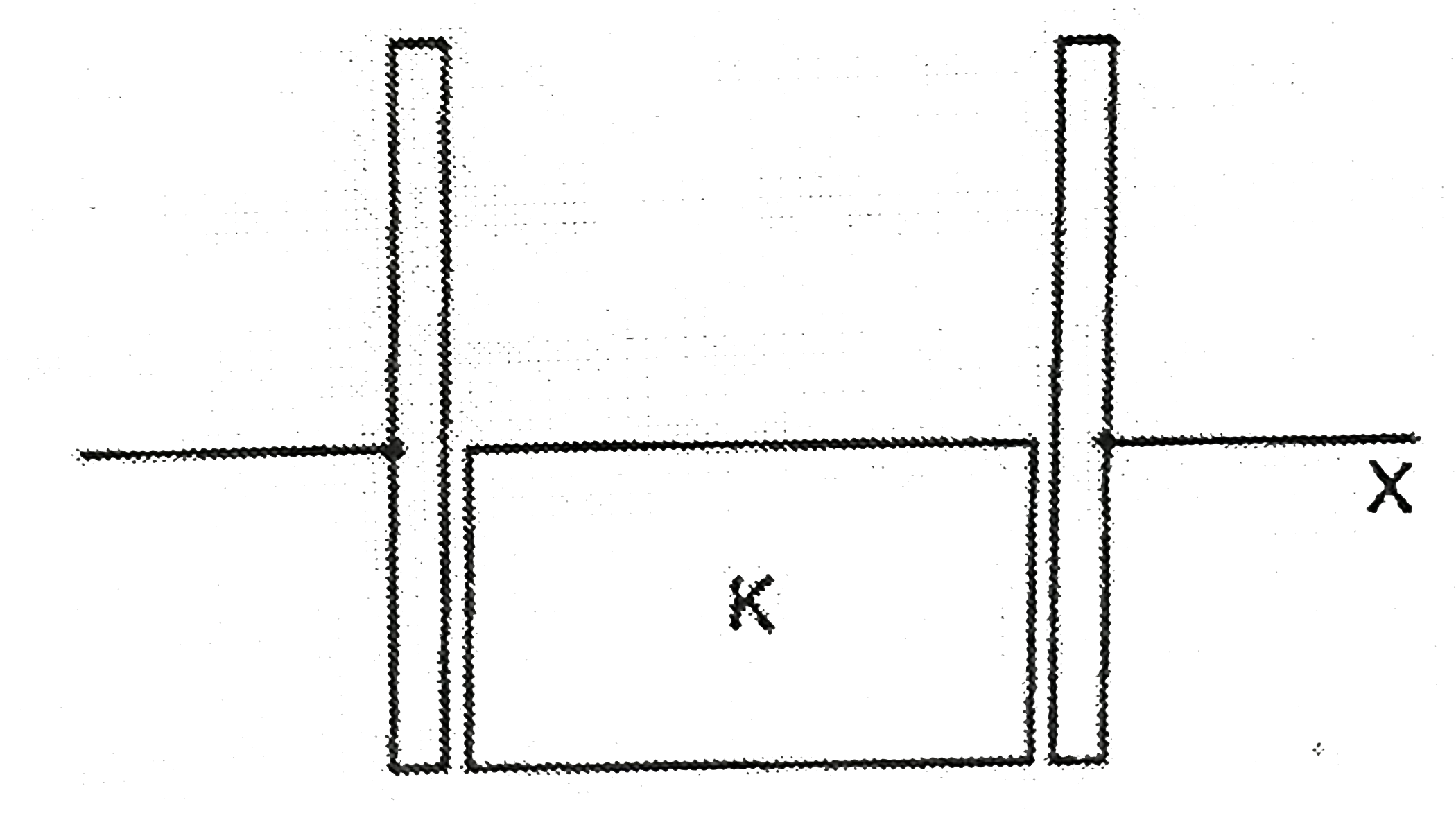
A parallel- plate capacitor is charged from a cell and then isolated from it. A dielectric slab of dielectric constant K is now introduced in the region between the plated, filling half of it. The electric intensity in the diaelectric is `E_(1)` and that in air is `E_(2)`.
A
`E_(1)=E_(2)`
B
`E_(1)=(E_(2))/(K)`
C
`E_(1)=(1-(1)/(K))E_(2)`
D
`E_(1)=(E_(2))/(K-1)`
Text Solution
Verified by Experts
The correct Answer is:
A
Topper's Solved these Questions
PRACTICE WORKSHEET 3
D MUKHERJEE|Exercise Assertion- Reason Type|3 Videos
PRACTICE WORKSHEET 3
D MUKHERJEE|Exercise Linked- Comprehension Type|3 Videos
PRACTICE WORKSHEET 2
D MUKHERJEE|Exercise Linked- Comprehension Type|4 Videos
PROPERTIES OF MATTER,FLUIDS
D MUKHERJEE|Exercise Type 2|35 Videos
Similar Questions
Explore conceptually related problems
A parallel plate capacitor is charged from a cell and then isolated from it. The separation between the plates is now increased
A parallel plate capacitor is charged to a certain voltage. Now if the dielectric material (with dielectric constant k ) is removed then the
A parallel plate capacitor carries a harge Q. If a dielectric slab with dielectric constant K=2 is dipped between the plates, then
In an isolted, charged, parllel-plate air capacitor, the charge per unit area on each plate has a magnitude of sigma . A dielectric slab having the dielectric constant K is now introduced between the plates. The induced charge per unit area on the surface of the dielectric will have magnitude.
A parallel plate air capacitor of capacitance C is connected to a cell of emF V and then disconnected from it. A dielectric slab of dielectric constant K , which can just fill the air gap of the capacitor, is now inserted in it. Which of the following is incorrect ?
D MUKHERJEE-PRACTICE WORKSHEET 3-Matrix-Matching Type